Getting remote employee onboarding right is one of the highest-leverage things a growing company can do, and one of the easiest to get wrong. Without a hallway to walk new hires down or a desk to point them to, every part of the experience has to be deliberately designed: the welcome email, the laptop that shows up on time, the first Slack message from their manager. Get the sequence wrong and you end up with a new hire who spends their first two weeks confused, disconnected, and quietly wondering if they made the right call. Get it right, and that same person is shipping real work by the end of week one.
This guide is built as a practical, step-by-step remote employee onboarding checklist, organized around three phases: before Day One, during the first week, and after the first 90 days. If you want the deeper "why" behind remote onboarding best practices, our earlier post, Setting Up Success for Your New Remote Employee, covers the philosophy and culture-building side in more depth.
Why Remote Employee Onboarding Deserves Its Own Checklist
According to Gallup, only 12% of employees strongly agree their organization does a great job onboarding new hires — and that gap widens for remote workers, who don't get the informal, hallway-conversation version of onboarding that office employees pick up automatically. A structured remote employee onboarding checklist closes that gap by replacing "figure it out as you go" with a clear, repeatable sequence that works the same way whether your new hire is down the street or on another continent.
The Society for Human Resource Management (SHRM) has also found that the cost of a bad hire can run between 50% and 200% of that employee's annual salary once you factor in lost productivity, rehiring, and team disruption. Strong onboarding is one of the most cost-effective ways to protect that investment, because employees who feel confident and supported in their first 90 days are far more likely to stay and perform well long-term.
Phase 1: Remote Employee Onboarding Before Day One
The biggest mistake companies make is treating Day One as the start of onboarding. In a remote setting, onboarding actually begins the moment the offer is signed.
Pre-Boarding Logistics Checklist
- Ship equipment early. Laptop, monitor, headset, and any role-specific hardware should arrive at least 2–3 business days before the start date, fully configured wherever possible.
- Send login credentials and account access separately and securely, ideally through a password manager invite rather than plain email.
- Confirm software access - email, project management tools (Asana, ClickUp, Monday.com), communication platforms (Slack, Microsoft Teams), and any role-specific systems is provisioned and tested before Day One.
- Send a welcome packet that includes company policies, the org chart, a short culture primer, and a simple "what to expect on Day One" email so there are zero surprises.
- Assign a buddy or onboarding mentor - someone outside the direct reporting line the new hire can ask "dumb questions" to without it feeling formal.
- Pre-fill the first-week calendar so the new hire isn't staring at an empty schedule wondering what to do.
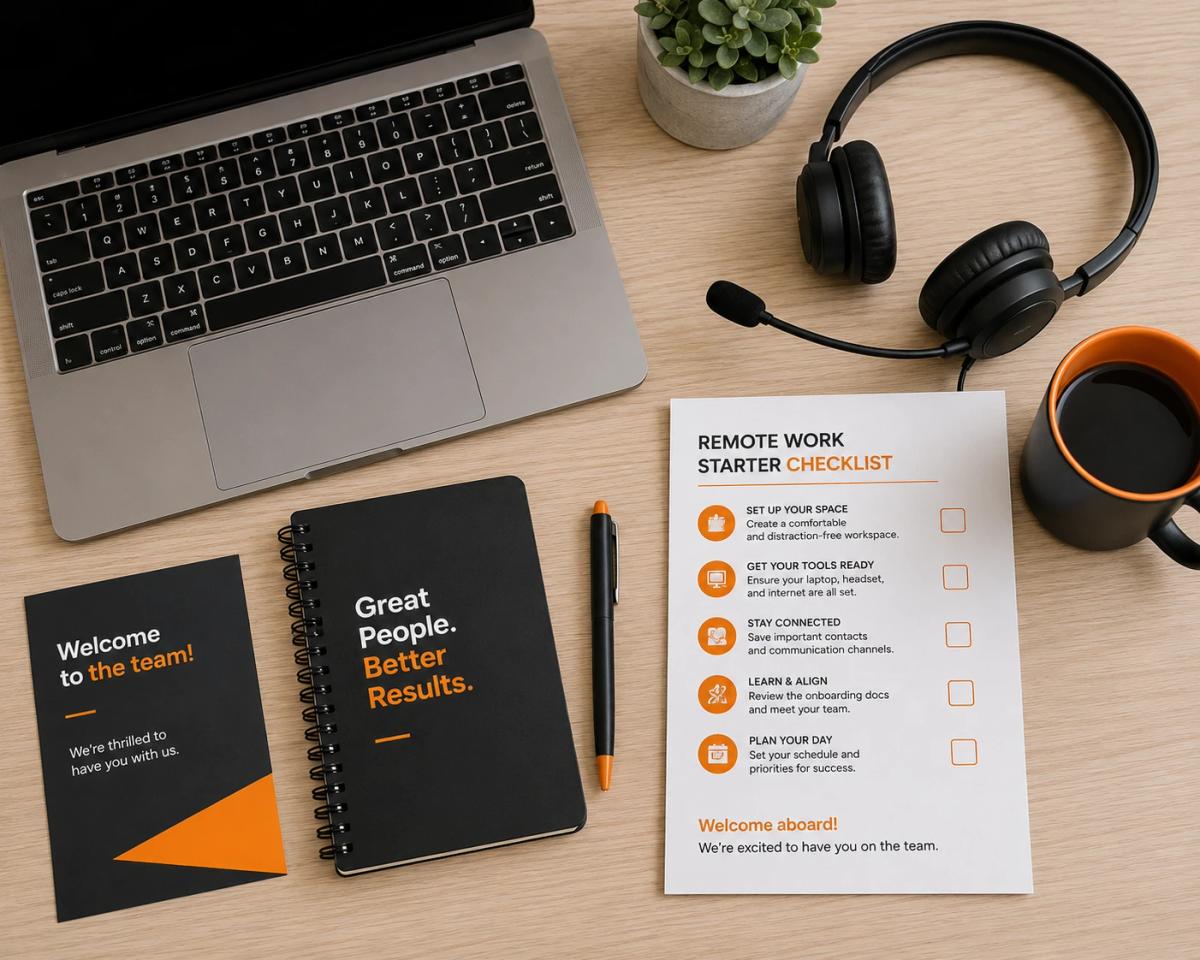
Getting this phase right is the difference between a new hire who logs in confident and ready, and one who spends their first morning hunting for passwords. This is exactly the kind of structured remote employee onboarding process that pre-vetted, ready-to-deploy talent benefits from most — when a new hire has already been thoroughly screened and matched to the role, your onboarding time can go entirely toward integration instead of basic skills verification.
Want pre-vetted remote talent who's ready to hit the ground running? Request Talent from All Talentz and skip the guesswork.
Phase 2: Remote Employee Onboarding During the First Week
The first week sets the emotional tone for the entire employment relationship. This is where remote employee onboarding either builds momentum or starts losing it.
Day One Checklist
- Host a live welcome call with the manager and immediate team. Camera on, casual tone, real introductions (not just names and titles).
- Walk through the org chart and team structure so the new hire understands who does what and who to go to for which questions.
- Review role expectations in writing, including the first 30/60/90-day goals, so there's a documented reference point.
- Set communication norms early: which channel is for what, expected response times, and how to flag being "heads down" or unavailable.
- Schedule a 1:1 with the assigned buddy, separate from the manager check-in.
First Week Checklist
- Daily check-ins (15 minutes is enough) so small confusions get caught before they snowball.
- Shadow a real project or meeting so the new hire sees how work actually flows, not just how it's described in a handbook.
- Introduce them to cross-functional teammates, not just their direct team. This is where remote hires often miss out compared to in-office staff.
- Assign one small, completable task in the first week. A quick early win builds confidence fast.
This is also a good moment to point new hires toward broader team-management resources. If your managers want more detail on running this kind of structured first week well, our related post on strategies for managing remote employees and our guide on top tools for managing remote employees are good next reads.
Phase 3: Remote Employee Onboarding After the First 90 Days
Most remote employee onboarding checklists stop at week one, which is a mistake. Real integration, the kind that drives retention, happens over the first quarter.
30/60/90-Day Checklist
- 30 days: Formal check-in on early wins, blockers, and whether the role matches what was described in hiring. Adjust expectations if needed.
- 60 days: Review progress against initial goals; start introducing slightly more ownership and autonomy.
- 90 days: Full performance conversation. What's working, what needs support, and what growth or development opportunities come next.
- Ongoing social integration: virtual coffee chats, optional team social calls, and visibility into company-wide wins (not just their own team's updates) so remote hires don't feel siloed.
- Continued learning access: course stipends, internal knowledge bases, or mentorship. Remote employees who keep growing are far more likely to stay.
If you're building (or rebuilding) an entire remote team rather than onboarding a single hire, our deeper guide — How to Build a High Performing Remote Team, walks through the structural decisions that make onboarding repeatable at scale.
Common Remote Employee Onboarding Mistakes to Avoid
- Treating Day One as the starting line instead of pre-boarding before it.
- Front-loading too much information in week one, leaving little room for hands-on learning.
- Skipping social integration, which is the fastest way to early disengagement among remote hires.
- No documented 30/60/90-day plan, leaving progress evaluation vague and inconsistent.
- Underestimating tech setup time - a broken login on Day One sets a bad tone that's hard to recover from.
A consistent, well-documented remote employee onboarding checklist removes the guesswork from each of these stages, which matters even more when you're scaling a distributed team quickly. Companies building out remote operations at speed often lean on a specialized partner for exactly this reason; to make sure every new hire, no matter how fast the team is growing, gets the same high standard of onboarding.
Building a distributed team and need it staffed right the first time? Contact All Talentz to talk through your needs.
How All Talentz Supports Remote Employee Onboarding
All Talentz isn't a typical staffing agency that hands you a resume and disappears. We're a full talent partner, and that shows up directly in how onboarding works. Every professional in our network is pre-vetted, pre-trained, and ready to be assigned, often within as little as 7 days, which means your "before Day One" checklist is largely handled before the candidate ever reaches your team. There's no scrambling to verify basic skills or chase down references mid-onboarding, that work is already done.
We also stay involved well past the placement itself. Each talent is supported by a dedicated relationship manager who actively monitors performance, checks in regularly, and flags issues early, covering much of the "30/60/90-day" check-in work described above before it ever becomes your problem. If a placement isn't the right fit, we don't leave you stuck mid-project: we replace the talent immediately, with minimal disruption to your team or timeline.
On the logistics side, we go beyond recruiting. All Talentz provides the work tools, equipment, and health insurance our talents need to do their jobs from Day One, along with ongoing talent management, so a meaningful chunk of the pre-boarding and tech-setup checklist above is already built into how we operate, not something you have to coordinate from scratch.
We place talent across Tech, Healthcare, Finance, Restoration, Legal, and Pest Control, in roles including data annotators, medical billing specialists, digital marketers, estimators, AI/ML specialists, software developers, UI/UX designers, call center support, accounts receivable specialists, virtual assistants, and client outreach and admin assistants.
In short: with All Talentz, remote employee onboarding starts from a much stronger position, because the talent, the tools, and the ongoing oversight are already in place before you say "welcome aboard."
Conclusion
Remote employee onboarding isn't a single event. It's a sequence that starts before Day One and continues well past the first 90 days. Companies that treat it as a structured, repeatable checklist rather than an afterthought see faster ramp-up times, stronger early engagement, and meaningfully better retention. Whether you're onboarding your first remote hire or your fiftieth, the principles stay the same: prepare early, communicate clearly, build in social connection, and keep checking in long after the welcome email has been sent.
If you'd rather not build that process from scratch or you're scaling faster than your current onboarding system can handle, All Talentz can help on both ends: finding pre-vetted remote talent ready to succeed, and supporting the onboarding logistics that make their first 90 days a success.
FAQ: Remote Employee Onboarding
What is remote employee onboarding? Remote employee onboarding is the structured process of integrating a new hire into a company when they work outside a traditional office, covering pre-boarding logistics, first-week orientation, training, and ongoing support through roughly their first 90 days.
How long should remote employee onboarding take? Most effective remote employee onboarding programs run a full 90 days. Day One and the first week focus on logistics and orientation, while the 30/60/90-day checkpoints track progress, address gaps, and build toward full autonomy in the role.
What should be included in a remote employee onboarding checklist? A solid checklist covers pre-boarding (equipment, account access, welcome packet), first-week orientation (team introductions, role expectations, a buddy system), and 30/60/90-day check-ins focused on progress, feedback, and social integration.
How is remote employee onboarding different from in-office onboarding? Remote employee onboarding requires more intentional structure because new hires miss the informal, hallway-style learning that happens naturally in an office. Communication norms, social connection, and tech setup all have to be planned deliberately rather than left to chance.
Can a staffing partner help with remote employee onboarding? Yes. A staffing partner like All Talentz reduces onboarding friction by pre-vetting candidates before they're matched to a role, which means less time spent verifying basic competency and more time spent on culture fit and role-specific integration.