
Most healthcare practices do not set out to run a lean administrative operation. What happens instead is this: a busy period arrives, a staff member leaves, or a new payer relationship adds complexity the existing team was not built to handle. The gap that results is not dramatic at first. Prior authorizations take a day longer. Scheduling follow-ups get pushed to tomorrow. Billing gets done but accounts receivable does not get worked. Over weeks and months, each small gap compounds into a real operational problem that clinical staff eventually absorb, which is how administrative understaffing turns into clinical burnout.
Remote healthcare administrative staff is the direct response to this pattern. Rather than hiring another full-time in-house administrator whose salary, benefits, and overhead the practice must carry regardless of how much the workload fluctuates, practices are building dedicated remote administrative teams whose specific expertise is matched to the specific gaps the practice needs to close. This post covers five of the most common administrative gaps healthcare practices face and what the right remote healthcare administrative staff does to close each one.
For a comprehensive overview of every role that falls under remote healthcare administrative staff and how each one works within a practice, our earlier post on the ultimate guide to remote healthcare administrative staff covers each role in depth.
Gap 1: Prior Authorizations Are Eating Hours Your Clinical Team Does Not Have
Prior authorization is one of the most time-consuming administrative processes in modern healthcare. The American Medical Association has consistently found that physicians and their staff spend a significant portion of each week managing prior authorization requests, tracking approval statuses, and handling denials from payers. That time does not generate revenue. It does not improve patient outcomes. It consumes hours that clinical staff should be spending on patient care.
The problem compounds when prior authorization management falls to a generalist front desk employee who is also managing phone calls, patient check-in, scheduling, and a dozen other demands simultaneously. Requests go in on time but follow-up is inconsistent. Approvals are not tracked systematically. Denials are not appealed because there is no one whose job it is to appeal them.
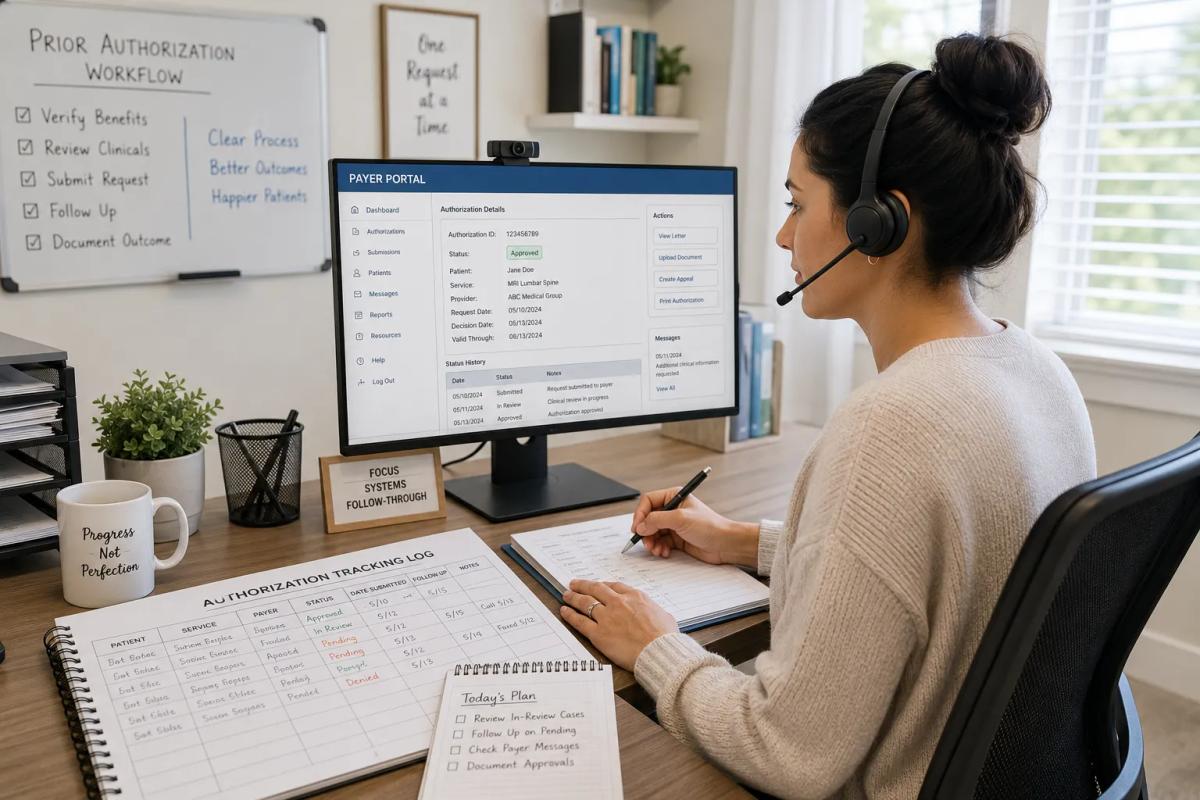
A dedicated remote healthcare administrative staff member who specializes in prior authorization closes this gap specifically. Their entire job is the authorization workflow: submitting initial requests with the correct clinical documentation, tracking approval timelines, following up with payers before delays affect patient appointments, and managing peer-to-peer review calls and appeals when payers push back. According to Portiva's analysis of prior authorization remote roles, dedicated prior authorization specialists ensure smooth communication between healthcare providers, insurance companies, and patients, which is the coordination layer that authorization-by-committee arrangements consistently fail to deliver.
What closes this gap: a remote prior authorization specialist with verified payer knowledge and systematic follow-up discipline, whose full attention is on the authorization queue rather than divided across front desk responsibilities.
All Talentz places dedicated remote healthcare administrative staff including prior authorization specialists who are pre-vetted and ready to work in as little as 7 days. Request Healthcare Talent from All Talentz and close the gap this week.
Gap 2: The Revenue Cycle Falls Behind Because No One Person Owns It End to End
Healthcare practices with fewer than 10 staff members often have their billing managed by someone who also handles patient-facing responsibilities. The billing gets done, but the follow-up does not. Claims are submitted, but accounts receivable is not worked. Denial letters arrive and sit unread because the person who manages billing is also the first person a patient speaks to when they walk in the door.
The result is a revenue cycle that completes its front end reasonably well and falls apart on the back end. Clean claims go out, but denied claims age past the point where collection becomes difficult. Accounts receivable grows into a backlog that the practice carries as perpetual financial friction.
Remote healthcare administrative staff with dedicated revenue cycle responsibility closes this gap by separating the billing function from everything else the front desk handles. A medical billing specialist or accounts receivable professional assigned exclusively to a practice works the denial queue every day, follows up on outstanding claims before they age, and tracks the accounts receivable metrics that tell the practice how the revenue cycle is actually performing.
The Healthcare Financial Management Association (HFMA) publishes benchmarks for days in accounts receivable and net collection rates that define what a well-run revenue cycle should achieve. Most practices that are absorbing billing responsibilities into a shared administrative role are operating well below those benchmarks without knowing it.
For more on what accurate medical billing looks like and how dedicated specialists achieve it, see our post on medical billing and coding accuracy and what every healthcare practice needs to get right.
What closes this gap: a dedicated remote medical billing specialist or accounts receivable professional whose entire focus is the practice's revenue cycle, not a fraction of it.
Gap 3: Scheduling Is Inconsistent Because Patient Follow-Up Keeps Getting Deprioritized
Patient scheduling sounds simple: a patient calls, an appointment is booked. What actually happens in a practice where scheduling is managed by staff who carry other responsibilities is a more complicated picture. Callbacks are delayed. Reminder calls go out late or not at all. Waitlist management is inconsistent. A new patient who called on a busy Tuesday and did not get a callback by Thursday may have already booked with another practice.
According to Projective Staffing's analysis of how remote roles help healthcare teams scale, when patients do not receive timely updates, reminders, or follow-ups, the burden returns to already busy front-office or clinical staff. That burden creates a feedback loop: the staff who should be managing scheduling are managing the fallout from scheduling that was not handled properly in the first place.
A remote patient scheduling coordinator as part of a dedicated remote healthcare administrative staff setup manages the full scheduling workflow within the practice's existing scheduling software: booking appointments, sending reminders, processing cancellations and reschedules, managing waitlists, and following up on no-shows. Patients experience the scheduling function as professional and responsive whether their appointment was booked by someone in the practice's physical office or by a remote scheduling coordinator two time zones away.
What closes this gap: a remote scheduling coordinator who owns the patient scheduling function consistently, rather than fitting it in around other responsibilities.
Not sure which remote healthcare administrative staff role your practice needs most? Contact All Talentz and talk through your specific operational gaps with our team.
Gap 4: Medical Records Are Delayed Because Documentation Support Is Always the Last Priority
Medical records management is one of the administrative functions that practices consistently understaff relative to its actual workload. Records requests arrive from patients, from other providers, and from insurers on a rolling basis. Chart organization and EHR maintenance require consistent attention. Release of information has compliance requirements under HIPAA that make errors consequential. And yet in most practices, medical records responsibilities fall to whoever has a few minutes at the end of the day.
The American Health Information Management Association (AHIMA) sets professional standards for health information management that define the competency level required to handle medical records responsibly. When records management is distributed among generalist staff as a secondary duty, the consistency and compliance accuracy that those standards require is difficult to maintain.
Remote healthcare administrative staff with dedicated medical records responsibilities manage records requests, chart organization, release of information processes, and EHR maintenance on a systematic schedule rather than as an afterthought. The function gets the dedicated attention it requires without occupying a full-time in-house role that the practice has to staff regardless of records volume.
What closes this gap: a remote records coordinator who treats medical records management as a primary responsibility rather than a secondary one.
Gap 5: The Clinical Team Is Absorbing Administrative Work That Does Not Belong to Them
The most visible sign that a practice's administrative capacity is insufficient is when clinical staff start doing administrative work. A physician who is completing prior authorization paperwork. A nurse who is calling insurance companies to follow up on claims. A physician assistant who is calling patients to remind them of appointments. Each of these is a sign that the remote healthcare administrative staff infrastructure is not adequate for the practice's actual operational needs.
When clinical staff absorb administrative work, the cost is not just their time. It is the clinical work that does not get done during that time, the burnout that accumulates from tasks that were not part of the professional role they trained for, and the long-term retention risk that burnout creates. According to Virtual Medical Staffing's guide to delegating administrative tasks to remote medical admins, the first step to resolving this pattern is identifying the biggest time leak: billing, prior authorizations, scheduling, or records, and assigning dedicated remote healthcare administrative staff to own it.
What closes this gap: a remote healthcare administrative staff structure that is built specifically around the administrative functions the practice needs covered, rather than expecting clinical staff to absorb what falls through.
What to Look for When You Build Remote Healthcare Administrative Staff
Not every remote hire delivers the same quality of administrative support. These are the markers that separate remote healthcare administrative staff that actually closes the gaps from placements that create new management demands.
Healthcare-specific experience, not just general administrative experience. HIPAA compliance knowledge, familiarity with EHR platforms, understanding of payer requirements and insurance terminology, and experience with the specific workflows of a healthcare practice are non-negotiable for roles that handle patient information and revenue cycle functions.
Dedicated assignment to one practice. A remote administrative professional divided across multiple clients cannot build the familiarity with your practice's EHR, your payer relationships, and your scheduling systems that makes them genuinely useful over time. Exclusive dedication is the difference between someone who builds knowledge of your practice and someone who manages a surface-level general function.
Pre-vetting that covers healthcare administrative competencies specifically. General vetting for communication skills and professionalism is not sufficient for roles that require knowledge of ICD-10 codes, prior authorization workflows, or HIPAA-compliant records handling. The partner placing the staff should be able to confirm what healthcare-specific competencies were assessed before the placement was made.
Ongoing management support after placement. The partner who places your remote healthcare administrative staff should provide oversight that continues after Day One: a relationship manager who monitors performance, checks in regularly, and responds immediately if a concern arises.
How All Talentz Builds Remote Healthcare Administrative Staff for Your Practice
All Talentz is a full talent partner, not a job board or a traditional staffing agency. Every healthcare administrative professional in our network has been pre-vetted across healthcare-specific technical skills, tool proficiency, communication quality, and role fit before any placement is made. You receive a matched, qualified professional, not a resume stack to screen.
Every placement is exclusively dedicated to one practice, arrives with tools and equipment provided by All Talentz, and is supported by a dedicated relationship manager who monitors performance and facilitates an immediate replacement if the placement is not the right fit.
Our healthcare talent services cover medical billing specialists, prior authorization specialists, patient scheduling coordinators, medical records coordinators, and accounts receivable professionals, all placed as part of a dedicated remote healthcare administrative staff arrangement.
For more on how the dedicated talent model works and what it delivers compared to traditional staffing approaches, see our post on how healthcare practices are rethinking medical staffing.
For more on how to integrate a new remote professional into your practice's existing workflows, see our post on how to onboard remote employees for long-term retention.
Conclusion
The administrative gaps that slow healthcare practices down are not caused by a lack of effort from the people carrying them. They are caused by assigning functions that require dedicated, specialist attention to professionals who are already carrying more than one job's worth of responsibilities. Remote healthcare administrative staff closes those gaps by providing dedicated, pre-vetted professionals whose full attention is on the specific administrative function the practice needs covered, without the fixed overhead of a full-time in-house hire. All Talentz places remote healthcare administrative staff including medical billing specialists, prior authorization specialists, scheduling coordinators, records coordinators, and accounts receivable professionals, with placements starting in as little as seven days and employment infrastructure managed on the All Talentz side.
Remote healthcare administrative staff are trained, dedicated professionals who handle the administrative functions of a healthcare practice from a remote location. This includes roles such as medical billing specialists, prior authorization specialists, patient scheduling coordinators, medical records coordinators, and accounts receivable professionals. They work within the practice's existing systems and workflows, building familiarity with the practice's payers, EHR platform, and operational processes over time.
Remote healthcare administrative staff can manage prior authorization requests and follow-up, patient scheduling and reminder calls, medical billing and claim submission, denial management and accounts receivable follow-up, medical records coordination, patient intake and eligibility verification, and general healthcare administrative support. The specific functions covered depend on which roles are placed and what the practice needs.
The primary reasons are speed of placement, cost flexibility, and specialist depth. A remote administrative professional placed through a full talent partner like All Talentz is pre-vetted, ready to work within days rather than weeks, and comes without the full-time employment overhead of salary, benefits, equipment, and office space. Practices also gain access to specialist expertise in specific functions like prior authorization or accounts receivable that a generalist in-house hire may not provide.
Remote healthcare administrative staff must comply with HIPAA requirements exactly as in-house staff do. All Talentz places professionals who understand HIPAA compliance requirements and work within secure, encrypted platforms for patient data handling. Any professional placed by All Talentz in a healthcare administrative role is assessed for HIPAA awareness and proper data handling practices before placement.
All Talentz can place a pre-vetted remote healthcare administrative professional in as little as seven days. Because every professional in our network is assessed and cleared before any client requirement arrives, the match-and-place timeline is fast relative to a traditional administrative hiring search.
All Talentz provides an immediate replacement guarantee. If a placement is not the right fit for any reason, the professional is replaced promptly with no delay, no penalty, and no need to restart a full search. Our dedicated relationship manager monitors every placement proactively and flags any performance concerns early.