
Every healthcare practice submits claims expecting to be paid for the care it delivers. What actually happens depends almost entirely on the accuracy of the medical billing and coding process that turns clinical work into a financial transaction. When that process is accurate, claims clear on the first submission, payment arrives on schedule, and the practice's revenue reflects the care it has actually provided. When it is not, the consequences compound: claims are denied, rework consumes staff time, payment is delayed by weeks, and revenue that should have arrived quietly disappears into a write-off column. According to Experian Health's 2025 State of Claims report, 41% of healthcare providers now report that 10% or more of their claims are denied, and billing errors contribute to nearly half of those denials.
The good news is that most of those denials are preventable. The path to preventing them is not primarily technological. It is a matter of having a skilled, dedicated professional who owns the medical billing and coding function with the depth and consistency the discipline requires. This post covers what that looks like in practice, stage by stage through the claim lifecycle. For a broader overview of what medical billing and coding services involve, our earlier post on what medical billing and coding services include covers the service landscape in depth.
What Medical Billing and Coding Actually Involves
Before examining where accuracy breaks down, it is worth being precise about what medical billing and coding actually encompasses. The two terms are often used together but describe distinct disciplines that require different expertise.
Medical coding is the process of translating clinical documentation, physician notes, diagnoses, procedures, and treatments, into standardized codes that payers use to determine whether and how much to reimburse. The primary code sets are ICD-10-CM for diagnoses, CPT codes for procedures and services, and HCPCS Level II codes for supplies and services not included in CPT. Each code set contains thousands of options that are updated annually by the relevant governing bodies. The American Academy of Professional Coders (AAPC) and the American Health Information Management Association (AHIMA) set the professional standards and credentialing requirements for medical coders in the United States. A certified professional coder (CPC) has passed a rigorous examination demonstrating competency across all major code sets and payer guidelines. Without that depth of knowledge, even a small coding choice, a missing modifier, a slightly inaccurate specificity level in a diagnosis code, can shift a clean claim into a denial.
Medical billing is the administrative process of submitting those coded claims to payers, following up on their status, managing denials and appeals, posting payments, and reconciling the practice's accounts receivable. A skilled medical billing and coding professional manages the full cycle, not just the submission step.
The two disciplines together form the revenue cycle of any healthcare practice. When both are performed with accuracy and consistency, the practice collects what it is owed. When either is performed by someone who lacks the specialist knowledge the function requires, the revenue cycle leaks.
1: Where Medical Billing and Coding Accuracy Begins: Patient Registration and Eligibility
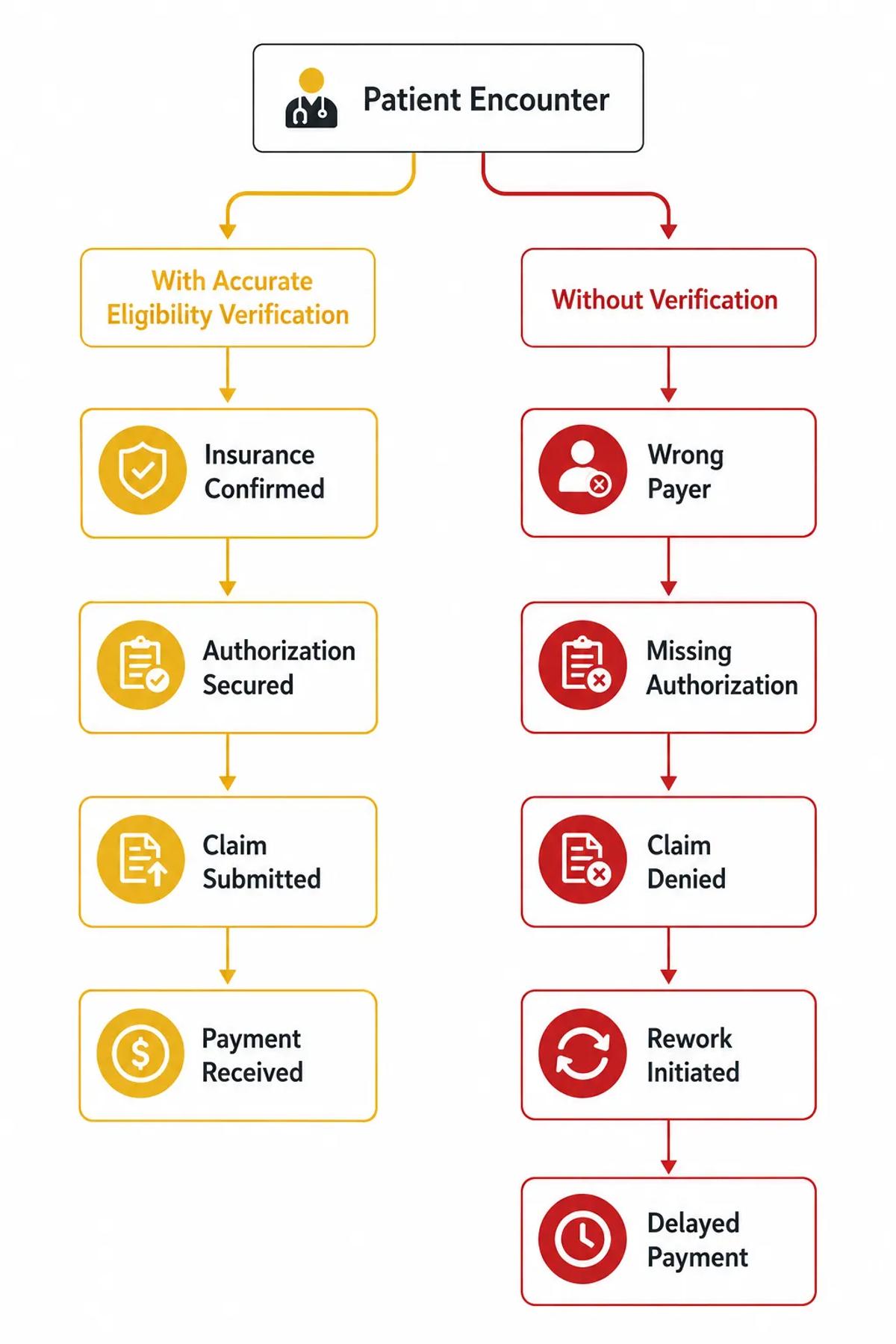
The claim lifecycle does not begin when a service is rendered. It begins at patient registration. Demographic errors, misspelled names, incorrect insurance identification numbers, wrong date of birth, missing coordination of benefits information, create problems that travel downstream through every subsequent stage of the billing process. A claim built on faulty registration data will be denied regardless of how accurately the coding was done.
Eligibility verification is the next critical control point. Before services are rendered, a skilled medical billing and coding professional confirms that the patient's insurance coverage is active, that the planned services are covered under the patient's plan, that any required referrals or prior authorizations are in place, and that the correct payer is identified when a patient has multiple coverages. According to Experian Health, missing or inaccurate claim data accounts for the single largest share of denials. The majority of those errors originate at registration and eligibility, before clinical services have even begun.
What skilled medical billing and coding practice looks like at this stage: every patient encounter is preceded by a structured eligibility check against the specific services planned for that visit. Insurance information is verified against current payer records, not assumed to be unchanged from a prior visit. Any discrepancy is resolved before the patient is seen, not after a claim comes back denied.
2: Coding Accuracy and Why It Requires Specialist Knowledge
Clinical documentation tells the story of a patient encounter. Medical coding translates that story into the numerical language payers use to evaluate and pay claims. The gap between an accurate translation and an inaccurate one is often a matter of specificity, modifier selection, or a payer-specific rule that changes the reimbursement outcome entirely.
Coding errors take several forms that are worth understanding:
Undercoding occurs when a coder assigns a less specific or lower-complexity code than the documentation supports. The claim is paid, but at a lower rate than the service warranted. Undercoding is revenue lost quietly, without a denial to flag that something went wrong.
Overcoding or upcoding occurs when codes are assigned at a higher complexity or specificity level than the documentation supports. In addition to triggering denials, upcoding carries serious compliance risk: it can result in audits, recoupment demands, and in egregious cases, legal exposure under federal fraud statutes.
Unbundling occurs when services that payers require to be billed under a single bundled code are submitted as multiple separate codes, each with its own reimbursement. Payers monitor for unbundling patterns and deny or flag claims that violate National Correct Coding Initiative (NCCI) edits.
Diagnosis-procedure mismatch occurs when the ICD-10 diagnosis code submitted does not support the medical necessity of the CPT procedure code on the same claim. Payers require that each procedure submitted is clinically justified by the documented diagnoses. A mismatch, even when the individual codes are both technically correct, results in a medical necessity denial.
Each of these errors requires specific knowledge of coding conventions, payer policies, and the clinical context behind the documentation. They are not detectable by general administrative staff working from basic billing software without coding credentials. A Certified Professional Biller (CPB) or Certified Professional Coder (CPC) from the AAPC has the trained eye to catch these issues before submission. Certified coders from AHIMA, including the CCS and RHIA credentials, bring equivalent depth particularly in facility and inpatient coding.
(CTA 1: Place here as a text CTA: "All Talentz places pre-vetted medical billing and coding specialists whose credentials and clinical knowledge have been verified before placement. Request Healthcare Talent from All Talentz and have a qualified specialist working for your practice in as little as 7 days.
3: Clean Claim Submission and What It Requires
A clean claim is one that passes payer edits on first submission and is processed for payment without requiring additional information, correction, or manual review. Achieving a high clean claim rate is the operational goal of any well-run medical billing and coding function, because every claim that clears on the first pass is a claim that does not consume rework time, delay payment, or create administrative friction.
Clean claim submission requires accurate coding, correct payer identification, properly formatted claim data that meets each payer's specific technical requirements, and compliance with submission deadlines that vary by payer. Many practices deal with multiple payers simultaneously, each with its own rules for claim format, required fields, modifier usage, and timely filing windows. Managing those variations requires systematic knowledge, not general familiarity.
Medical Economics' 2025 State of Claims analysis notes that denial rates have climbed steadily in recent years, driven by increasingly complex payer requirements and more aggressive claims review processes. The practices that maintain high clean claim rates in that environment are not the ones with better software. They are the ones with more knowledgeable people managing the billing function.
4: Denial Management and Accounts Receivable Follow-Up
Even in a well-run medical billing and coding operation, some denials will occur. What distinguishes a high-performing practice from a struggling one is what happens next. According to Fierce Healthcare's reporting on the 2025 MDaudit denial analysis, denial-related audit amounts rose significantly in 2025, and the rework required to overturn them is substantial. Between 35% and 65% of denied claims are never resubmitted at all, according to industry analysis cited by TextExpander's medical billing errors guide. Revenue that could have been recovered is simply abandoned.
Skilled denial management requires reading the denial reason code accurately, identifying whether the denial is a coding error, a documentation gap, an eligibility issue, or an administrative error, and submitting a corrected claim or formal appeal with the appropriate supporting documentation within the payer's appeal window. Each of those steps requires specialized knowledge. Denial management is not a task that a clinician, a practice manager, or a front-desk generalist can absorb without specialist training, and the payer's appeal deadlines wait for no one.
What skilled medical billing and coding practice looks like at this stage: denials are reviewed within 24 to 48 hours of receipt, root causes are categorized and tracked by denial type to identify patterns rather than treating each denial as an isolated incident, and appeals are filed promptly with payer-specific supporting documentation, not generic template letters.
Why Medical Billing and Coding Cannot Be a Shared Responsibility
In many healthcare practices, particularly smaller physician groups and specialty clinics, medical billing and coding is handled by someone who also manages other administrative functions: scheduling, patient communications, referral coordination, or reception. The billing work is real and the person handling it is dedicated. But the depth of knowledge that consistent medical billing and coding accuracy requires is genuinely incompatible with being split across multiple roles.
Code sets change annually. Payer requirements change throughout the year. NCCI edits are updated quarterly. Prior authorization requirements shift. Every one of those updates creates an opportunity for an error that a specialist would catch and a generalist would miss. The specialist catches it because their full professional attention is on the billing and coding function. The generalist misses it because their attention is appropriately distributed across everything else the practice needs.
This is not a criticism of the people in those roles. It is a structural reality about what medical billing and coding accuracy requires: dedicated, credentialed, continuously updated expertise focused entirely on the revenue cycle.
For more on how dedicated remote professionals compare to shared administrative arrangements for healthcare practices, see our post on what a dedicated remote staffing company does differently.
Is your practice's billing function being handled by someone wearing multiple hats? Contact All Talentz to discuss placing a dedicated medical billing and coding specialist whose full attention is on your revenue cycle.
How All Talentz Places Medical Billing and Coding Specialists
All Talentz places dedicated, pre-vetted medical billing and coding specialists with healthcare practices through a full talent partner model. Every specialist in our network has been assessed for coding credentials, tool proficiency, knowledge of payer-specific requirements, and direct experience with the medical billing and coding functions the role requires, before any placement is made.
Here is what that model delivers for a healthcare practice:
A dedicated professional whose full attention is on the practice's billing and coding function, not divided across administrative responsibilities. The specialist works within the practice's existing systems and workflows, building familiarity with the practice's payers, coding patterns, and denial history over time.
Placement in as little as 7 days. The specialist arrives credentialed, tool-ready, and familiar with the core billing and coding disciplines the role requires, without a multi-week onboarding cycle before productive work begins.
Work tools and equipment provided by All Talentz. Health insurance and employment infrastructure managed on the All Talentz side. A dedicated relationship manager who monitors performance, checks in regularly, and facilitates an immediate replacement if the placement is ever not the right fit.
Our healthcare talent services cover medical billing specialists, accounts receivable professionals, and healthcare support staff.
Beyond healthcare, All Talentz also places technology professionals who support healthcare practices with EHR integrations, billing software configuration, and digital infrastructure. Our tech talent services cover software developers and systems specialists for healthcare technology environments.
For more on how the remote talent model integrates with healthcare practice operations, see our post on remote employee onboarding best practices.
Conclusion
Medical billing and coding accuracy is not a back-office administrative function that runs itself with the right software. It is a specialist discipline that determines, at every stage of the claim lifecycle, whether a healthcare practice collects what it has earned. From the eligibility check before a patient is seen to the denial appeal filed before a payer's window closes, each stage requires a professional with the credentials, current knowledge, and dedicated attention to perform it correctly. For healthcare practices that are absorbing their billing function into a shared role, experiencing consistent denial patterns, or simply aware that their revenue cycle is not running as cleanly as it should, a dedicated medical billing and coding specialist is the structural solution. All Talentz places pre-vetted specialists with practices that need the revenue cycle handled with the depth and consistency it deserves, with placements starting in as little as seven days and full employment infrastructure managed on our side.
Medical coding is the process of translating clinical documentation into standardized code sets, specifically ICD-10-CM for diagnoses, CPT codes for procedures, and HCPCS Level II codes for supplies and services. Medical billing is the administrative process of submitting those coded claims to payers, following up on their status, managing denials and appeals, and posting payments. Together, these two disciplines form the revenue cycle of any healthcare practice. They require different but complementary expertise, and both must be performed accurately for a practice to collect what it is owed.
For coding roles, the Certified Professional Coder (CPC) credential from the AAPC and the Certified Coding Specialist (CCS) from AHIMA are the most widely recognized. For billing roles, the Certified Professional Biller (CPB) from the AAPC demonstrates competency in claim submission, denial management, and revenue cycle operations. The Registered Health Information Administrator (RHIA) credential from AHIMA is relevant for more senior health information management roles. Credentials matter because they represent a structured, tested standard of competency that self-described experience alone does not provide.
According to Experian Health's 2025 State of Claims report, the leading causes of denials are missing or inaccurate claim data, prior authorization issues, incomplete patient registration data, and coding inaccuracies. Most of these errors originate early in the revenue cycle, at registration and coding, before a claim is ever submitted. Practices that catch these errors at the source, through structured eligibility verification and credentialed coding review before submission, achieve materially higher clean claim rates than those that address errors reactively after a denial.
A dedicated specialist brings three things that a generalist handling billing as a secondary responsibility cannot consistently provide: depth of technical knowledge across code sets and payer requirements, continuous attention to the billing function rather than divided attention across multiple administrative roles, and a systematic approach to denial pattern tracking that identifies root causes rather than treating each denied claim as a one-off problem. Together, those three factors produce higher first-pass acceptance rates, faster payment cycles, and lower write-off rates.
Errors that are not caught before submission result in denials that must be reworked at a cost of $25 to $50 per claim, according to industry benchmarks. Between 35% and 65% of denied claims are never resubmitted at all, meaning that revenue is simply lost without ever being pursued. For healthcare practices operating on thin margins, the cumulative effect of uncorrected billing and coding errors is a persistent revenue leak that compounds over time and is rarely fully visible until a practice conducts a formal audit of its denial patterns.
Yes. Medical billing and coding functions are well-suited to remote delivery because the work is documentation-based and conducted entirely within digital systems: EHR platforms, practice management software, clearinghouses, and payer portals. All Talentz places dedicated remote medical billing and coding specialists who work exclusively within one practice's systems and workflows, building familiarity with that practice's payers, coding patterns, and denial history over time.