Denied claims are not random. They follow patterns, and those patterns are almost always traceable to specific, preventable errors in how claims are prepared, coded, and submitted. When a healthcare practice hires a remote medical billing specialist for healthcare practice, those patterns get identified, corrected, and prevented before the next billing cycle. That shift from reactive to proactive is what drives the revenue improvement that most practices are looking for but rarely achieve with in-house administrative staff who are not specialists in billing compliance.
This post is written for practice managers, solo physicians, physical therapists, dental groups, and clinical teams who are tired of chasing denied claims and want to understand what a dedicated remote billing specialist actually does differently from a general administrative hire.
The Denial Rate Problem Is Bigger Than Most Practices Realise
The industry-wide initial denial rate hit 11.8 percent according to the most recent Experian State of Claims data, up from 10.2 percent just a few years earlier. For a practice submitting 300 claims per month, that translates to roughly 35 denied claims every single month, each costing between $25 and $181 to rework according to MGMA benchmarks.
The deeper problem is what happens to those denied claims. Only about 35 percent of denied claims are ever resubmitted. The rest become permanent write-offs, revenue that the practice earned by delivering care but never collected because the billing process failed at the administrative stage.
This is not primarily a technology problem. Billing software does not catch errors that result from incorrect coding, missing prior authorizations, or documentation gaps that do not trigger automated flags. Those require a trained human who understands both the clinical context and the payer requirements, which is exactly what a dedicated remote medical billing specialist for healthcare practice brings.
What a Remote Medical Billing Specialist for Healthcare Practice Actually Does
Day-to-Day Scope of a Remote Medical Billing Specialist for Healthcare Practice
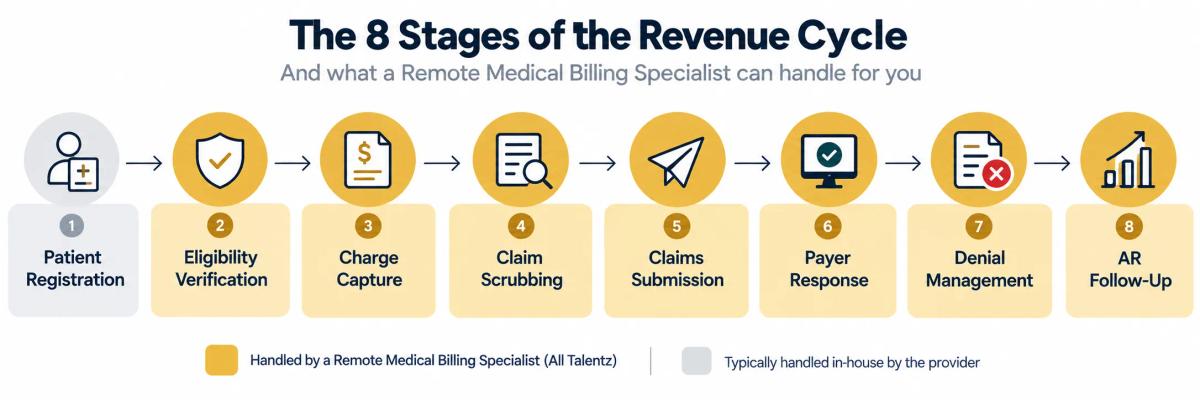
The scope goes well beyond entering charges and submitting claims. A trained remote medical billing specialist for healthcare practice operates across the full revenue cycle, with the goal of reducing denials at the front end rather than just reworking them after the fact:
•Eligibility verification before each appointment, confirming active coverage, deductible status, and in-network standing to prevent demographic denials
•Accurate CPT and ICD-10 coding matched to the documentation in clinical notes, reducing coding errors that account for a significant share of initial denials
•Claim scrubbing before submission, reviewing each claim for errors, missing modifiers, and payer-specific formatting requirements
•Electronic claims submission with real-time status tracking and immediate response to rejections within the timely filing window
•Denial management, identifying the root cause of each denial, correcting the error, and submitting a properly documented appeal
•Prior authorization support, tracking which procedures and medications require pre-approval and submitting requests before services are delivered
•Accounts receivable follow-up, pursuing outstanding balances from both payers and patients on a structured schedule
•Monthly reporting, providing the practice with clear visibility into denial rates by category, collections performance, and AR aging
For practices that also want to outsource patient-facing communication alongside billing, our guide on outsourcing customer service for small business covers how to structure that alongside the billing function without duplicating effort.
Prior Authorization Is Where Most Practices Lose Before the Claim Is Even Filed
The American Medical Association reports that physicians and their staff spend an average of 14 hours per week managing prior authorizations. That burden falls almost entirely on clinical and administrative staff who are already at capacity, and when prior authorization requests are missed, delayed, or submitted incorrectly, the claim is denied before care is even delivered.
A remote medical billing specialist for healthcare practice monitors prior authorization requirements by payer and by procedure, submits requests proactively, and tracks pending authorizations to ensure no service is delivered without coverage confirmation. This single function, done consistently, eliminates a category of denial that many practices simply write off as unavoidable.
Reduce Denied Claims With a Dedicated Remote Medical Billing Specialist
All Talentz places trained, HIPAA-aware billing professionals matched to your specialty and payer mix.
The Benchmark a Practice Should Be Aiming For
The HFMA top-quartile target for initial denial rates is under 5 percent, with best-in-class multi-specialty groups running between 3 and 4 percent. The current industry average sits between 9 and 12 percent, which means a significant proportion of US practices are performing at more than twice the standard that top performers achieve.
The gap between average and top-quartile performance is not primarily explained by software or technology. It is explained by the quality of the human beings managing the billing function, their familiarity with payer-specific requirements, their discipline in working denials within the filing window, and their ability to spot root causes rather than just resubmitting the same flawed claim.
A dedicated remote medical billing specialist for healthcare practice brings that level of focus to a function that most practices currently manage as a secondary responsibility of administrative staff whose primary job is something else.
The Cost Comparison That Changes the Conversation
An in-house medical billing specialist in the US earns between $42,000 and $58,000 per year in base salary. Once employer payroll taxes, benefits, and overhead are added, the loaded annual cost typically falls between $58,000 and $75,000 for a single billing hire. For a solo physician or small group practice, that is a significant fixed expense for a function that fluctuates with patient volume.
Local medical billing companies typically charge between 4 and 9 percent of net collections. For a practice collecting $800,000 per year, that is $32,000 to $72,000 annually, often with limited visibility into what is actually being done on denied claims and AR follow-up.
A remote medical billing specialist for healthcare practice placed through All Talentz starts from $400 per month, a dedicated professional focused entirely on the practice's billing function. The saving compared to either of the alternative models is substantial, and unlike a percentage-of-collections billing company, the cost does not rise as collections improve.
What All Talentz Looks for When Placing a Remote Medical Billing Specialist
Every remote medical billing specialist for healthcare practice placed through All Talentz is assessed for proficiency in the billing platforms most commonly used by US healthcare practices, including Kareo, AdvancedMD, eClinicalWorks, athenahealth, and Practice Fusion. Candidates are also evaluated for knowledge of the CPT, ICD-10, and HCPCS coding systems relevant to the specialty they will be supporting, HIPAA data handling requirements, and experience working within the payer mix typical of the client's patient population. You can see the full scope of healthcare billing and support roles we cover on our healthcare talent page
For practices that need a broader view of how to structure remote healthcare staffing across multiple functions, our guide on working with an international healthcare recruiter covers how All Talentz sources and vets healthcare professionals for US medical facilities.
Talk to Us About Your Practice's Billing Challenges
All Talentz places remote medical billing specialists matched to your specialty, software, and payer mix.
Conclusion
The data on medical claim denials is not ambiguous. An industry average of 11.8 percent, 41 percent of practices running above 10 percent, and only 35 percent of denied claims ever being reworked represents a revenue problem that compounds every month it is not addressed. Hiring a remote medical billing specialist for healthcare practice is how practices move from that average toward the top-quartile benchmark of under 5 percent, not by buying new software, but by having a dedicated, trained professional whose entire focus is on getting claims right the first time and recovering the ones that do not make it through.
The cost model makes it accessible at every practice size, from a solo physician to a multi-provider group, and the All Talentz placement process means a vetted billing specialist can be deployed in less than 48 hours of a talent request. This is one of the clearest examples of the benefits of hiring remotely.
Start Recovering the Revenue Your Practice Has Already Earned
Trained. Vetted. HIPAA-aware. All Talentz places remote medical billing specialists that deliver results.
A remote medical billing specialist for healthcare practice manages the full revenue cycle, including eligibility verification, CPT and ICD-10 coding, claim scrubbing and submission, prior authorization tracking, denial management, AR follow-up, and monthly reporting. The goal is to reduce denied claims at the front end rather than reworking them after rejection.
Through All Talentz, remote medical billing specialist engagements start from $400 per month. This compares to $58,000 to $75,000 per year for an in-house hire, or 4 to 9 percent of net collections for a local billing company, making the remote model significantly more cost-effective at any practice size.
The HFMA top-quartile target is under 5 percent, with best-in-class multi-specialty groups achieving 3 to 4 percent. The current industry average is between 9 and 12 percent. A dedicated remote medical billing specialist for healthcare practice is the most direct path from average to top-quartile performance.
Yes. Prior authorization management is one of the most impactful functions a remote medical billing specialist for healthcare practice handles, tracking which procedures and medications require pre-approval, submitting requests proactively, and following up on pending authorizations to prevent denials before care is delivered.
Yes, when working through a compliant partner. All Talentz operates within an ISO 27001 and SOC-2 Type 2 certified security framework. Every billing specialist signs a comprehensive Business Associate Agreement in compliance with HIPAA requirements, and patient data access is structured through secure, permission-based protocols.
All Talentz typically deploys a placed billing specialist within seven business days of receiving a talent request. Candidates are pre-vetted for software proficiency, coding knowledge, and HIPAA compliance before being presented to the client.