
Healthcare practices operate under a resource constraint that is unlike most other businesses. Clinical staff represent the highest-cost, hardest-to-replace talent the practice employs, and the work they are trained to do, providing patient care, diagnosing conditions, and managing treatment, is the work that only they can perform. Every hour a physician, nurse practitioner, or physician assistant spends on scheduling calls, insurance verification, patient intake paperwork, or billing follow-up is an hour that is not going to clinical work.
A virtual assistant for healthcare practice operations addresses this directly. It places a dedicated, trained administrative professional between the clinical team and the administrative workload that currently absorbs their time, protecting clinical capacity for clinical work and improving the patient experience at every administrative touchpoint simultaneously.
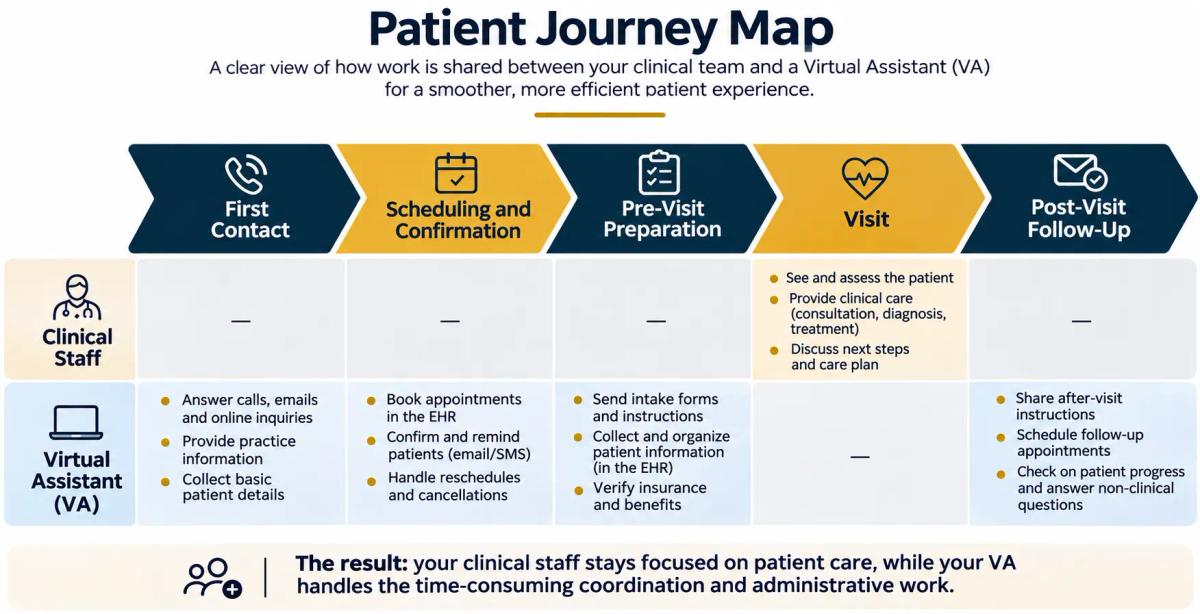
This post follows the patient journey from first contact through post-visit follow-up, showing where a healthcare virtual assistant intervenes at each stage and what changes for both the clinical team and the patient when those touchpoints are handled by a dedicated professional rather than a stretched clinical staff member.
For a broader look at how remote healthcare administrative staff supports practice operations across multiple functions simultaneously, see our post on how remote healthcare administrative staff closes the gaps slowing your practice down.

Touchpoint 1: First Contact and Inquiry Handling
The patient's first impression of a healthcare practice is formed before they ever meet a clinician. It is formed the moment they call, email, or submit an online inquiry and experience how the practice responds. When that first response is a voicemail, a delayed email reply, or a harried clinical staff member who is clearly managing multiple things at once, the impression is formed. When it is a professional, warm, knowledgeable response from someone whose entire function is to make that first contact excellent, the impression is formed very differently.
In most independent and small group practices, first contact is handled by clinical staff who also manage other responsibilities. Phone calls arrive during patient consultations, during charting time, and between appointments. They are answered when there is a moment and returned when there is another. A prospective patient who calls three times without reaching a live person and does not receive a callback within a few hours has a decision to make, and many make it by calling the next practice on the list.
A virtual assistant for healthcare practice first contact management answers calls and responds to inquiries consistently, captures patient information accurately through a structured intake process, schedules consultations in the correct appointment type with the correct provider, and sends confirmation communications that reduce the no-show rate before it becomes a revenue problem.
The American Medical Association (AMA) has found that administrative tasks contribute significantly to physician burnout, with front-desk and intake coordination among the most frequently cited time drains. A dedicated virtual assistant absorbs this layer entirely, allowing clinical staff to engage with new patients for the first time during a clinical encounter rather than an administrative one.
Touchpoint 2: Scheduling, Confirmation, and Appointment Preparation
Scheduling is more complex in a healthcare practice than in most businesses. Appointment types vary by clinical need. Provider availability varies by specialty, credentialing, and prior authorization status. Insurance coverage determines which providers a patient can see and at what cost. Getting any of these wrong before a patient arrives creates a cascade of problems on the day of the appointment.
A virtual assistant for healthcare practice scheduling manages all of this complexity systematically. They schedule appointments to the correct provider based on the patient's insurance and clinical need. They send confirmation communications at the intervals that reduce no-show rates most effectively, typically 48 hours and again the morning of the appointment. They verify insurance eligibility before the appointment rather than after, so coverage gaps are identified and addressed while there is still time to act.
They also coordinate the pre-appointment administrative preparation that clinical staff currently handle: gathering intake forms, requesting prior medical records, confirming prior authorizations, and ensuring the patient arrives with the documentation the clinical team needs to provide care efficiently.
The Medical Group Management Association (MGMA) tracks the operational metrics that define high-performing practices and consistently identifies scheduling efficiency and no-show rate management as top contributors to revenue cycle performance and clinical throughput. A virtual assistant who owns the scheduling and confirmation function professionally improves both.
All Talentz places virtual assistants for healthcare practices whose patient communication skills, scheduling competency, and HIPAA awareness are verified before placement. Request Healthcare Talent from All Talentz and have a qualified practice VA working for you in as little as 48 hours.
Touchpoint 3: Insurance Verification and Billing Communication
Insurance-related administrative work is one of the most time-consuming and technically demanding administrative functions in a healthcare practice, and it is one that clinical staff are frequently asked to absorb despite having no specific training in it.
Insurance eligibility verification before each appointment, prior authorization coordination with payers, explanation of benefits communication with patients, and follow-up on billing questions after the encounter are all functions that require knowledge of payer requirements, billing codes, and the specific language that resolves insurance queries efficiently. When a clinical nurse practitioner or a medical assistant is handling these calls between patient appointments, the quality of both the clinical work and the insurance administration suffers simultaneously.
A virtual assistant for healthcare practice billing communication handles patient-facing insurance inquiries, explains benefit coverage in plain language, coordinates with the billing team on outstanding claim questions, and follows up with patients who have received statements they do not understand. This function reduces inbound confusion calls to the clinical team while simultaneously improving the patient's experience of the practice's financial communication.
For practices in Canada, provincial health insurance administration, supplementary insurance coordination, and patient payment communication require the same dedicated attention. For UK private practices, excess fee communication, insurance pre-authorization coordination, and patient invoice management are equivalently demanding administrative functions that a dedicated virtual assistant handles without requiring clinical staff involvement.
Touchpoint 4: Post-Visit Follow-Up and Patient Retention
The administrative workload in a healthcare practice does not end when the patient leaves the consultation room. Post-visit follow-up communication, recall reminders, chronic condition check-in scheduling, and patient satisfaction management are all functions that drive patient retention, clinical outcomes, and practice revenue.
In most practices, these functions are the first to be deprioritized when clinical staff are stretched. The recall reminder for the patient who needs a six-month follow-up goes unsent because there was no time to pull the list and make the calls. The patient satisfaction survey sits in a draft state because no one owns the process. The test result communication that should have gone out within 24 hours arrives three days later because the physician's administrative time was absorbed by more urgent demands.
A virtual assistant for healthcare practice post-visit operations manages these touchpoints systematically. Recall reminders go out on schedule. Post-visit communication follows the practice's defined protocols. Patient feedback processes are managed consistently rather than aspirationally. The cumulative effect of this consistency is a patient experience that feels attentive and professional rather than rushed and intermittent.
The Canadian Medical Association (CMA) has published guidance on the relationship between administrative burden and physician burnout in Canada, identifying post-visit administrative workload as a significant contributor to the capacity constraints that limit how many patients practices can serve. A virtual assistant who owns the post-visit administrative layer recovers clinical capacity that administrative burden was consuming.
Want to identify which administrative touchpoints in your practice would benefit most from a dedicated virtual assistant? Contact All Talentz and talk through your practice's workflow with our team.
HIPAA and Privacy Compliance for a Healthcare Virtual Assistant
This is the compliance question every healthcare practice should ask before placing any virtual assistant, and the answer should be explicit rather than assumed.
A virtual assistant for healthcare practice operations handles protected health information (PHI) as defined under HIPAA in the US, and under the Personal Health Information Protection Act (PHIPA) in Canada and equivalent privacy legislation across European markets. Any virtual assistant handling PHI must work under a Business Associate Agreement (BAA) that defines the privacy and security obligations that apply to their handling of patient information.
A reputable placement partner provides BAA documentation as part of the engagement structure and places virtual assistants who have been trained in HIPAA-compliant communication practices: what patient information can be discussed in which channels, how to handle documentation securely, and what the escalation path is for any potential privacy concern.
The U.S. Department of Health and Human Services Office for Civil Rights publishes guidance on HIPAA Business Associate requirements that practices can use to verify that any virtual assistant arrangement meets the required compliance framework before PHI is shared.
How All Talentz Places Virtual Assistants for Healthcare Practices
All Talentz places dedicated, pre-vetted virtual assistants for healthcare practices across the US, Canada, and Europe. Every VA placed in a healthcare role is assessed for patient communication professionalism, scheduling system proficiency, insurance coordination knowledge, HIPAA awareness, and documentation accuracy before any match is made.
The virtual assistant placed works exclusively for one practice. They build familiarity with the practice's provider schedules, payer relationships, patient communication standards, and workflow preferences over time. Work tools and equipment are provided by All Talentz. Employment and health insurance are managed on our side. A dedicated relationship manager monitors performance and facilitates an immediate replacement if the placement is not the right fit.
Our healthcare talent services cover healthcare virtual assistants, medical billing specialists, prior authorization coordinators, and patient scheduling professionals, all placed as dedicated resources exclusively assigned to the practices they serve.

Conclusion
A virtual assistant for a healthcare practice does not replace clinical expertise. It protects it. When first contact is answered professionally, scheduling is managed systematically, insurance questions are handled without clinical staff involvement, and post-visit follow-up happens on schedule, clinical staff engage with patients in clinical capacity rather than spending clinical hours on administrative work that was always someone else's job. The practices that make this shift consistently report both clinical staff satisfaction improvements and patient experience improvements, because the same change that reduces administrative burden on clinical staff also makes the practice more responsive and attentive from the patient's perspective. All Talentz places dedicated, HIPAA-aware healthcare virtual assistants for practices across the US, Canada, and Europe, with placements starting in as little as seven days and employment infrastructure managed entirely on our side.
Hire a Healthcare Virtual Assistant Through All Talentz
A healthcare virtual assistant handles the administrative touchpoints that currently absorb clinical staff time: first contact and inquiry responses, patient scheduling and confirmation, insurance eligibility verification, prior authorization coordination, billing question follow-up, post-visit communication, and recall reminder management. They work within the practice's existing scheduling and communication systems from a remote location under HIPAA-compliant protocols.
A healthcare virtual assistant placed through All Talentz operates under a Business Associate Agreement (BAA) as required by HIPAA and has been assessed for HIPAA-compliant communication and documentation practices before placement. This includes training on what PHI can be handled in which channels, secure document management, and appropriate escalation processes for privacy concerns.
A virtual assistant for a healthcare practice handles the patient-facing and scheduling administrative functions: first contact, appointment scheduling, confirmation, insurance verification communication, and post-visit coordination. A medical billing specialist handles the revenue cycle back-end: claim submission, coding accuracy, denial management, and AR follow-up. Many practices benefit from both. The primary gap in most small practices is the patient-facing administrative function, which is where the virtual assistant delivers the most immediate impact.
Common practice management and scheduling platforms include Kareo, AdvancedMD, Athenahealth, eClinicalWorks, Jane App, and Power Diary depending on the practice type and geography. All Talentz verifies platform proficiency before placing any healthcare virtual assistant and matches the professional's system experience to the practice's existing tools.
All Talentz can place a pre-vetted, dedicated healthcare virtual assistant in as little as 48 hours.
All Talentz provides an immediate replacement guarantee with no delay, no penalty, and no need to restart a full search.