Most businesses treat onboarding as an administrative event. There is paperwork to complete, accounts to activate, a few introductory calls to schedule, and then the new hire is considered "onboarded." That framing is precisely why only 12% of employees say their organization does onboarding well, according to Gallup research, and why nearly 30% of new hires leave within their first 90 days.
The businesses that successfully onboard remote employees for the long term do not treat onboarding as a checklist. They treat it as a retention investment, and the data is unambiguous about the return: organizations with strong onboarding processes improve new hire retention by 82% and productivity by over 70%, according to Brandon Hall Group research. When you successfully onboard remote employees, 69% of those employees are more likely to stay with the organization for three or more years, according to AIHR citing multiple onboarding studies. When onboarding fails, 64% of employees are inclined to leave within their first year.
This post is not a step-by-step checklist. If you are looking for the process sequence, our post on how to onboard remote employees in seven proven steps covers the tactical sequence in depth. This post is about the four factors that research consistently identifies as the actual drivers of long-term retention for remote hires, and what each of them requires in practice.
Why Retention Is the Right Lens for How You Onboard Remote Employees
Before looking at the four factors, it is worth establishing why retention is the right lens through which to evaluate your onboarding approach, rather than productivity speed or administrative completion rates.
The average cost to hire a new employee sits at approximately $4,700 according to SHRM 2025 benchmarking data, and replacing an employee who leaves early costs between 50% and 200% of their annual salary in total turnover costs when lost productivity, rehiring, and ramp time are counted, according to Brandon Hall Group data. For a $60,000 remote hire who leaves after three months, the organization has lost not just the recruitment investment but a further $30,000 to $120,000 in turnover cost, before the replacement search begins.
When you onboard remote employees well enough to retain them, that investment compounds in the other direction: 69% of well-onboarded employees stay three or more years, and employees in extended onboarding programs become fully proficient 34% faster than those in shorter programs. They also generate measurably higher business outcomes. Organizations with strong onboarding report a 60% increase in revenue per full-time employee and 1.5x growth in profit, according to research compiled by Speakwise citing AIHR data.
The business case for getting remote onboarding right is not primarily about making new hires feel welcome, though that matters. It is about the financial consequences of losing a hire who was never properly integrated, and the compounding financial benefit of retaining one who was. With that frame established, here are the four factors that research consistently shows make the difference.
Factor One: The 44-Day Window
Enboarder's 2025 HR Leader Survey research identified a specific window that organizations have on average to make a decisive impression on a new remote hire: 44 days. BambooHR's 2024 research found that 70% of new hires decide whether a job is the right fit within the first month, and 29% decide within the first week. The data from Enboarder further shows that 86% of new hires decide how long they will stay with a company within their first six months.
To onboard remote employees in a way that wins that window, the experience within the first six weeks needs to communicate three things unambiguously: that the organization is prepared and organized, that the role is what was described in hiring, and that the new hire is valued and supported. When any of these three signals is absent, the retention decision often goes the wrong way before the role has even had a fair chance to establish itself.
Enboarder's 2025 survey identified the top three reasons new hires leave in the first 90 days as a misalignment between job expectations and reality (30.3%), a lack of connection with team or company culture (19.5%), and a poor onboarding experience (17.4%). Each of these is directly addressable through deliberate early onboarding design, specifically through written role expectations shared before Day One, structured social integration in the first two weeks, and a pre-planned 30/60/90-day structure communicated clearly at the start.
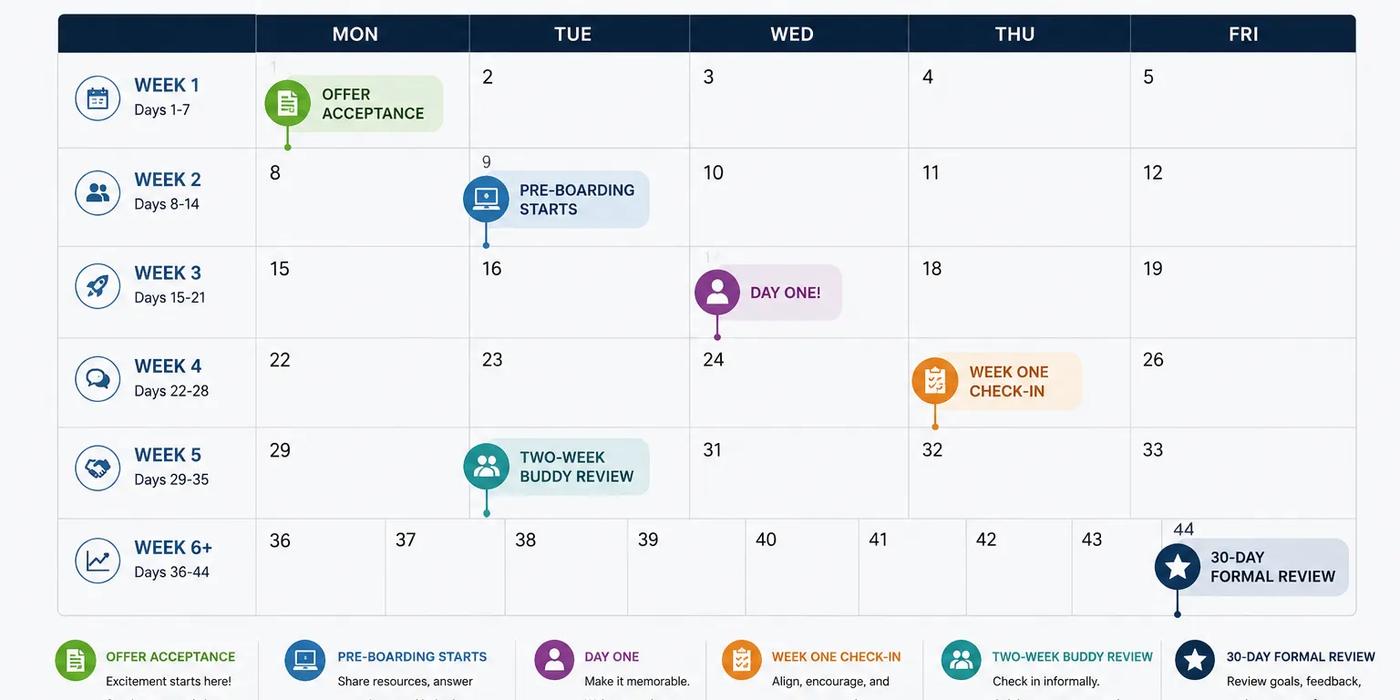
What the 44-day window means in practice: The first six weeks should be the most intentionally designed period of your onboarding program, not the least. Pre-boarding begins the moment an offer is signed. Day One through Week Two focuses on connection and role clarity. The 30-day review is a formal conversation about whether reality is matching what was described. The 44-day window is not about overwhelming a new hire with culture immersion. It is about making sure the most important signals are sent early enough to anchor the retention decision.
When you place talent through All Talentz, every professional arrives pre-vetted and role-clarity is established before placement, not after. The 44-day window starts from a stronger position. Request Talent from All Talentz to see the difference.
Factor Two: Connection Before Competence
One of the most consistent findings in remote onboarding research is that new hire retention is more strongly predicted by social connection than by technical skill development during the onboarding period. Organizations that leave social integration to chance are, in practice, gambling with their most expensive new hire investment.
One in five new hires reports that their company takes no steps to help them find support among coworkers, according to Deel's 2025 onboarding data. For a remote employee who cannot walk into an office and build relationships through proximity, this is not a minor gap. It is the primary cause of the isolation that accelerates departure decisions. Remote employees are 117% more likely than on-site employees to plan to leave, according to Paychex data compiled by Truffle, and the primary driver of that disparity is not the remote work model itself. It is the absence of deliberate social integration.
The return on investing in connection during onboarding is well-documented. Onboarding buddy programs increase retention by 52% and reduce time-to-productivity by 60%, according to Microsoft research cited by Speakwise. Companies that assign mentors see productivity increases in 87% of cases. Employees with onboarding buddies are also 23% more satisfied than those without, according to Apollo Technical data. Effective onboarding makes employees 18 times more committed to their employer compared to those with poor onboarding experiences.
What connection before competence means in practice: When you onboard remote employees with a deliberate social integration plan, the structure looks like this. An onboarding buddy is assigned before Day One, someone outside the direct reporting line who the new hire can ask informal questions without it feeling high-stakes. Cross-functional introductions are scheduled in the first two weeks, not just introductions to the immediate team. At least one non-work social interaction, a virtual coffee chat or casual team call, is built into the first week calendar. The new hire's manager holds a daily 15-minute check-in for the first two weeks, not a weekly one-on-one. Social integration is not an extra. For remote employees, it is the infrastructure that everything else depends on.
Factor Three: Manager Involvement Is the Multiplier
The research on what differentiates exceptional onboarding from adequate onboarding consistently points to one variable above all others: manager involvement. When managers are actively involved in the onboarding process, new hires are 3.4 times more likely to describe their onboarding experience as exceptional, according to Gallup research cited by Gable.
The problem is that most managers are not equipped to deliver this. Enboarder's 2025 survey found that 83% of managers have no formal training in people management. Nearly one in three HR leaders has seen a hiring manager fail to provide a new hire with any guidance or training at all. When onboarding is designed as an HR-owned, HR-delivered process that managers observe rather than lead, the single most powerful variable for new hire retention is being underutilized.
When you onboard remote employees through a manager-centric model, the manager becomes the primary architect of the experience rather than a passive participant. This shifts several specific responsibilities from HR to the direct manager:
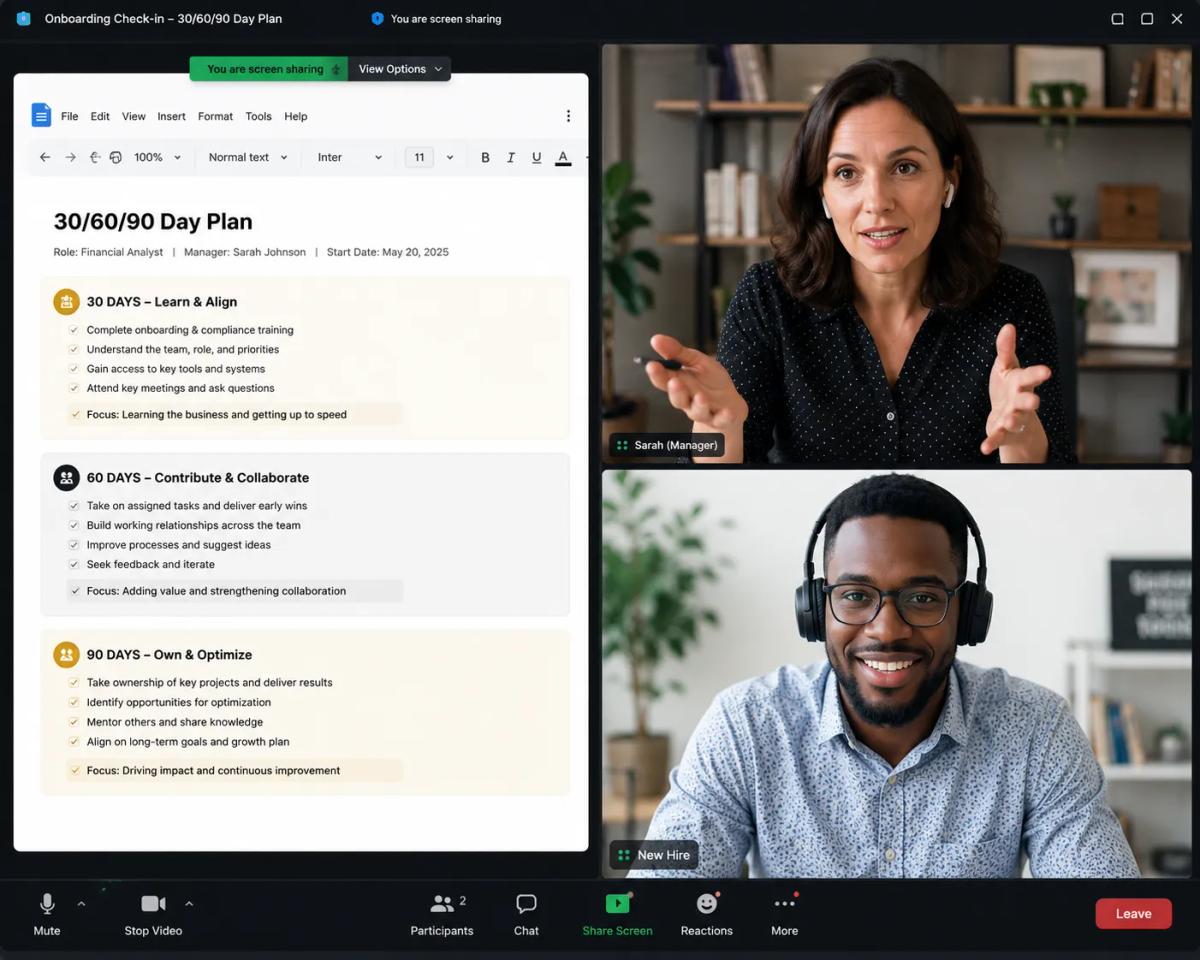
The written 30/60/90-day plan is created by the manager, in collaboration with HR, not handed to the manager by HR to execute. The daily check-ins in the first two weeks are owned by the manager, not scheduled as HR touchpoints. The 30-day performance conversation is conducted by the manager, not a generalist survey. Career growth discussions begin at the 60-day mark, not at the annual review. According to BambooHR research cited by TechJury, 89% of employees who had effective onboarding feel highly engaged, and engaged employees are 30 times more likely to report high job satisfaction. The manager is the primary driver of that engagement signal.
Factor Four: Measurement Turns Onboarding From a Guess Into a System
More than half of organizations do not measure the effectiveness of their onboarding programs at all, according to Kronos research cited by HR Chief. Among those that do, only 47% evaluate onboarding at the 90-day mark. This means that most businesses running onboarding programs for remote employees have no reliable signal for whether those programs are working until someone leaves.
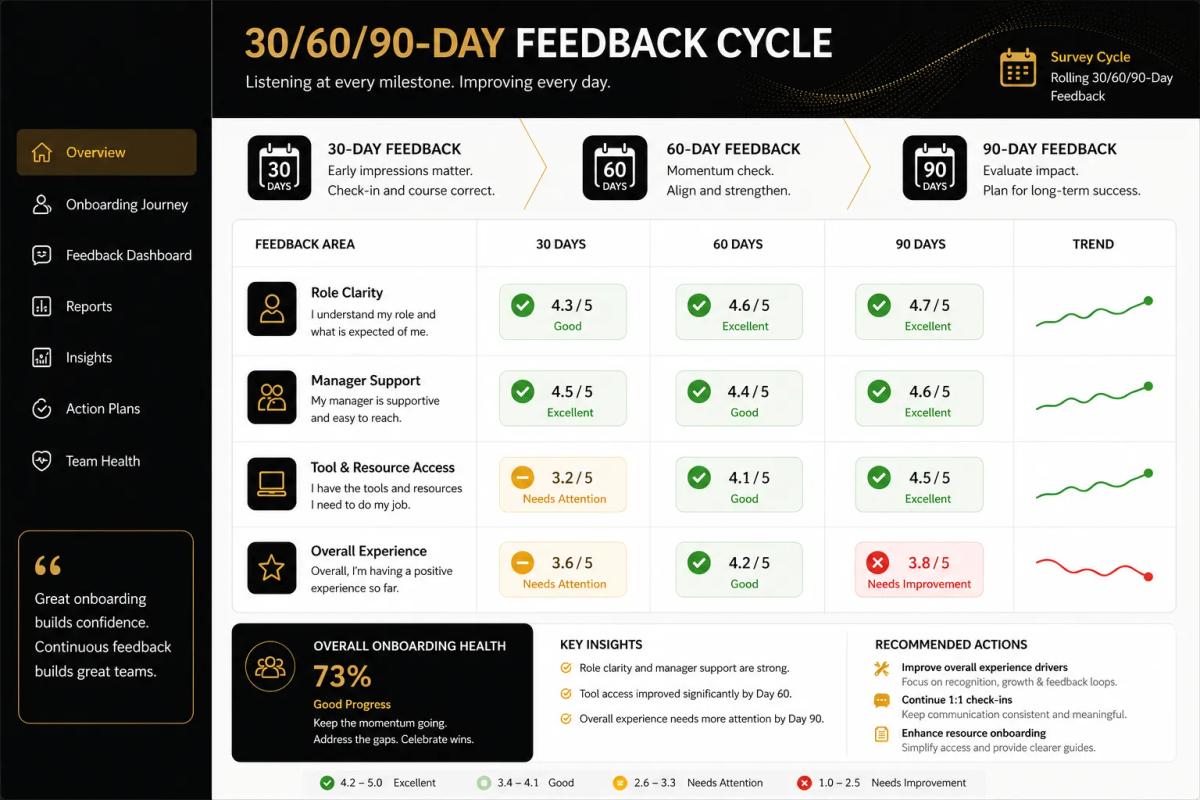
The measurement gap matters because the problems that cause remote new hires to disengage and leave are almost always visible before the departure, if there is a system to surface them. A remote employee who is unclear about their role does not typically announce the confusion. They operate with it, perform at reduced effectiveness, and eventually resolve it by leaving. A structured feedback loop at 30, 60, and 90 days surfaces that confusion as a fixable problem rather than a departure statistic.
Research from Apollo Technical found that organizations that actively solicit feedback during onboarding see a 91% improvement in new hire relationship quality. Enboarder's 2025 survey found that 29% of HR leaders rank high attrition during onboarding as their single top challenge, but only a minority are measuring onboarding systematically enough to identify where the attrition is being driven.
What measurement looks like in practice: Three surveys of five to seven questions each, sent at the end of Week One, at 30 days, and at 90 days. Questions that cover four areas: clarity of role expectations, quality of manager support, access to tools and resources, and overall experience to date. The results should be reviewed by both HR and the direct manager, and any score below a threshold should trigger a proactive outreach, not a wait-and-see. Organizations with formal 90-day onboarding programs with measurement built in see 31% higher new hire productivity than those without, according to HR Effectiveness Report 2025 data.
For a closer look at what goes wrong when these measurement systems are absent, see our post on remote onboarding mistakes that push new hires to quit.
All Talentz relationship managers run structured check-ins with every placed professional throughout the engagement, providing the measurement and early-warning layer that most businesses skip. Contact All Talentz to learn how that support is built in from placement.
How All Talentz Makes It Easier to Onboard Remote Employees for the Long Term
The four factors above describe what great remote onboarding requires. All Talentz addresses several of the most operationally difficult parts of that framework by design.
Every professional placed through All Talentz arrives pre-vetted and pre-trained, which removes the competency-verification pressure from the 44-day window. The first six weeks can focus entirely on integration, role clarity, and social connection because the skills question was answered before the placement was made.
Every placement is also supported by a dedicated All Talentz relationship manager who monitors performance, runs regular structured check-ins, and provides the measurement layer that Factor Four describes. That manager catches problems early, before they become departures, and escalates to a replacement immediately when a match is genuinely not working.
The employment infrastructure on the All Talentz side, equipment provided, health insurance managed, employment compliance handled, removes the logistical friction from pre-boarding. Remote professionals arrive on Day One ready to work because the setup was completed before they started.
We place pre-vetted remote professionals across six industries:
Our tech talent services place software developers, AI and ML specialists, UI/UX designers, data annotators, and QA engineers.
Our healthcare talent services place medical billing specialists and healthcare support professionals.
Our finance talent services place accounts receivable specialists, financial analysts, payroll specialists, and bookkeepers.
Our remediation talent services place estimators and operations professionals for restoration businesses.
Our legal talent services place legal researchers, paralegals, and legal receptionists.
Our pest control talent services place CSRs, accountants, and sales support professionals.
For more on how the dedicated placement model compares to traditional hiring across business functions, see our post on what a dedicated remote staffing company does differently.
Conclusion
The data on how to onboard remote employees for long-term retention points consistently in one direction: organizations that treat onboarding as a strategic investment rather than an administrative process see 82% higher retention, 70% greater productivity, and employees who are 3.4 times more likely to describe their experience as exceptional. The four factors that drive those outcomes are not complicated. The 44-day window requires deliberate early design. Connection before competence requires intentional social integration. Manager-centric onboarding requires giving managers the ownership and the accountability. Measurement requires feedback loops at 30, 60, and 90 days. What makes these factors difficult is consistency: applying all four, for every remote hire, every time. All Talentz makes that easier to sustain by building several of these factors into the placement model itself, so the business can focus on integration while the management and performance monitoring layer runs in parallel.
Research from SHRM and Brandon Hall Group consistently shows that new hires take 8 to 12 months to reach full productivity. The minimum effective onboarding program covers 90 days with formal check-ins at 30, 60, and 90-day marks. Organizations with programs of 90 days or longer improve new hire retention by 82% and productivity by over 70%. The most common mistake is treating onboarding as complete after one to two weeks of orientation.
Research from Gallup identifies manager involvement as the single most powerful variable. When managers are actively involved in the onboarding process, new hires are 3.4 times more likely to describe their experience as exceptional. Social connection is the second most important factor, with onboarding buddy programs increasing retention by 52% according to Microsoft research cited by Speakwise.
The core framework remains the same: pre-boarding before Day One, a structured first-week experience, social integration in the first two weeks, and a 30/60/90-day check-in cycle. The practical adaptations for different time zones include async-first documentation so nothing critical is time-zone-gated, defined overlap hours between the new hire and their manager, pre-recorded onboarding content that can be consumed on the new hire's schedule, and a buddy who has been briefed on the time zone situation and has committed to regular async communication.
The most reliable indicators are: 90-day retention rate (the percentage of remote hires still with the organization at each milestone), 30/60/90-day satisfaction surveys covering role clarity, manager support, tool access, and overall experience, and time-to-productivity measured against the role-specific milestones in the 30/60/90-day plan. Organizations that measure at each of these points catch retention risk early enough to address it before it becomes a departure.
Remote employees lack the ambient context that office environments provide naturally: overhearing team conversations, observing how people interact, building relationships through proximity. When deliberate social integration is not designed into the onboarding process, remote hires operate in isolation with limited context and reduced connection, which accelerates the disengagement and departure decision. Research from Paychex found that remote employees are 117% more likely than on-site employees to plan to leave.
Every All Talentz placement is supported by a dedicated relationship manager who monitors performance, runs structured check-ins at regular intervals, and flags any concerns early. The pre-vetting process means the new hire arrives skills-confirmed, which removes competency verification from the onboarding agenda. Equipment and employment infrastructure are managed on the All Talentz side, so the business can focus onboarding resources on integration, connection, and culture rather than logistics. If a placement is not the right fit, replacement is immediate.