
Here is a number worth sitting with: only 12% of employees say their organization does onboarding well, according to Gallup research. That means 88% of businesses, across every size and sector, are putting new hires through an experience that falls somewhere between forgettable and damaging. For remote hires, the consequences of getting onboarding wrong arrive faster and hit harder than they do for in-office employees, because there is no hallway, no ambient office culture, and no colleague to quietly help a confused new hire find their footing. When a remote onboarding experience fails, the new hire is alone with their confusion, and they tend to act on it: nearly one in three remote employees plans to leave earlier than their in-office counterparts, and approximately 30% of all new hires leave within their first 90 days.
The uncomfortable truth behind those numbers is that most of the exits are preventable. The causes are almost always the same pattern of remote onboarding mistakes that show up consistently across organizations of every size. This post names them directly, explains the data behind each one, and tells you exactly what to do instead.
If you want the full framework for building a remote onboarding process from scratch, our earlier post on how to onboard remote employees in proven steps covers the complete sequence. Think of this post as the companion: what happens when the steps in that guide are skipped.
Remote Onboarding Mistakes Start Before Day One
Most businesses think of onboarding as what happens on the first day. That assumption is itself one of the most costly remote onboarding mistakes a company can make.
Research from Deel's 2025 onboarding study found that 64% of employees received no pre-boarding before their first day, and 40% did not receive even the minimum required to start their role, including equipment, login credentials, or a schedule. For a remote hire who cannot walk into an office and ask for help, arriving on Day One without a working laptop, system access, or a clear agenda does not just create a slow start. It communicates something far more damaging: that the company did not plan for them.
The data on what that first impression costs is clear. Research from BambooHR found that 44% of new hires report regretting their decision after the first week. 70% have decided whether to stay or leave within the first month. The onboarding experience is not just an HR formality. It is the single most influential factor in whether a new hire commits to the role long-term, and the window is short.
What to do instead: Begin the onboarding process the moment the offer is signed. Ship equipment so it arrives at least two business days before the start date. Send login credentials and system access through a secure channel ahead of Day One. Pre-fill the first week's calendar so the new hire never stares at an empty schedule wondering what to do. High-performing organizations are 35% more likely to initiate the onboarding process before a new hire's official start date, according to research compiled by FirstHR citing Aberdeen data, and that gap in approach accounts for a significant portion of the gap in retention outcomes.
When you hire talent through All Talentz, pre-boarding is built into the placement process. Equipment is provided, systems are configured, and your new remote professional is ready to contribute from Day One. Request Talent from All Talentz to see how it works.
Mistake 1: Treating Day One as an Orientation, Not an Integration
One of the most widespread remote onboarding mistakes is conflating orientation with onboarding. Orientation is a single-day event: show someone where the documents are, explain the benefits, have them sign the forms. Onboarding is the full integration process that continues for months. Research shows that 43% of companies treat onboarding as a one-day or one-week activity, yet new hires typically take 8 to 12 months to reach full productivity, and structured onboarding programs of 90 days or longer improve first-year productivity by 70%, according to Brandon Hall Group research.
For remote employees, the confusion between these two things is particularly damaging because the Day One experience often consists of a few Zoom calls, a document repository link, and a hope that the new hire figures out the rest. There is no ambient absorption of how the team works, no overhearing of conversations that provide context, no informal lunch that builds an early relationship.
What to do instead: Build a 30/60/90-day onboarding plan before the new hire starts and share it with them during pre-boarding. Day One should cover introductions and culture, not paperwork. Week One should include at least one assigned task with a clear deliverable so the new hire experiences a small early win. The 30-day check-in should be a formal conversation about what is working and what is not, conducted by the direct manager, not just HR.
Mistake 2: Skipping Social Integration for Remote Hires
One in five new hires reports that their company takes no steps to help them find support among coworkers, according to Deel's 2025 onboarding research. For an in-office employee, that gap is partially filled by proximity: the colleague at the next desk, the conversation in the kitchen, the group walking to lunch. For a remote hire, if the company does not deliberately build social connection into the onboarding process, it does not happen at all.
The consequence shows up directly in retention data. Remote employees are 117% more likely than on-site employees to plan to leave, according to Paychex data compiled by Truffle. That disparity is not caused by remote work itself. It is caused by the isolation that results when companies fail to build connection deliberately into the onboarding experience.
This is one of the remote onboarding mistakes with the clearest, easiest fix. Research shows that buddy systems produce 36% higher retention rates, and 87% of companies that assign mentors see productivity increases as a result.
What to do instead: Assign an onboarding buddy from outside the direct team before Day One. This is someone the new hire can ask questions to without it feeling formal or high-stakes. Schedule at least one non-work social interaction in the first two weeks, whether a virtual coffee chat or a casual team call. Introduce the new hire to cross-functional colleagues, not just their immediate team, in the first week.
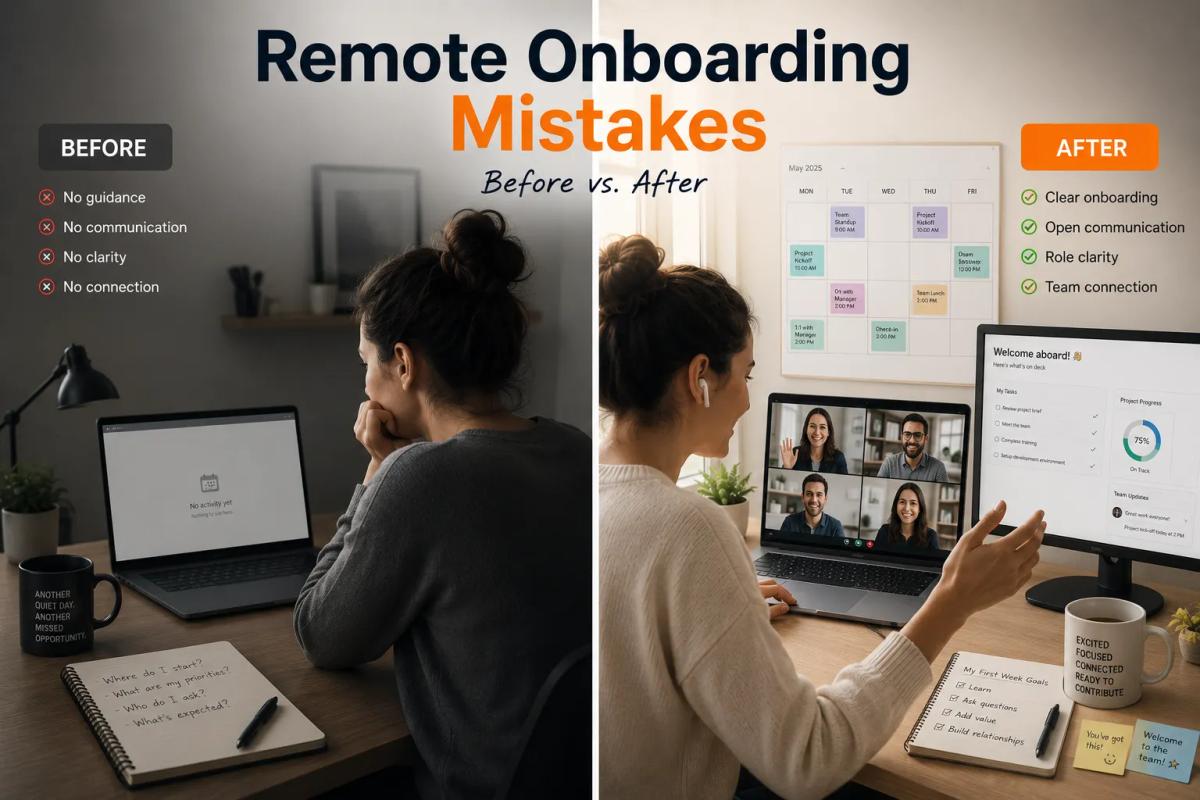
Mistake 3: Overloading New Hires With Information in the First Week
Counterintuitively, one of the most common remote onboarding mistakes is not neglect but excess. Managers and HR teams, aware that a remote hire cannot pick things up by osmosis, overcorrect by front-loading every policy document, tool tutorial, and company overview into the first five days. The new hire spends the week absorbing information but doing no actual work, and leaves the week feeling simultaneously overwhelmed and underutilized.
Research from Enboarder's 2025 HR Leader Survey found that 44.8% of organizations provide only general guidelines for a 30/60/90-day plan and leave the execution to managers, which frequently means that either nothing is delivered or everything is delivered at once with no sequencing. Neither produces a confident, productive new hire.
What to do instead: Sequence information delivery across the full onboarding period. Week One should cover the essential context needed to begin contributing: team structure, role expectations, key tools, and immediate priorities. Process documentation, extended product knowledge, and deeper company history can be staged across weeks two through eight. Introduce one major concept or system per week rather than all of them in the first 48 hours. Assign one real task in the first five days. An early win builds confidence faster than any amount of documentation.
Mistake 4: No Clear Goals or Success Metrics for the First 90 Days
Research from HR Cloud citing multiple studies found that 60% of companies fail to set clear goals during onboarding. Nearly 30% of HR leaders have seen a manager fail to provide a new hire with any guidance or training at all, according to Enboarder's 2025 survey. For remote hires who cannot observe how their colleagues interpret their role and cannot ask a quick clarifying question between meetings, unclear expectations are not just uncomfortable. They are a primary driver of early departure.
Enboarder's research found the top three reasons new hires leave in the first 90 days are: a misalignment between job expectations and reality (30.3%), a lack of connection with team or company culture (19.5%), and a poor onboarding experience (17.4%). The first reason alone accounts for nearly a third of all early exits, and it is entirely preventable with one document: a written 30/60/90-day plan with clear, specific milestones that is shared with the new hire before their start date.
What to do instead: Write the 30/60/90-day plan as part of the pre-boarding process, not after the hire starts. Include specific, measurable outcomes for each phase rather than vague objectives. Review the plan at each milestone in a formal one-on-one and adjust if role clarity or team context has shifted the priorities.
(CTA 2: Place here as a text CTA: "All Talentz relationship managers monitor every placement proactively, which means your remote professional has clear performance milestones, regular check-ins, and structured support throughout the onboarding period and beyond. Contact All Talentz to learn how the model works in practice.
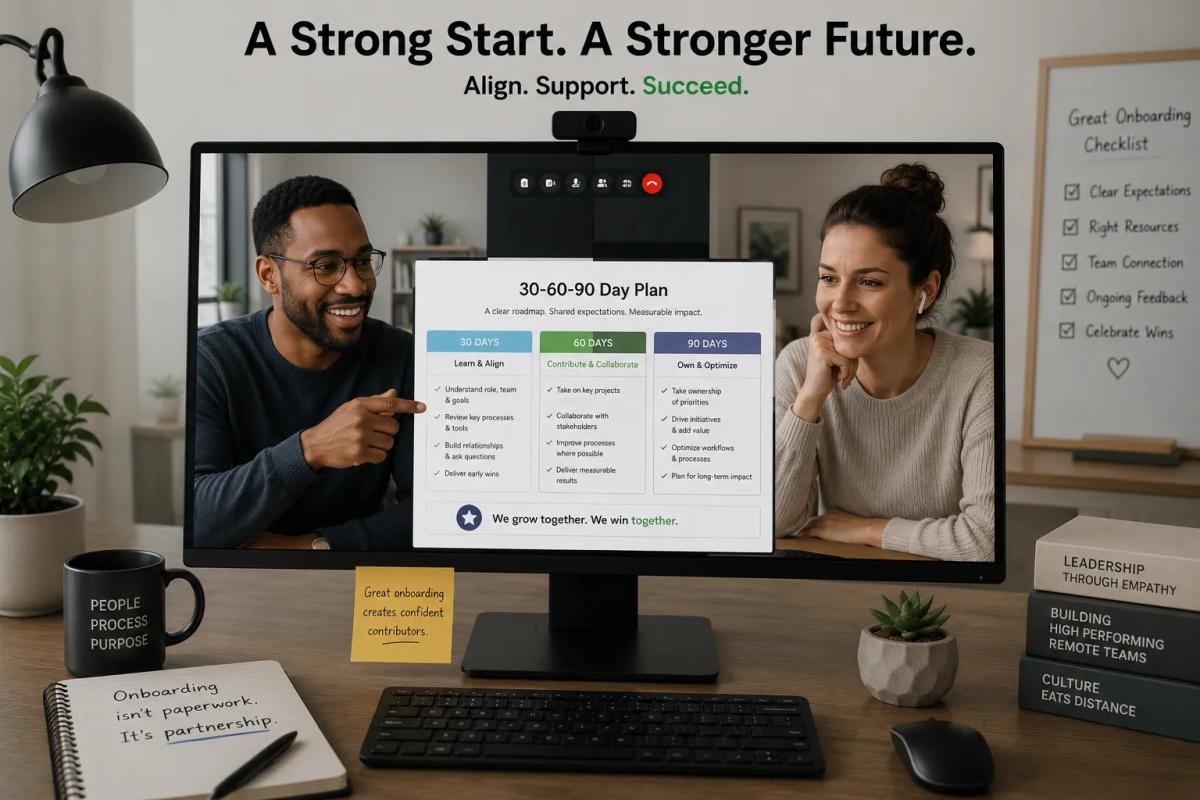
Mistake 5: Declaring Onboarding Complete After the First Month
Only 11% of onboarding programs last three months or longer, despite research consistently showing that new hires require 8 to 12 months to reach full productivity, according to SHRM data. Most companies consider onboarding done after the first week of orientation or, at most, the first month of check-ins. For remote employees who are building context and relationships more slowly than in-office peers, cutting off structured support after 30 days is one of the remote onboarding mistakes with the most direct impact on the 90-day retention cliff.
Enboarder's 2025 research found that 86% of new hires decide how long they will stay with a company within their first six months. The decision is not made on Day One. It accumulates across a series of experiences, conversations, and signals that tell the new hire whether the company values their growth or considers them "figured out" after a few weeks of orientation.
What to do instead: Build a minimum 90-day onboarding structure with formal touchpoints at the 30, 60, and 90-day marks. At each touchpoint, cover four things: what is going well, what feels unclear or unsupported, whether the role matches what was described in hiring, and what the next 30 days should focus on. After 90 days, transition to a monthly check-in cadence rather than eliminating structured support entirely. Companies that gather feedback at 30, 60, and 90-day intervals see 91% improvement in new hire relationship quality, according to research compiled by Apollo Technical.
Mistake 6: Assuming the Onboarding Process for In-Office Hires Translates Directly to Remote Hires
The final and perhaps most foundational of all remote onboarding mistakes is treating remote onboarding as simply a virtual version of in-office onboarding. Research from Paychex found that 36% of remote workers find onboarding confusing, compared to 32% of on-site employees. That gap reflects the structural difference between the two experiences: in-office onboarding benefits from ambient context that remote onboarding must replicate deliberately.
Remote hires cannot absorb culture by watching how people interact in a meeting room. They cannot read the room in a hallway conversation. They cannot observe how fast or slow the team actually works versus how it is described in a handbook. Every piece of context that an in-office new hire picks up organically must be explicitly designed into the remote onboarding experience, or it does not arrive at all.
What to do instead: Audit your current onboarding process and identify every element that relies on physical presence, then design a remote-specific alternative for each. Culture orientation should include recordings of real team meetings, not just written culture documents. Manager access should include a standing daily or every-other-day 15-minute check-in during the first two weeks, not just a weekly one-on-one. Tool walkthroughs should be live and recorded, not just written guides. And the 90-day structure described above should be treated as non-negotiable, not optional.
For a complete walkthrough of building a remote onboarding process that addresses each of these gaps, see our post on the remote employee onboarding checklist.
Why Onboarding Gets Easier When the Talent Comes Pre-Vetted and Managed
One reason remote onboarding mistakes are so persistent is that most businesses are handling both problems at once: finding and evaluating talent AND onboarding them into the business. When the placement itself is uncertain, the onboarding process absorbs extra weight: the manager is still assessing whether the hire was the right choice while simultaneously trying to integrate them.
The All Talentz model separates those two problems. Every professional placed through All Talentz is pre-vetted and pre-trained before the placement is made. By the time they join your team, the question of whether they are the right skill fit has already been answered. That means your onboarding energy can go entirely toward integration, context-building, and relationship development, rather than basic competency verification.
Beyond the placement itself, every All Talentz professional is supported by a dedicated relationship manager who monitors performance, conducts structured check-ins, and flags concerns early. That relationship manager layer handles much of the 30/60/90-day oversight described above on your behalf, so the structured support that most businesses deprioritize or abandon is built into the model from Day One.
And if a placement is ever not working out for any reason, the replacement happens immediately. No re-running a search, no restarting the onboarding process from scratch.
All Talentz places talent across six industries with pre-vetted professionals ready to integrate into your team:
Our tech talent services place software developers, AI/ML specialists, UI/UX designers, data annotators, and QA engineers.
Our healthcare talent services place medical billing specialists and healthcare support professionals.
Our finance talent services place accounts receivable specialists, financial analysts, payroll specialists, and bookkeepers.
Our remediation talent services place estimators and operations professionals for restoration businesses.
Our legal talent services place legal researchers, paralegals, and legal receptionists for law firms.
Our pest control talent services place CSRs, accountants, and sales support professionals for pest control operations.
For a broader look at how businesses are approaching the remote staffing model and what to look for in a talent partner, see our post on what a dedicated remote staffing company does differently.
Conclusion
Remote onboarding mistakes are costing businesses far more than they realize: failed hires at $25,000 to $50,000 per occurrence, early turnover rates that can run to 30% within the first 90 days, and the quieter ongoing cost of engaged talent who disengage instead of quit because their first experience told them the company was not organized enough to care. The good news is that every mistake on this list is fixable, and none of them requires a large budget or a dedicated HR team to address. They require structure, sequence, and deliberate attention to the fact that a remote hire's integration does not happen by accident. It has to be designed.
If you want to remove the onboarding problem at the source by starting with pre-vetted, pre-trained talent that arrives ready to contribute and is supported by a management layer that runs in parallel with your own, All Talentz can have the right professional placed with your business in as little as seven days.
The most consistent remote onboarding mistakes are: no pre-boarding before Day One, treating orientation as a substitute for a full 90-day onboarding program, skipping deliberate social integration for remote hires, overloading new hires with information in the first week without sequencing it, setting no clear 30/60/90-day goals, and assuming that an in-office onboarding process translates directly to a remote one without redesigning it for the virtual environment.
Research from Enboarder's 2025 HR Leader Survey puts the cost of a failed new hire at $25,000 to $50,000 depending on seniority. Brandon Hall Group research puts replacement cost at 50% to 200% of the employee's annual salary when total turnover costs are included. For a business losing multiple new hires in the first 90 days, the annual cost can reach six figures before the pattern is recognized and addressed.
Research from SHRM and Brandon Hall Group consistently shows that new hires take 8 to 12 months to reach full productivity. Structured onboarding programs of 90 days or longer improve new hire retention by 82% and productivity by 70%, according to Brandon Hall Group data. The minimum effective onboarding program includes formal touchpoints at 30, 60, and 90 days, with a transition to monthly structured check-ins afterward rather than eliminating support entirely.
Remote employees lack the ambient context, spontaneous relationship-building, and environmental cues that help in-office employees absorb culture and expectations naturally. When those elements are absent and not replaced deliberately, remote hires operate in isolation with unclear expectations and limited social connection, conditions that accelerate the decision to leave. Research from Paychex found that remote employees are 117% more likely than on-site employees to plan to leave.
Research consistently points to two high-impact interventions: starting onboarding before Day One through pre-boarding, and implementing a structured 30/60/90-day plan with formal check-ins at each milestone. Individually, each of these interventions improves retention outcomes measurably. Combined, they address both the logistical gaps (equipment, access, information) and the human gaps (expectations, connection, feedback) that drive early remote hire attrition.
All Talentz removes the competency-verification burden from onboarding by pre-vetting every professional before placement, so your onboarding energy goes entirely toward integration rather than assessment. Every All Talentz placement is also supported by a dedicated relationship manager who provides the 30/60/90-day oversight, proactive check-ins, and performance monitoring that most businesses deprioritize. Replacements are immediate if a placement is ever not the right fit, removing the re-search and re-onboarding cost entirely.