
The technology talent market is not simply competitive. It is structurally broken for businesses trying to hire through traditional channels. The average time to hire a software developer has stretched to 95 days, up from 65 days in 2025, according to data cited by the daily.dev recruiting resource center. During that same period, offer acceptance rates have dropped from 73% to 51%, meaning nearly half of all offers extended after a months-long search are rejected. Top developers are off the market in as few as 10 days. A hiring process that takes three months to produce an offer is, in practice, producing offers to candidates who have already accepted other roles. For businesses that need to hire remote tech talent to keep their projects moving, the traditional tech recruiting process is not just slow. It is functionally unreliable.
The approach that is working for growing businesses across the US, Canada, and Europe is not running a better version of the same search. It is using a dedicated remote talent partner that pre-vets technology professionals before any client conversation starts, matches them to the specific role and stack the business needs, and places them in days rather than months. For a broad look at how the tech recruiting landscape is structured and which companies operate within it, our earlier post on tech recruiting companies for US employers covers the full market context. This post focuses specifically on the faster, pre-vetted dedicated model and why it outperforms a traditional 95-day search for businesses that need technology talent placed and productive quickly.
Why the Tech Talent Market Makes It So Hard to Hire Remote Tech Talent
The difficulty of the current technology hiring environment is not a cyclical slowdown. It is a structural mismatch between supply and demand that has been building for over a decade and is now at its most acute.
The Bureau of Labor Statistics forecasts software developer employment growing 15% from 2024 to 2034, at twice the average rate for all US occupations. By 2026, the developer shortage in the United States is projected to exceed 1.2 million unfilled positions, according to BLS data cited by multiple industry research sources including Grid Dynamics and Tecla. US employers posted nearly 1.1 million technology and IT jobs in 2025 alone, with AI, ML, and data science roles growing 163% year over year and security roles growing 124%, according to Robert Half's 2026 technology job market analysis.
The IT skills shortage is expected to cause $5.5 trillion in losses globally by 2026, according to an IDC survey of North American IT leaders. 87% of tech leaders already report challenges finding skilled workers, according to Robert Half's 2026 research. And 60% of businesses name the IT skills gap as the number one barrier to digital transformation, according to data compiled by Tecla from multiple industry sources.
Against that backdrop, a 95-day average hiring timeline for tech roles is not just inconvenient. It represents approximately 95 days of delayed project delivery, 95 days of work absorbed by existing team members who were not hired to cover that role, and 95 days of opportunity cost that compounds directly against the business's competitive position. For businesses that need to hire remote tech talent to maintain development velocity, this is one of the most operationally expensive problems in their operation.
Facing a tech talent gap right now? Request Remote Tech Talent from All Talentz and get a pre-vetted specialist placed with your team in as little as 7 days.
Tech Roles Best Suited to the Hire Remote Tech Talent Model
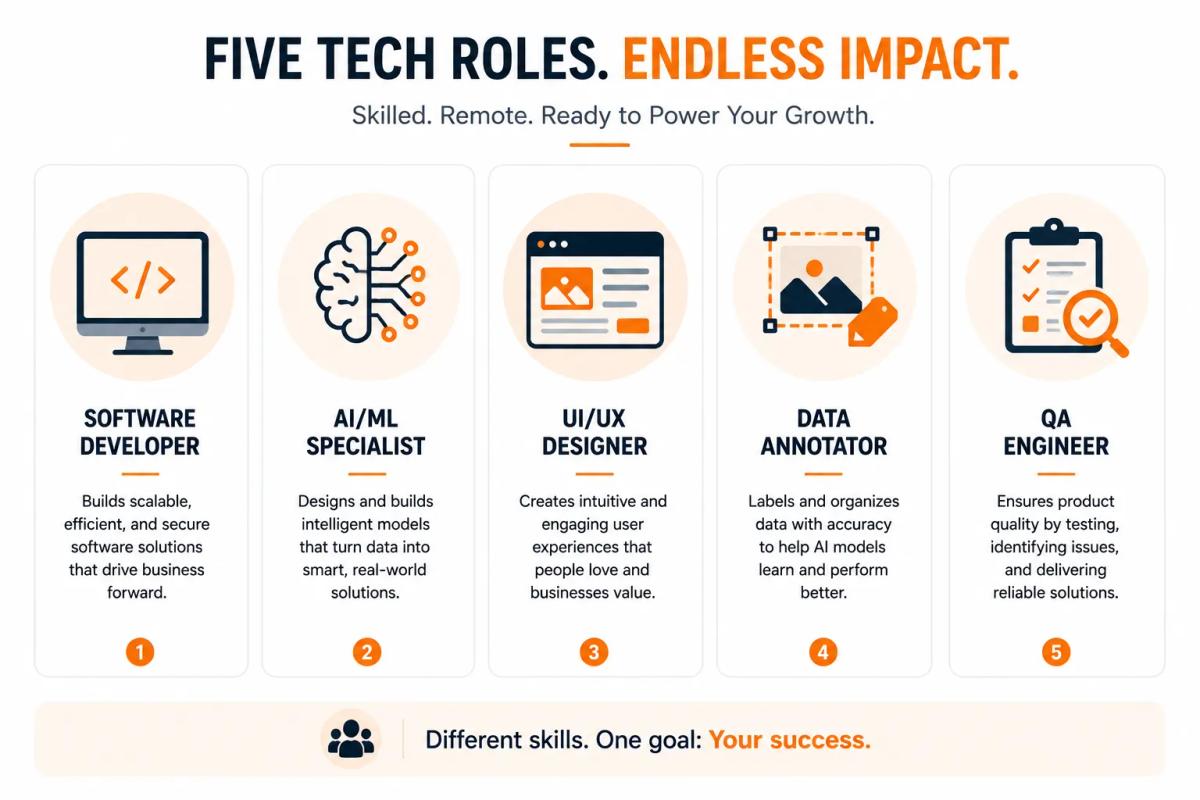
Not all technology roles carry the same urgency or the same remote-delivery viability. These are the positions where the dedicated remote talent model delivers the clearest value, based on 2026 demand data and the nature of the work itself.
Software Developers and Engineers
Software development roles account for the largest share of unfilled tech positions in the US market. The median annual salary for a US software developer reached $110,140 in 2024, according to BLS data, and competition for senior developers has pushed compensation significantly higher than that benchmark in specialized disciplines. When you hire remote tech talent for development roles through a pre-vetted model, you access developers who have already cleared skills assessments before the match is made, which removes the technical screening stage that accounts for a significant portion of the 95-day hiring timeline.
AI and ML Specialists
AI and ML engineer roles represent the single sharpest demand spike in the 2026 tech market. Robert Half found that AI, ML, and data science job postings grew 163% in 2025 year over year. The AI skills shortage is affecting 51% of business leaders across industries, according to data from Tecla citing Nash Squared research. Demand for AI engineers is running approximately three times higher than available supply, according to research cited by daily.dev. For businesses trying to build AI capabilities in 2026, the supply gap makes a traditional search almost impossible to execute within a useful timeframe.
UI/UX Designers
Design roles are frequently misclassified as lower priority than engineering roles, but a product that engineers well and communicates poorly does not retain users. UI/UX designers working on product interfaces, design systems, and user research are consistently listed among the in-demand tech support roles that businesses struggle to fill. The work is fully deliverable remotely and measurable in clear output milestones.
Data Annotators
AI and ML model training requires large volumes of accurately annotated data. Data annotation is a high-volume, specialist function that scales up and down with AI development cycles, making the dedicated remote talent model particularly well-suited to this role. A pre-vetted data annotator placed exclusively with your business builds familiarity with your labeling standards and quality requirements over time, which significantly improves annotation accuracy compared to rotating freelance or crowdsourced annotation.
QA Engineers and Testers
Quality assurance engineering is one of the most consistently understaffed disciplines in tech operations. When a business is under delivery pressure, QA is frequently the function that gets resources pulled. A dedicated remote QA engineer maintains testing coverage without competing with developer headcount for budget priority.
The Cost of the 95-Day Search vs. the Pre-Vetted Remote Model
The financial case for choosing to hire remote tech talent through a dedicated pre-vetted model rather than a traditional tech recruiting process becomes clear once the full cost of the 95-day search is on the table.
Cost of the 95-day traditional search:
Lost delivery value: 95 days of delayed feature delivery, bug resolution, or AI deployment represents real competitive cost. For a business running a product team, a vacant senior developer role for three months can delay a product cycle and push a launch past a market window.
Recruitment spend: The average cost per hire across all roles is $5,475 according to SHRM 2025 benchmarking data, and technology roles typically run significantly higher due to the specialized technical screening required. Executive search and specialized tech recruiter fees commonly run 15% to 25% of first-year salary.
Offer rejection cost: With a 51% offer acceptance rate in 2026, a business that successfully navigates a 95-day search still has approximately a 50% chance of the offer being rejected and restarting the search from scratch. The true expected timeline for a successful tech hire in the current market is often 150 days or longer when offer rejection is factored in.
Salary benchmarks: CompTIA data found the median wage for US tech workers is 127% higher than the national median wage. A mid-level software developer commands a starting salary between $90,000 and $130,000 nationally depending on specialization. Add employer overhead and the full first-year cost of a mid-range developer in-house typically exceeds $130,000 to $160,000 before a line of code is written.
The pre-vetted remote model:
When a business chooses to hire remote tech talent through a full talent partner like All Talentz, the timeline compresses to as little as seven days, the recruitment overhead is removed, the employment infrastructure is managed on the talent partner's side, and the professional placed is already screened for the specific technical skills the role requires. For a senior developer role where the alternative is a three-to-six-month search with a 50% offer acceptance rate, the speed and reliability advantage of the pre-vetted model is not marginal. It is the difference between a project that ships this quarter and one that does not.
For a broader look at how this cost comparison plays out across business functions beyond tech, see our post on in-house hiring vs outsourcing remote talent.
Want to see what a pre-vetted remote tech placement looks like for your specific stack and role? Contact All Talentz and talk to our team about your open tech positions.
Industries That Benefit Most When They Hire Remote Tech Talent
Technology talent requirements cut across every industry in 2026. The businesses feeling the shortage most acutely are those where technology is not just an enabler but a core operational dependency. All Talentz places remote tech professionals across six industries, each with its own technology demands.
Tech companies have the most acute need to hire remote tech talent, particularly for AI/ML roles, senior software engineers, and specialized cloud and security professionals. With 93% of tech and IT leaders saying staffing firms have been effective at helping them with AI-related hiring challenges, according to Robert Half 2026 research, the case for using a specialized talent partner rather than a solo hiring effort is well-established. Our tech talent services place software developers, AI/ML specialists, UI/UX designers, data annotators, and QA professionals.
Healthcare businesses are increasingly technology-dependent, with EHR systems, patient portal platforms, billing automation, and telehealth infrastructure all requiring active development and maintenance. Our healthcare talent services include technology professionals alongside billing and clinical support staff.
Finance companies, including fintech platforms, lending businesses, and advisory firms, operate in a technology environment where security, compliance, and performance are non-negotiable requirements. The need for developers who understand regulatory coding environments makes pre-vetting even more important. Our finance talent services cover both technology and accounting functions.
Restoration companies increasingly use project management platforms, estimating software, and customer communication tools that require ongoing technical support and integration work. Our remediation talent services include tech support professionals alongside estimators and operations staff.
Legal firms use case management platforms, document automation tools, and AI-assisted legal research systems that require technical setup, maintenance, and integration expertise. Our legal talent services include tech support alongside paralegals and legal researchers.
Pest Control businesses use routing software, CRM platforms, and online booking systems that need ongoing technical management and troubleshooting. Our pest control talent services cover technology, CSR, and accounting functions.
For more on how remote professionals integrate into business operations across sectors, see our post on remote employee onboarding best practices.
What to Confirm Before You Hire Remote Tech Talent Through Any Partner
With the phrase "hire remote tech talent" generating a significant volume of platform, marketplace, and recruiting agency options, these are the specific criteria that separate a placement that delivers from one that extends the delay.
Pre-vetting that covers technical skills specifically. A general skills assessment that covers communication and professionalism is not the same as a technical screen that validates proficiency in the specific languages, frameworks, and tools the role requires. Ask explicitly what the vetting process covers and what technical assessment methodology is used.
Exclusive assignment to your business. A developer juggling work for three clients simultaneously cannot give your codebase the focus, context accumulation, or accountability that a dedicated in-house hire would deliver. Confirm that any professional placed with your business is working exclusively for your team.
Stack and tool fit verified before placement. A developer who is strong in Python but your platform runs on Node.js is not a match. Require that the talent partner confirms stack-specific compatibility before presenting any candidate.
Speed of placement backed by actual process. A partner who claims seven-day placement but has no pre-built talent network to draw from cannot honor that claim consistently. Ask specifically how many pre-vetted professionals in the relevant technical discipline are currently available in their network.
Management support that continues after placement. The months of a technology professional's ramp are when most placement failures occur. A partner who steps back after Day One leaves your team managing that ramp without support. Look for a named relationship manager who monitors performance and checks in proactively throughout the engagement.
The Bureau of Labor Statistics Occupational Outlook Handbook provides authoritative projections for technology occupations through 2034 that are useful for businesses planning their technology hiring strategy.
The CompTIA State of the Tech Workforce 2025 report also provides detailed data on in-demand skills, salary benchmarks, and hiring trends by technology specialty that inform good hiring decisions.
How All Talentz Works When You Hire Remote Tech Talent Through Us
All Talentz is a full talent partner, not a job board, a freelance marketplace, or a traditional tech recruiting firm. The difference is operational from the first conversation.
When you come to All Talentz to hire remote tech talent, every technology professional we match to your business has already cleared a multi-stage assessment covering technical skills in the relevant discipline, communication structure for remote and asynchronous workflows, tool proficiency for the platforms your team uses, and role-fit against the specific responsibilities you need covered. You do not receive a stack of resumes. You receive a matched professional who is ready to integrate with your team.
Here is what the model delivers in practice.
Placement in as little as 7 days. While the 2026 average tech hire takes 95 days, most All Talentz technology placements are operational within a week. The speed difference comes from the pre-vetting that happens before your requirement arrives, not after.
Work tools and equipment provided. Every technology professional we place is fully equipped by All Talentz. The professional arrives ready to access your systems and begin contributing without you provisioning hardware first.
Health insurance and employment managed on our side. All Talentz handles the full employment relationship, including health benefits and compliance. You access the development or AI expertise without carrying the direct employer overhead.
A dedicated relationship manager assigned to every placement. One of our relationship managers actively monitors your tech professional's performance, conducts regular check-ins, and flags any delivery concerns before they affect your project timeline. You are not managing the management layer yourself.
Immediate replacement guarantee. If a tech placement is not delivering the right output or fit for your team, we replace immediately. No delay, no penalty, and no restarting a 95-day search from the beginning.
Conclusion
The 2026 tech talent market has made the traditional hiring playbook operationally unworkable for most businesses across the US, Canada, and Europe: 95-day timelines, 51% offer acceptance rates, and a 1.2-million-developer shortage that pushes every search into direct competition with hundreds of other businesses chasing the same scarce pool. The businesses that are maintaining technology velocity in this environment are not running better traditional searches. They are choosing to hire remote tech talent through a pre-vetted, dedicated model that bypasses the search entirely and puts a matched, work-ready professional in place within a week. All Talentz places pre-vetted software developers, AI and ML specialists, UI/UX designers, data annotators, and QA engineers across six industries, with placements starting in as little as seven days and full employment infrastructure managed on our side.
The US is facing a developer shortage projected to exceed 1.2 million unfilled positions by the end of 2026, according to Bureau of Labor Statistics data. Average time to hire for technology roles has stretched to 95 days, and offer acceptance rates have dropped to 51%. The shortage is most acute in AI and ML, cybersecurity, and senior software development roles, where demand is growing two to three times faster than available supply.
All Talentz places software developers, AI and ML specialists, UI/UX designers, data annotators, and QA engineers, among other technology roles. Every professional is pre-vetted and pre-trained before placement, with technical skills assessed for the specific disciplines and tools the client business uses.
A tech recruiting company searches for and presents candidates, with the business then running its own technical interviews, assessments, and onboarding. All Talentz completes the technical vetting before the client conversation starts. The business receives a matched, pre-cleared professional rather than a shortlist to interview, which is what compresses the timeline from 95 days to as little as 7 days.
Most technology placements through All Talentz are operational within 7 days. Because every professional in our network is pre-vetted and ready before any client requirement arrives, the match-and-place process is fast rather than the search-and-screen cycle that drives the 95-day industry average.
All Talentz provides an immediate replacement guarantee. If a technology placement is not delivering the right output or fit for your team, we replace the professional promptly, with no delay, no penalty, and no need to restart a search from scratch. Our dedicated relationship manager monitors performance throughout the engagement and flags concerns early.
Yes. Every professional placed through All Talentz is exclusively assigned to one client business. They are not shared across multiple client accounts or working for competing teams simultaneously. Exclusive assignment is how the professional builds the codebase familiarity, product context, and team workflow knowledge that makes a placement genuinely productive over time.
All Talentz places remote technology professionals across Tech, Healthcare, Finance, Restoration, Legal, and Pest Control industries. Each industry has a dedicated service page on alltalentz.com with detail on the specific roles and technology disciplines we support in that sector.