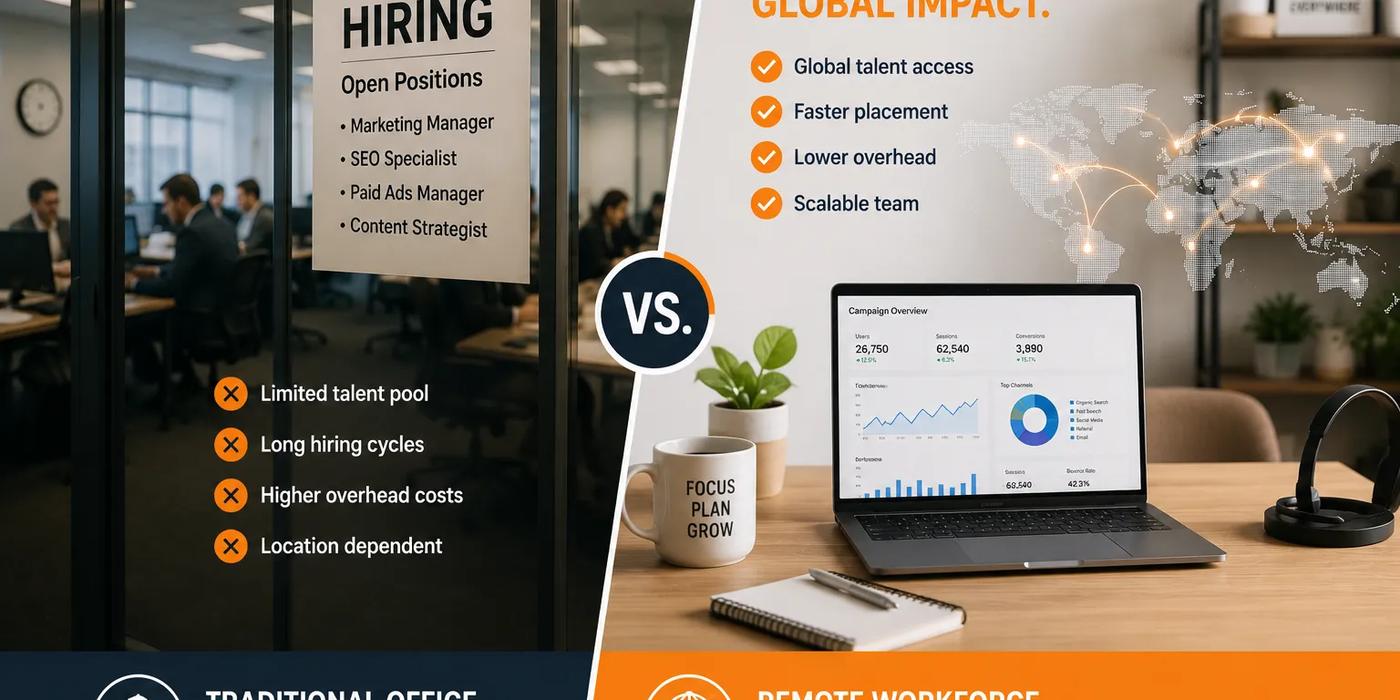
Most businesses approach the in-house hiring vs outsourcing question as a cost problem: which option is cheaper? That framing is too narrow, and it leads to decisions that look sensible on a spreadsheet but fall apart in execution. The real question is not just which option costs less upfront. It is which option gets qualified talent into your operation faster, keeps it there longer, and lets your leadership team focus on the work that actually drives growth. The 2026 data makes that answer increasingly clear, and it is not what the instinct to build an in-house team would suggest.
If you are working through the broader strategic framing of this decision, our earlier post on in-house vs outsourcing and making the right choice for your business covers the foundational considerations in depth. This post focuses on the data layer: what current research actually shows about costs, speed, talent availability, and outcomes when you put in-house hiring vs outsourcing side by side.
What the 2026 Data Says About In-House Hiring vs Outsourcing
The shift in how businesses think about in-house hiring vs outsourcing has been building for years, but the data from 2026 makes the trend impossible to ignore.
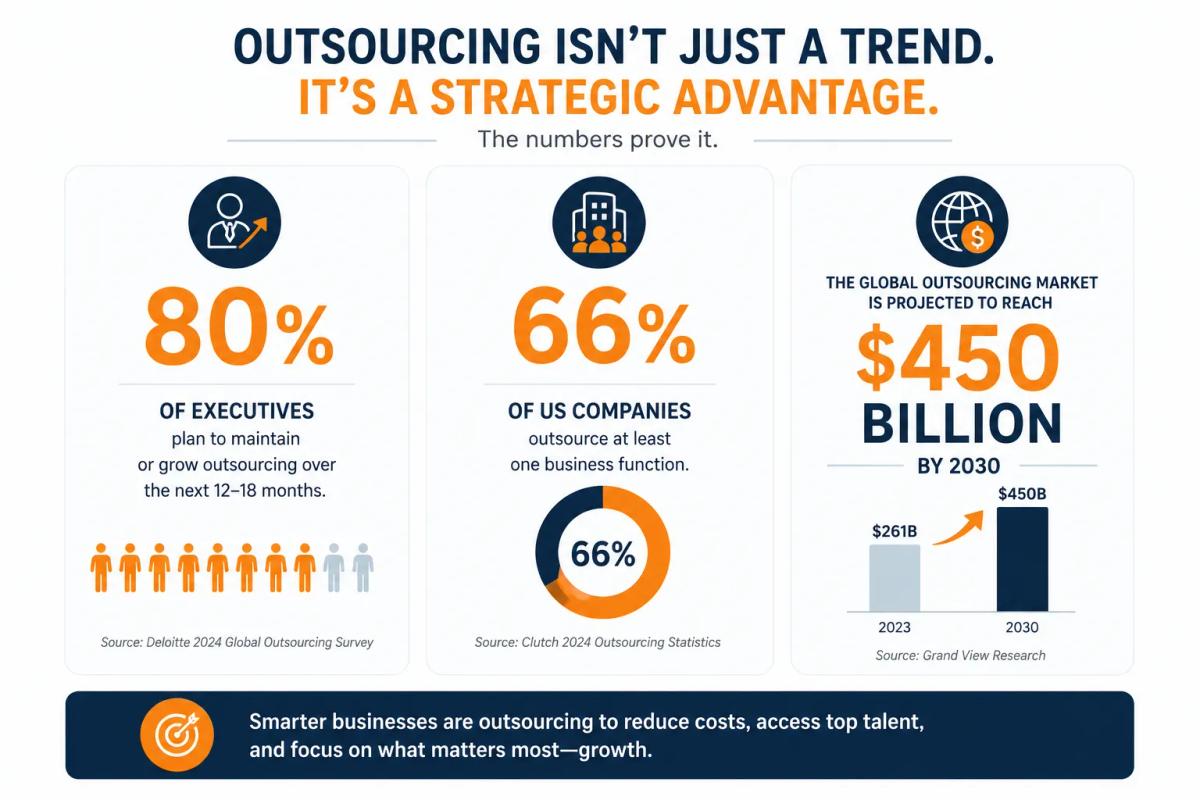
According to Deloitte's Global Outsourcing Survey, 80% of executives say they plan to maintain or increase their investment in third-party outsourcing. Notably, the reasons for that choice have shifted: cost reduction as the primary driver fell from 70% of executives in 2020 to just 34% in 2024. What replaced it? Access to specialized talent, digital capabilities, and operational flexibility. Businesses are no longer outsourcing simply to save money. They are outsourcing because they cannot find or retain the talent they need through in-house hiring alone.
That finding is reinforced by a 2025 ManpowerGroup study, which found that 74% of employers say they struggle to find the skilled talent they need. Meanwhile, more than half of small businesses in the United States now outsource at least one key function, according to Forbes, and 66% of US companies report outsourcing in at least one department.
The global outsourcing market reflects this demand: it is projected to reach $450 billion by the end of 2026 at a steady 5.1% compound annual growth rate, with the broader BPO market projected to reach $695.77 billion by 2033, according to Grand View Research data cited by Digital Minds BPO.
These are not numbers that describe a niche workaround. They describe a mainstream business strategy that the majority of US companies are already using, with adoption accelerating.
The True Cost of In-House Hiring vs Outsourcing
The cost comparison in in-house hiring vs outsourcing is almost always wider than businesses expect, because most calculations only count salary. Once the full picture is on the table, the gap becomes significant.
The Real Cost of In-House Hiring
A full-time in-house hire carries costs that extend well beyond the base salary line. For a mid-level specialist role, the full-cost breakdown typically includes:
Base salary: varies widely by role and location, but national benchmarks for common business roles run from $50,000 to over $90,000 annually for experienced professionals (Robert Half 2026 Salary Guide).
Employer payroll taxes: approximately 7.65% of base salary in FICA contributions alone, plus state unemployment tax.
Health insurance: employer contributions to group health plans average $6,000 to $10,000 per employee per year depending on plan type and company size.
Equipment and software: upfront provisioning of hardware and licensed software typically runs $2,000 to $5,000 per new hire, with ongoing renewal costs.
Onboarding and training: estimates for onboarding cost, including management time, documentation, and productivity lag during ramp-up, typically range from $1,000 to $5,000 per hire depending on role complexity.
Recruitment cost: the average cost to hire a new employee in the United States runs between $4,000 and $7,000 per placement according to SHRM data, covering job advertising, interviewing time, and recruiter fees where applicable.
Time to hire: in the current talent market, with 74% of employers struggling to find skilled candidates, a competitive search for a qualified specialist can take 8 to 12 weeks. Every week a role sits open is a week of either understaffed operations or overloaded existing team members absorbing tasks they were not hired to do.
The Cost When You Outsource Remote Talent
When businesses outsource remote talent through a full talent-partner model, the cost structure changes significantly:
According to Statista data cited by multiple outsourcing research sources, companies save between 20% and 70% on operational costs when outsourcing to third-party vendors, depending on industry and service complexity. For roles like virtual assistants and administrative specialists, hiring a remote professional can save up to 78% in overhead and operating costs compared to a full-time local hire, according to research compiled by VA Masters citing Stanford and industry data.
In the in-house hiring vs outsourcing comparison, the outsourcing model removes recruitment cost, reduces benefits overhead, eliminates equipment provisioning, and compresses time-to-hire from months to days when the talent partner pre-vets and pre-trains professionals before placement.
Want to see what outsourcing a role looks like for your specific situation? Request Talent from All Talentz and get a pre-vetted remote professional matched to your business in as little as 7 days.
When In-House Hiring Wins and When Outsourcing Wins
The in-house hiring vs outsourcing decision is not a blanket answer that applies the same way to every role or every business. The data points toward a framework that helps identify which option is right for which situation.
When In-House Hiring Makes More Sense
In-house hiring tends to win when the role requires deep, real-time integration with proprietary products, systems, or company culture that cannot be transferred or documented externally. Senior leadership roles, roles involving highly sensitive strategic decisions, and roles where institutional knowledge accumulation is the primary value delivered over time often belong in-house.
In-house hiring also makes sense when the business has reached a scale where a specific function is so central to daily operations that having it owned internally becomes a competitive advantage that justifies the overhead.
When Outsourcing Remote Talent Makes More Sense
Outsourcing remote talent outperforms in-house hiring when:
The role is skills-based and process-driven, meaning quality is measurable and the professional can be effective working within your systems without physical co-location.
The business needs the role filled quickly and the talent market makes local sourcing slow and expensive.
The full employment overhead of an in-house hire does not match the scale of the need, meaning the business needs 80% of what a full-time hire delivers at 50% of the cost.
The role covers a function where specialized expertise is needed but not necessarily a specialized in-house team, such as finance, legal support, technology development, or administrative operations.
The business is scaling faster than its in-house hiring process can match.
This is precisely the operating range where All Talentz clients sit: growing businesses that need skilled professionals across specific functions, placed quickly, without the overhead and timeline of traditional in-house hiring.
In-House Hiring vs Outsourcing Across Key Business Functions
The in-house hiring vs outsourcing question plays out differently across different functions. Here is how it maps to the roles and industries All Talentz serves.
Technology
More than 72% of US tech companies outsource software development, testing, and infrastructure support, and outsourcing reduces engineering costs by up to 40%, according to outsourcing research compiled by VirtualLatinos and AbroadWorks. For businesses that need developers, AI and ML specialists, UI/UX designers, or data annotators, the in-house hiring vs outsourcing calculation heavily favors outsourcing unless the role involves core proprietary IP that must remain internal.
All Talentz places pre-vetted tech professionals through our tech talent services, including software developers, AI and ML specialists, UI/UX designers, and data annotators.
Healthcare
Healthcare businesses face a specific version of the in-house hiring vs outsourcing challenge: billing and revenue cycle roles require deep compliance knowledge, but the talent pool for experienced medical billing specialists is constrained locally. Outsourcing these roles remotely gives healthcare operators access to specialists who already know the billing environment without the cost and timeline of a local search.
All Talentz places medical billing specialists and healthcare support professionals through our healthcare talent services.
Finance and Accounting
Finance is identified by multiple outsourcing surveys as one of the most frequently outsourced business functions, alongside IT and payroll. IT services at 54%, finance at 44%, and payroll at 32% are the three most outsourced functions globally according to Invedus research citing industry data. For finance roles including accounts receivable, accounts payable, financial analysis, bookkeeping, and payroll management, the in-house hiring vs outsourcing data clearly favors the remote outsourcing model for businesses that do not need a full-time on-site team.
All Talentz places finance and accounting professionals through our finance talent services. For more detail on the finance-specific case, see our post on how to outsource finance talent for your business.
Restoration and Construction
Restoration businesses carry variable project loads, subcontractor billing complexity, and estimating demands that fluctuate with project pipeline. In-house hiring for these roles creates fixed overhead against variable revenue. Outsourcing remote estimators and finance operations talent gives restoration businesses the capacity they need during busy periods without locking in full-time employment costs.
All Talentz places estimators and operations professionals through our remediation talent services.
Legal
Legal practices deal with billing complexity, trust account management, and paralegal or legal research capacity that often fluctuates with caseload. The in-house hiring vs outsourcing decision for legal support roles increasingly favors remote outsourcing, particularly for legal research and paralegal functions that do not require physical court presence.
All Talentz places legal research and paralegal professionals through our legal talent services.
Pest Control
Pest control businesses deal with recurring service billing, CSR coverage, and multi-location administrative demands that strain small in-house teams. Outsourcing customer service and accounting roles remotely gives pest control operators the support capacity they need without the overhead of expanding a local team.
All Talentz places customer service representatives, accountants, and sales support professionals through our pest control talent services.
Not sure which roles to outsource first in your business? Contact All Talentz and talk to our team about which functions are the best fit for remote talent placement.
The Hybrid Model: Why In-House Hiring vs Outsourcing Is Often Not an Either/Or Choice
One of the most important findings from current outsourcing research is that the most effective businesses are not choosing exclusively between in-house hiring vs outsourcing. They are running hybrid models that put each approach where it performs best.
According to outsourcing research compiled by Digital Minds BPO citing Deloitte data, 80% of executives planned to keep or grow their third-party service relationships while simultaneously hiring internally for core strategic functions. The hybrid model blends in-house leadership and strategy ownership with outsourced specialist delivery for defined operational functions.
For a growing business, this often looks like keeping a small in-house operations lead who oversees delivery, while the actual delivery roles, finance, tech, legal support, administrative support, are filled through a remote outsourced talent model that can scale up or down without the friction of adding or removing full-time employees.
This approach also protects against the main risk of pure in-house hiring at scale: a single departure from a small team can create a critical gap that takes months to fill in the current talent market. A talent partner model with replacement guarantees removes that single-point-of-failure risk.
For more on how remote teams are structured in practice, our post on the benefits of hiring remote employees covers the operational and cultural case in depth.
How All Talentz Resolves the In-House Hiring vs Outsourcing Question
All Talentz operates as a full talent partner, not a traditional staffing agency or a job board. The distinction matters when you are weighing in-house hiring vs outsourcing, because the All Talentz model eliminates most of the friction that makes outsourcing feel risky.
Every professional in our network is pre-vetted, pre-trained, and ready to be assigned to your business before the match is ever made. You do not receive a stack of resumes and a panel of interviews. You receive a matched professional who has already cleared our assessment process and is ready to integrate with your team.
Here is what the model delivers in practice:
Placement in as little as 7 days. While in-house hiring in the current market takes 8 to 12 weeks on average, most All Talentz placements are operational inside a week. That speed gap alone changes the cost math significantly.
Work tools and equipment provided. The professional arrives ready to work. You do not provision hardware or configure software access from scratch before work can begin.
Health insurance and employment managed on our side. All Talentz handles the employment relationship, benefits, and compliance. You access the expertise without carrying the employer infrastructure.
A dedicated relationship manager. One of our relationship managers monitors your professional's performance, checks in proactively, and flags issues before they become disruptions. You are not managing the management layer alone.
Immediate replacement guarantee. If a placement is not the right fit, we replace immediately. No delay, no penalty, no restarting a search from the beginning.
This is the model that resolves the in-house hiring vs outsourcing tension for most growing businesses: the speed and expertise of outsourcing, delivered with the continuity and accountability of a dedicated professional.
Conclusion
The in-house hiring vs outsourcing debate has moved well past theory. The 2026 data shows that most US businesses are already using a blend of both, and the ones leaning further into remote outsourced talent are doing so not because of budget pressure alone but because in-house hiring is slower, more expensive, and less reliable in a market where 74% of employers cannot find the skilled talent they need locally. For growing businesses in technology, healthcare, finance, legal, restoration, and pest control, the case for outsourcing specialist roles remotely is stronger in 2026 than it has ever been.
All Talentz places pre-vetted, pre-trained remote professionals across all six of these industries, with placements starting in as little as seven days and full employment infrastructure handled entirely on our side.
What is the main difference between in-house hiring and outsourcing? In-house hiring means recruiting, employing, and managing a professional directly as part of your internal team, with all the associated salary, benefits, equipment, and overhead costs. Outsourcing means engaging an external talent partner to provide a pre-vetted professional who works within your business remotely, with the employment infrastructure managed by the partner. The core trade-off is control and integration on the in-house side versus speed, cost efficiency, and flexibility on the outsourcing side.
In most cases for specialist and operational roles, yes. Research compiled from Statista and Deloitte data shows businesses save between 20% and 70% on operational costs when outsourcing, depending on the role and industry. The savings come from reduced salary benchmarks, eliminated employer overhead, faster time-to-productivity, and the removal of recruitment costs and delays.
Roles that are skills-based, process-driven, and measurable in output are generally best suited to the outsourcing model. This includes finance and accounting roles, technology development, legal research, healthcare billing, administrative support, and customer service. Roles requiring deep daily integration with proprietary products or sensitive strategic decisions tend to be better suited to in-house hiring.
In-house hiring in the current talent market typically takes 8 to 12 weeks from job posting to a productive new hire. Outsourcing through a pre-vetting talent partner like All Talentz compresses that timeline to as little as 7 days, because the professional has already been assessed and trained before placement.
Yes, and this is the most common approach among growing businesses. The hybrid model keeps in-house leadership and core strategic functions internal while outsourcing specialist operational roles. According to Deloitte research, 80% of executives plan to maintain or grow third-party outsourcing even while also hiring internally.
With All Talentz, the answer is immediate replacement with no penalty and no restarting a full search process. This is one of the key operational advantages of the talent-partner model over in-house hiring, where a departure creates a gap that can take months to fill.
All Talentz places pre-vetted remote professionals across Tech, Healthcare, Finance, Restoration, Legal, and Pest Control. Each industry has a dedicated service page on alltalentz.com with detail on the specific roles we place in that sector.