
Two restoration companies receive the same call at 2 a.m. A pipe has burst, water is moving through a finished basement, and the homeowner is on the phone with their insurance company. Both send a crew. Both set up equipment. Both do good work. The difference shows up over the next few days, and it comes down to a single question: who writes the estimate, and when?
This post follows that one loss through two versions of the same company to show what a remote Xactimate estimator for restoration companies actually changes. It is not about better crews or better equipment. It is about where the paperwork lives and how quickly it moves. If you are also weighing broader estimating support for bids and projects, our post on outsourcing construction estimating covers that side of the business.
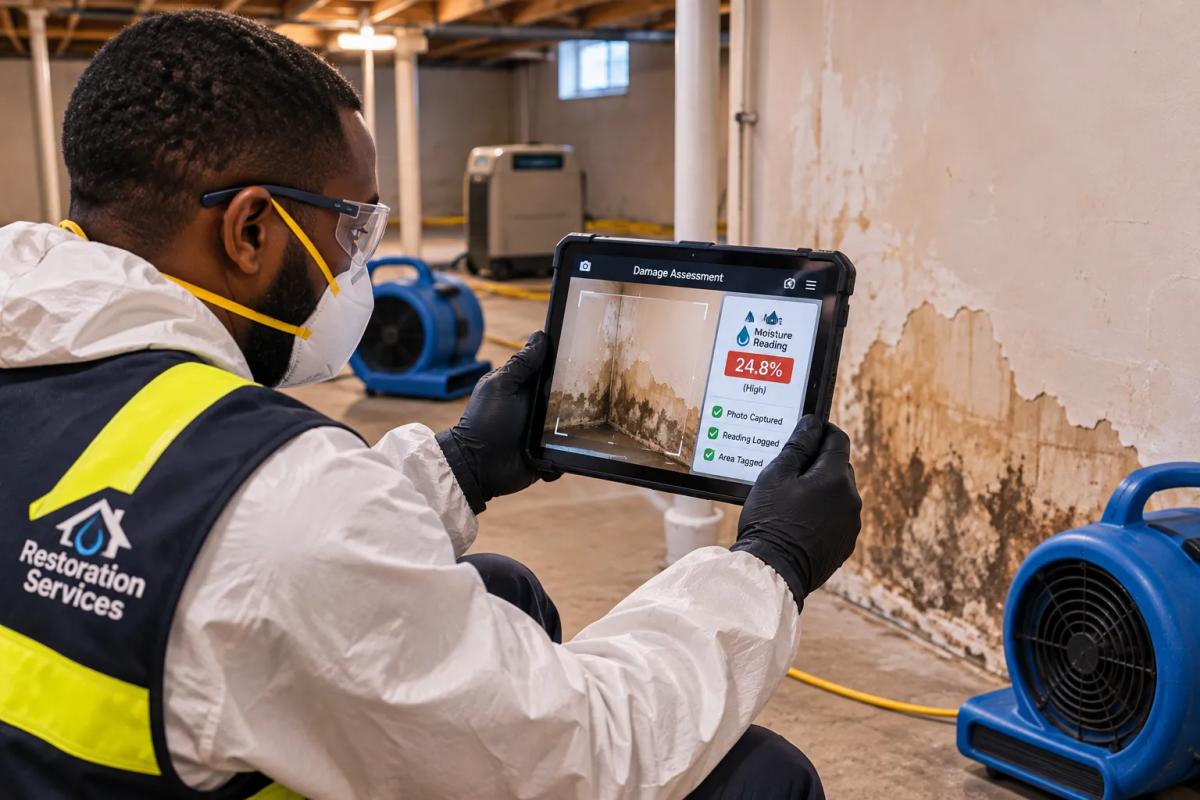
Company A: The Estimate Waits for the Estimator
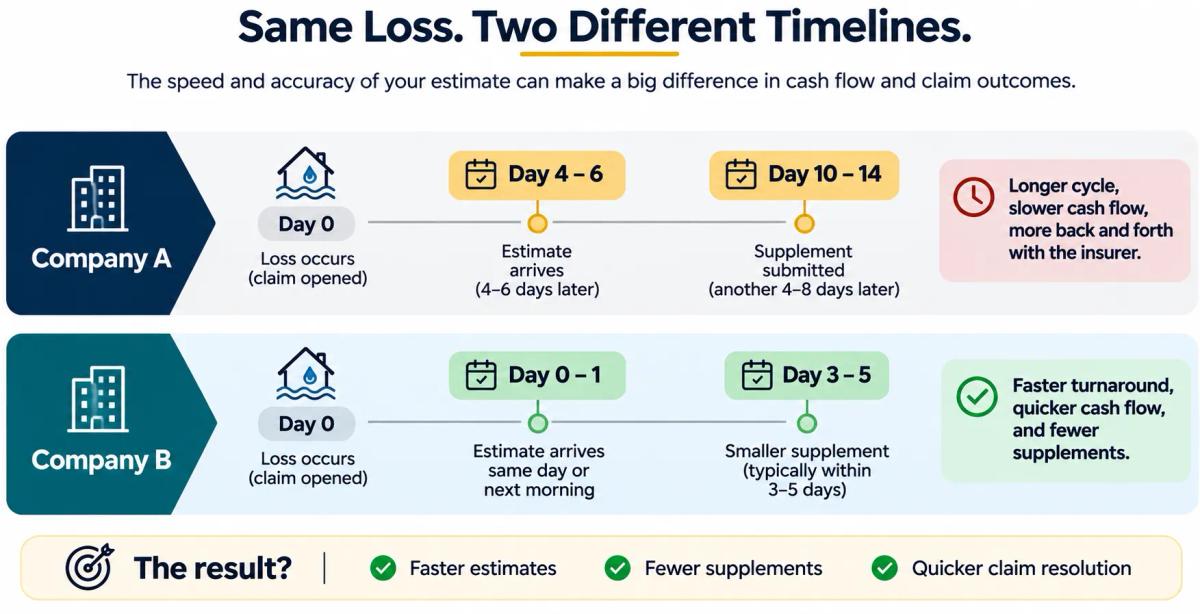
At Company A, one project manager runs several jobs at once. After the emergency work is done, they drive between sites, talk to adjusters and homeowners, and coordinate trades. The estimate for the basement sits in a queue behind two others.
The project manager writes it in the evening, from memory and a handful of photos. Line items are missed because the notes were thin. The adjuster, who is waiting, asks for more detail. A supplement is needed, and it is written days later. Cash flow slows because the company cannot bill until the scope is approved. Meanwhile the homeowner, who is living with the disruption, keeps calling for updates.
Nothing here is carelessness. It is capacity. The person best placed to write the estimate is also the person who is busiest managing the job.
Company B: The Estimate Is Written While the Crew Dries the Structure
Company B uses a dedicated remote estimator. While the crew is still on site, the technician uploads photos, a sketch or measurements, moisture readings, and notes into a shared folder. The estimator reviews them that morning, asks any quick questions, and builds the estimate in Xactimate, line by line, with the documentation to support each item.
The estimate reaches the adjuster fast, with fewer gaps, and the project manager never leaves the field. If the adjuster questions a line, the estimator already has the photo or reading to point to. The supplement, if one is needed, is smaller and faster. The company bills sooner, and the homeowner gets clear communication from the start.
The Restoration Industry Association and R&R Magazine have both discussed the growth of remote estimating in the industry. R&R's article on the rise of remote estimating describes how off-site estimators free project managers and estimators to focus on managing jobs, supporting customers, and coordinating trades.
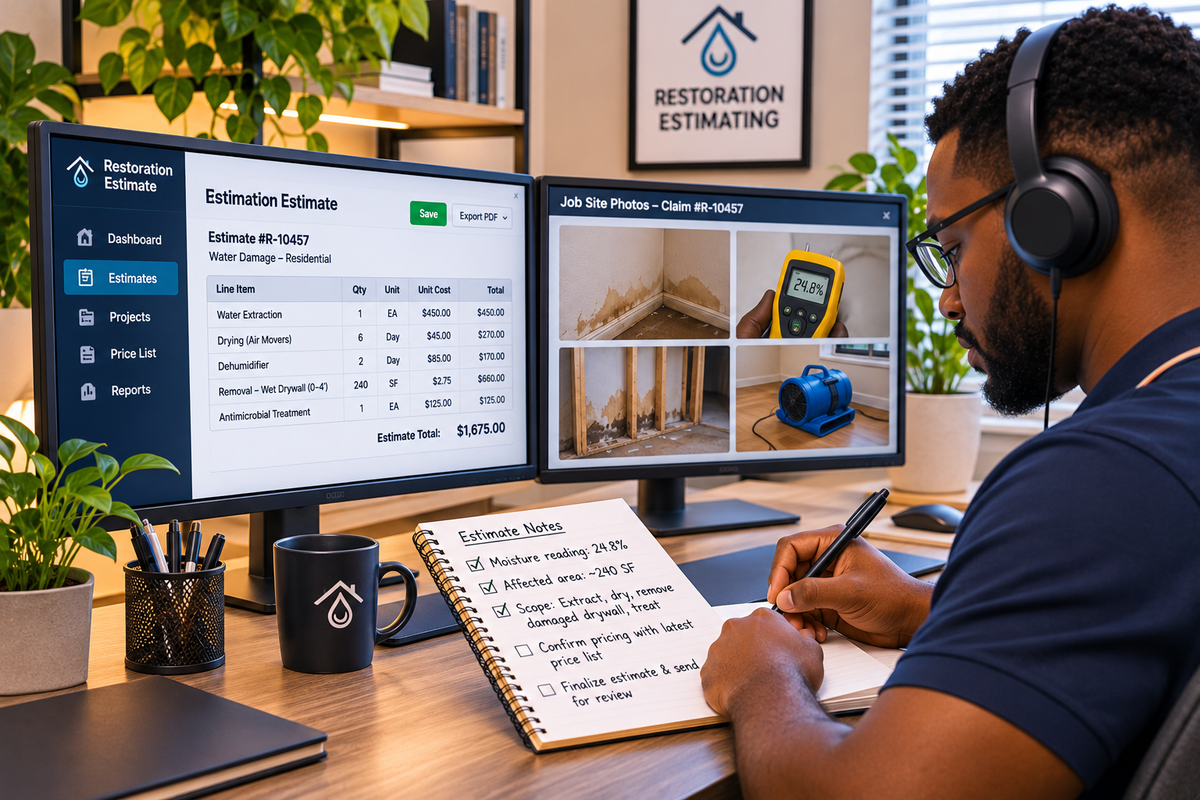
What a Remote Xactimate Estimator for Restoration Companies Needs From the Field
A remote estimator can only write what they can see. The quality of the estimate depends on the quality of the documentation the field team sends. That is why the handoff matters as much as the estimator.
Documentation Quality Decides Estimate Quality
Give your remote Xactimate estimator for restoration companies a simple, consistent package for every loss:
Photos with context. Wide shots of each room, close-ups of damage, and photos of materials and labels that affect scope.
Measurements or a sketch. Dimensions and room layouts that let the estimator build quantities accurately.
Moisture readings and equipment logs. Records of readings, equipment placed, and dates, which support drying line items and monitoring.
Scope notes. A short note from the technician about what was removed, what remains, and any conditions that affect cost.
Working to a recognized standard helps here. The Institute of Inspection, Cleaning and Restoration Certification publishes industry standards such as the S500 for water damage restoration, which many carriers and contractors use as a reference for what proper drying and documentation look like. An estimator who understands the standard writes scope that matches what your crews actually did.
Want an estimator who works from your photos and notes? Request Talent from All Talentz and have a vetted professional placed in less than 48 hours.
Where the Gains Show Up
The benefits of a dedicated remote estimator tend to appear in the same places across companies.
Speed to estimate. Estimates go out while the loss is still fresh, which keeps adjusters and homeowners informed.
Fewer missed line items. A person whose only job is writing estimates builds the habit of checking every room and every category.
Smaller, faster supplements. Better documentation up front means fewer disputes later.
Project manager time. Managers spend their days on jobs, trades, and customers instead of at a laptop.
Capacity during surges. Storms and freezes create bursts of work. A dedicated estimator gives you extra capacity without hiring locally for a peak that will pass.
Cost savings matter too, but they work best alongside quality. Restoration companies working with All Talentz can save up to 75% compared with equivalent local hiring costs, while getting estimators chosen for skill and consistency.
Loss Types a Remote Estimator Can Handle
A well-matched remote estimator can work across the main restoration categories, including water losses, fire and smoke, mold, contents, and reconstruction. In the US, Xactimate is the common language for insurer-referred losses, and many Canadian contractors who work with insurers use it as well. Confirm that the estimator has experience with the loss types you handle most and with the way your carriers and adjusters expect estimates to be formatted. Verisk's Xactware, the company behind Xactimate, publishes training and product resources that help you understand the platform and its pricing.
What to Look For in a Remote Xactimate Estimator for Restoration Companies
Hands-on Xactimate skill. Ask for a sample estimate or a short test based on a mock loss, and look at how the line items are built and explained.
Experience with your loss types. Mitigation, reconstruction, and fire work each have their own scope patterns.
Carrier awareness. Familiarity with common carrier guidelines and how adjusters review estimates reduces back-and-forth.
Clear written communication. Questions to the field team and notes to adjusters should be short and specific.
Turnaround commitments. Agree on how quickly the first draft is due after documentation arrives.
Dedicated assignment. An estimator who works only for you learns your pricing preferences, your scope habits, and your crews.
Not sure how many estimates a week you could hand off? Contact All Talentz and we will help you size the role.
How All Talentz Places Remote Estimators for Restoration Companies
All Talentz is a full talent partner. Every professional we place is vetted and trained before any client conversation, assigned exclusively to one business, and placed in less than 48 hours. We provide the work tools and manage employment, and a dedicated relationship manager monitors performance, checks in regularly, and replaces a placement immediately if it is not the right fit.
Our remediation talent services cover estimators and operations support for restoration and construction companies in the US, Canada, and Europe. To see how a new estimator becomes productive quickly, read our post on how to onboard remote employees for long-term retention.
Conclusion
The two restoration companies in this story had the same crews, the same equipment, and the same 2 a.m. call. What differed was who wrote the estimate and when. A remote Xactimate estimator for restoration companies moves that work off the project manager's plate, gets estimates to adjusters while the loss is fresh, and reduces the gaps that cause supplements and delays. The condition is good documentation from the field, and the payoff is faster billing, steadier cash flow, and managers who can stay on the job. All Talentz places vetted, dedicated estimators in less than 48 hours, with a relationship manager behind every placement.
Request a Remote Estimator for Your Restoration Company
A remote Xactimate estimator reviews photos, measurements, moisture readings, and scope notes from your field team and builds the estimate in Xactimate, with the documentation needed to support each line item.
A project manager splits time between estimating and managing jobs. A dedicated estimator writes estimates as their full-time focus, which usually means faster turnaround and fewer missed items.
Photos with context, measurements or a sketch, moisture readings and equipment logs, and short scope notes. Consistent documentation produces consistent estimates.
Yes, when matched to their experience. Confirm the estimator has handled the loss types you see most often.
Many Canadian contractors who work with insurers use it. Confirm the format and requirements your insurers expect.
All Talentz places vetted professionals in less than 48 hours, and a relationship manager monitors the placement and replaces it immediately if needed.