
Construction estimating sits at the center of every contractor's business development activity, and it is the function that most consistently creates the ceiling on how much a contracting business can grow. When a contractor is good at the work but slow at estimating, bid opportunities are missed simply because the estimate did not arrive before the client moved to someone else. When estimates lack precision, won bids turn into loss-making projects, and the contractor.
For contractors across the US and Canada who want to pursue more work without stretching their estimating capacity past its limit, the decision to outsource construction estimating has become a direct solution to both of these problems. A dedicated remote estimator with specialist experience in the relevant trade or project type produces accurate, detailed estimates on timelines that a distracted in-house team managing multiple priorities rarely maintains.
This post looks at the specific ways that outsourcing construction estimating changes three things that directly determine whether a contracting business wins more work and runs it profitably: bid accuracy, turnaround speed, and estimating capacity at scale.
What Bid Accuracy Actually Costs When It Is Wrong
Bid accuracy is the metric contractors focus on least until a project loses money. At that point, the connection between the estimate and the outcome is clear, but the damage is already done.
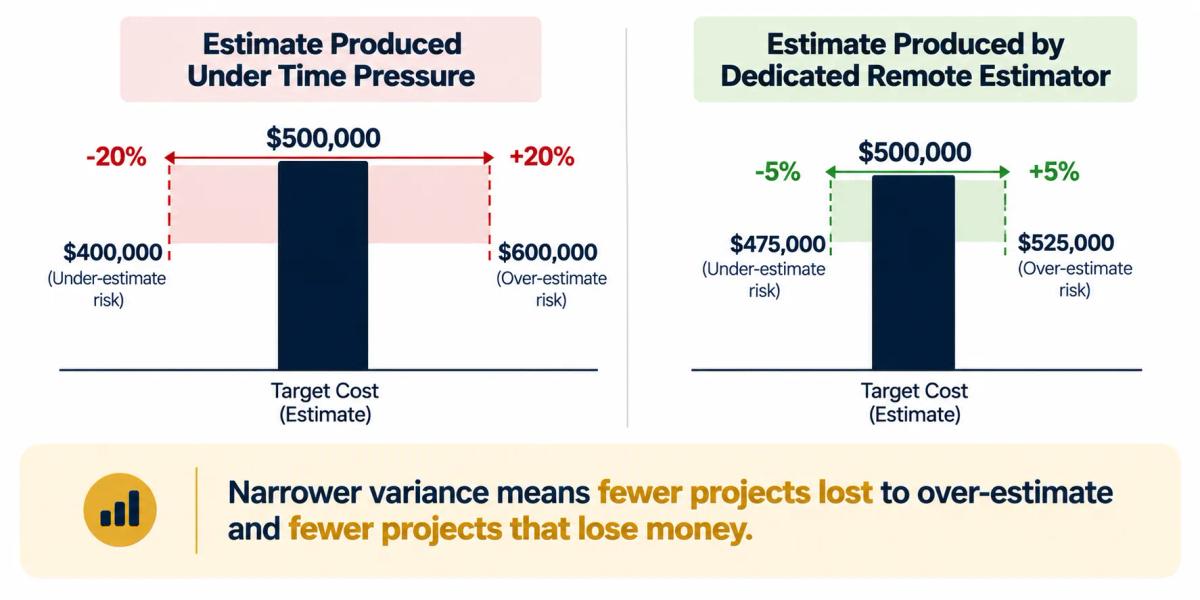
An over-estimate loses the bid. The contractor does not get the work, the opportunity cost is absorbed quietly, and the pipeline narrows. An under-estimate wins the bid and loses money on every dollar of revenue it brings in. For a contracting business running on single-digit net margins, a project won on an estimate that was 8% low can turn a profitable revenue period into a net loss.
The most common source of estimating inaccuracy is not dishonesty or carelessness. It is speed. When an estimating function is stretched across an owner or project manager who is simultaneously managing active projects, client relationships, supplier negotiations, and safety obligations, the estimate gets done in whatever time is available rather than with the attention the complexity of the scope requires. Material quantities are rounded rather than precisely taken off. Labor productivity factors are estimated by memory rather than from project data. Subcontractor bids are requested late and accepted without comparison because there is no time to wait for alternates.
A dedicated remote estimator who outsources construction estimating work does one thing: produce accurate, detailed estimates. They take off quantities systematically from drawings. They apply current material costs from supplier databases. They use documented productivity factors rather than working from memory. When their full professional attention is on the estimate rather than divided across the field, the accuracy of the output reflects that focus.
The American Society of Professional Estimators (ASPE) sets professional standards for construction estimating competency in the US, including requirements for systematic quantity survey methodology and cost database maintenance. In Canada, the Canadian Institute of Quantity Surveyors (CIQS) provides equivalent professional standards for construction cost estimation. A remote estimator working to these professional standards produces estimates that are built on documented methodology rather than experience and intuition alone.
What Turnaround Speed Costs When It Is Slow
In competitive bid environments, the contractor who responds fastest to a tender does not always win. But the contractor who responds after the decision has been made always loses. Turnaround speed on estimates is not a customer service metric. It is a bid qualification metric.
For restoration contractors responding to insurance-referred work, where adjusters are coordinating multiple bids simultaneously and move quickly once they have what they need, a 48-hour estimate response capability is often the difference between being in the selection conversation and being replaced before the conversation ends. For general contractors bidding commercial work, late bid submissions are frequently excluded from consideration regardless of price or quality.
The bottleneck that slows estimating turnaround is almost never skill. It is capacity. When the person who does the estimating is also running projects, managing subcontractors, and handling client communications, the estimate goes to the back of the queue when project demands are acute. And project demands are always acute in a busy construction business.
When contractors outsource construction estimating to a dedicated remote professional, the estimate moves to the front of the queue by definition, because for the remote estimator there is no other queue. They work the estimate from receipt of drawings to completed submission without the competing demands that delay in-house estimating. Turnaround commitments that were aspirational become operational because the function has dedicated capacity behind them.
All Talentz places dedicated remote estimators whose construction estimating experience and software proficiency are verified before placement. Request Estimating Talent from All Talentz and have a specialist working your bids in as little as 48 hours
What Estimating Capacity Limits Cost at Scale
The third constraint that outsourcing construction estimating addresses is capacity. A single in-house estimator, or a business owner performing the estimating function, can only produce a finite number of estimates per week at the quality the work requires. When the bid volume exceeds that capacity, the contractor makes choices: which opportunities to pursue and which to let pass. Those choices are frequently made based on which bids arrived most recently rather than which opportunities are strategically most valuable.
For a contracting business that is actively trying to grow its revenue, this capacity constraint is a ceiling. The business cannot pursue more work than its estimating function can handle, and its estimating function can handle less than the market offers when it is running on the owner's partial attention or a single overloaded estimator managing a heavy project load simultaneously.
When contractors outsource construction estimating, this ceiling rises. Additional bid volume can be absorbed without additional overhead, because the remote estimating arrangement scales with the contractor's bid activity rather than requiring a full-time additional hire at full employment cost. During a busy tendering period, a remote estimator can be directed toward the highest-priority opportunities. During quieter periods, the overhead does not persist at full-time employment cost.
AACE International, the professional organization for cost engineering and project control, has documented extensively how estimating capacity constraints limit project pipeline development for contracting businesses. Their research on estimating function maturity shows that businesses with systematic, dedicated estimating capability consistently develop larger and more profitable pipelines than those managing estimating as an overflow function.
What to Look for Before You Outsource Construction Estimating
Trade and project type specialization. Construction estimating is not a generic skill. A residential framing estimator and a commercial mechanical estimator operate in different cost universes with different productivity factors, different supplier relationships, and different subcontractor bid structures. Before you outsource construction estimating, confirm that the estimator's background aligns with your primary project types and trade scope.
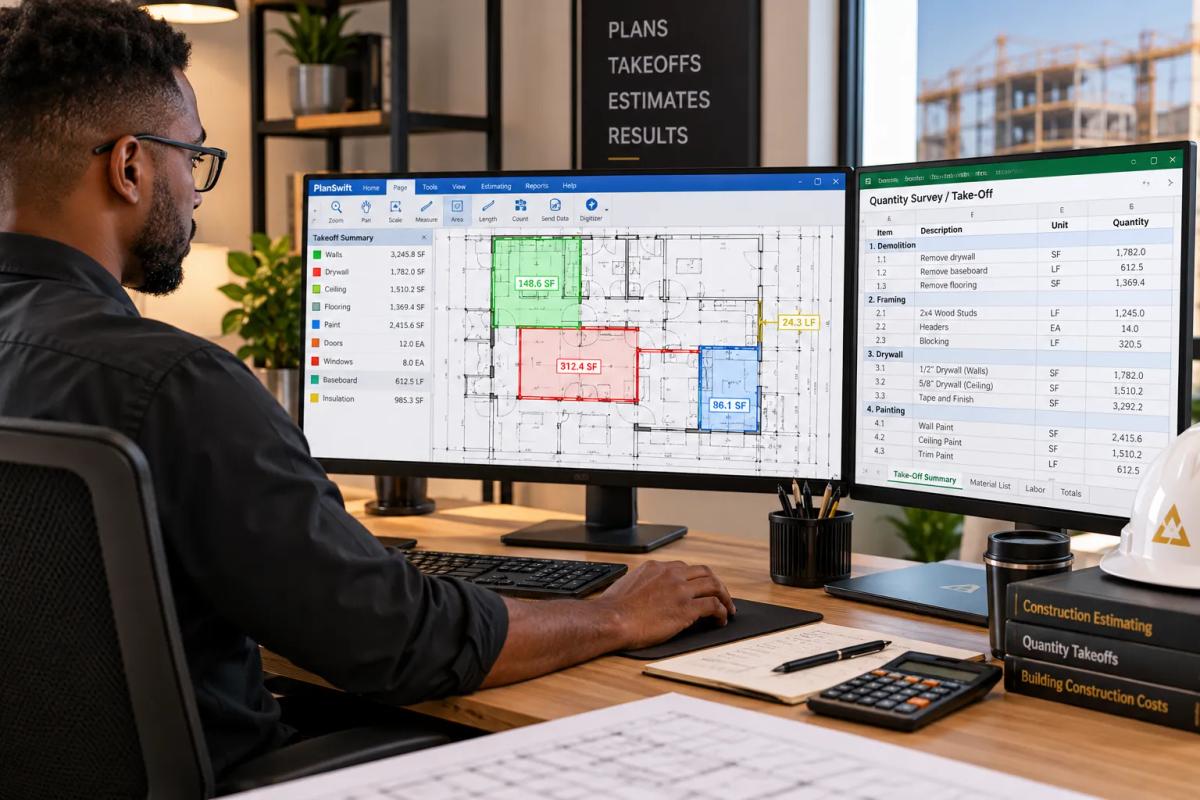
Software proficiency. Estimating software varies significantly across the industry. PlanSwift, Bluebeam, ProEst, Clear Estimates, and Xactimate for restoration work each have different take-off workflows and output formats. A remote estimator should be able to work within the platform your business uses or produce outputs compatible with your existing project management workflow.
Quantity survey methodology. Ask specifically how the estimator approaches a take-off. The answer reveals whether they use systematic area and linear measurement from drawings or estimate from experience and rule-of-thumb ratios. The former produces defensible, traceable estimates. The latter produces estimates that look precise but carry hidden variance.
Material pricing currency. Material costs in construction change frequently. A remote estimator who maintains current supplier pricing relationships or uses updated cost databases produces estimates that reflect the actual cost to build rather than costs from a prior period. Ask how the estimator keeps their material cost data current.
Not sure whether your estimating gap is accuracy, speed, or capacity? Contact All Talentz and talk through your bid volume and project types with our team. We will match you with the right estimating specialist for your work.
How All Talentz Places Remote Estimators for Contractors
All Talentz places dedicated, pre-vetted construction estimating professionals for contractors across the US and Canada through a full talent partner model. Every estimator placed has been assessed for trade and project type experience, software platform proficiency, quantity survey methodology, and cost database management before the match is made.
The estimator placed works exclusively for one contractor. They build familiarity with the contractor's typical scope, preferred subcontractor relationships, and bid format preferences over time, which improves the quality and efficiency of each successive estimate rather than starting fresh every engagement. Work tools and equipment are provided by All Talentz. Employment and health insurance are managed on our side. A dedicated relationship manager monitors performance and facilitates an immediate replacement if the placement is not the right fit.
Our remediation talent services cover construction and restoration estimators, project coordinators, and operations support professionals, all placed as dedicated resources exclusively assigned to the contractors they serve.
For more on how the dedicated outsourcing model compares to traditional staffing and shared service arrangements, see our post on what a dedicated remote staffing company does differently.
Conclusion
The ceiling on most contracting businesses is not the quality of the work they deliver. It is the volume of bids they can produce accurately and quickly enough to convert into revenue. Outsourcing construction estimating addresses that ceiling directly by placing dedicated, specialist attention on the function that determines which opportunities a business can pursue, how accurately it prices them, and how quickly it responds before the client makes a decision. For contractors in the US and Canada who are losing bids on turnaround time, losing margin on estimate accuracy, or simply unable to pursue all the work their capacity could deliver, a dedicated remote estimator changes the operational reality without adding the full overhead of an in-house hire. All Talentz places pre-vetted construction estimating specialists with contractors across both markets, with placements starting in as little as seven days and employment infrastructure managed entirely on our side.
Outsource Construction Estimating Through All Talentz
Outsourcing construction estimating means engaging a dedicated remote estimating professional to prepare quantity take-offs, material and labor cost estimates, and bid submissions for your construction or restoration projects. The estimator works within your existing estimating software and bid format, produces estimates to professional standards, and handles the full estimating workflow from drawing receipt to completed submission.
Remote estimators can cover a range of construction and restoration project types including residential and commercial new construction, remodeling and renovation, restoration and remediation, mechanical, electrical, and plumbing work, and specialty trade scopes. All Talentz matches estimators to contractors based on trade and project type alignment rather than placing generalists into specialized scopes.
Win rates improve through two mechanisms: accuracy and speed. Accurate estimates price work competitively without leaving money on the table or creating loss-making bids. Fast turnaround ensures bids are submitted while the client is still in the decision window rather than after they have moved on. A dedicated remote estimator with specialist attention on the estimating function improves both without the contractor having to choose between them.
The most relevant platforms vary by project type. PlanSwift and Bluebeam are widely used for digital take-offs across commercial and residential work. ProEst and Clear Estimates are common for general contracting. Xactimate is the standard for insurance-related restoration estimating. All Talentz verifies software proficiency before placing any estimating professional.
Estimating software provides the tools for quantity take-off and cost assembly. A skilled estimator provides the judgment: which productivity factors apply to this specific scope, where contingency is warranted, how subcontractor bids should be compared, and how the estimate should be structured to address the client's specific decision criteria. Software does not replace that judgment. A dedicated estimator applies it systematically.
Talentz can place a pre-vetted, dedicated construction estimating professional in as little as 48 hours.