The assumption that breaks most distributed teams is also the most natural one to make: that good teamwork requires people to be available at the same time. For teams working within a single time zone, that assumption mostly holds. For teams spread across multiple time zones, it is the source of nearly every chronic frustration: meetings that require someone to be online too early or too late, decisions that stall waiting for an overlap window, and team members who feel like they are permanently out of sync with the rest of the group.
Learning to manage remote teams across different time zones well does not mean finding better scheduling tools. It means changing how the team thinks about time, presence, and collaboration at a fundamental level. According to Talenteum's remote team management research, 59% of remote teams already span two to five time zones, which means the distributed model is not a niche arrangement. It is how the majority of remote teams actually operate. The leaders who navigate it well are not the ones with the best calendar software. They are the ones who have made four specific shifts in how they lead.
This post covers those four shifts and what each looks like in practice. For the tactical checklist of tools and processes that support time-zone management, our earlier post on how to effectively manage remote teams across different time zones covers that layer in depth. This post is about the leadership layer that makes those tactics actually work.
The Core Tension When You Manage Remote Teams Across Different Time Zones
Before the four shifts, it is worth naming the central tension clearly.
When every team member is in the same time zone, the default operating model is synchronous: questions get asked and answered in real time, decisions happen in meetings, and visibility into what everyone is working on comes naturally from shared physical or virtual presence. That model works because time is a shared resource.
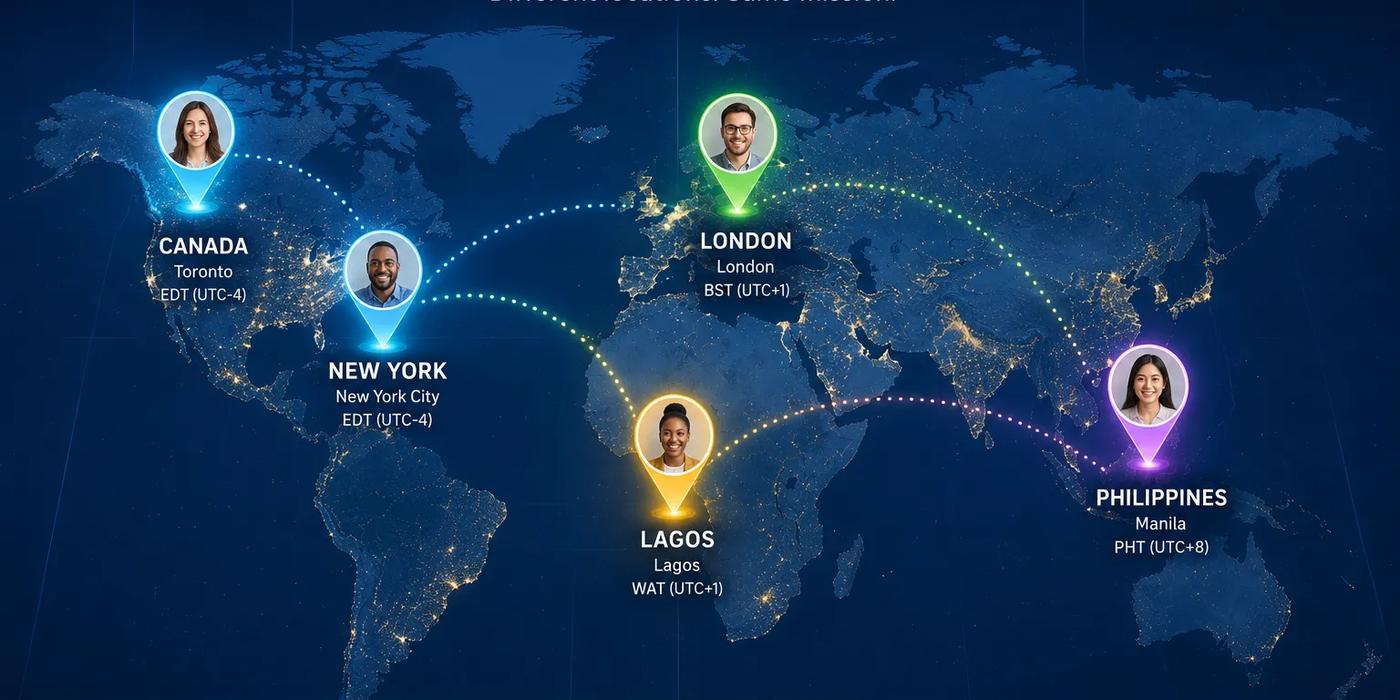
When you manage remote teams across different time zones, time is no longer a shared resource. A team member in Lagos and a team member in San Francisco share only a few hours of conventional business overlap, and even those hours are inconvenient for one of them. A team that tries to operate on a synchronous-first model despite a distributed time zone spread will produce a recognizable pattern: a small number of time zones are treated as primary and the others are treated as peripheral, which produces exactly the cohesion loss the leader was trying to avoid.
The four shifts below are how leaders change that pattern.
1: Move from Synchronous Default to Async First
The most consequential shift in learning to manage remote teams across different time zones is changing the default communication mode from synchronous to asynchronous.
Async-first does not mean never meeting in real time. It means that the default assumption is no longer "we will discuss this live" but rather "we will document this clearly enough that someone can respond when they are next available." Real-time meetings are reserved for decisions that genuinely benefit from live discussion: high-stakes decisions, relationship-building moments, and conversations where tone and nuance matter enough to justify coordinating across time zones.
What async-first looks like in practice: a question that previously would have gone into a chat channel expecting an immediate response instead goes into a shared document with context, background, and the specific decision or input needed. An update that previously would have been delivered in a weekly sync call instead goes into a recorded video or a structured written update that team members review in their own working hours. The discipline is not in choosing the right app. It is in changing the habit from "ping and wait" to "document and trust."
Infeedo's guide to asynchronous work best practices notes that teams using async communication cut unnecessary meetings and save meaningful time each week, while giving distributed team members the autonomy to work at their most productive hours. The productivity gain is real, but the cohesion gain is equally important: when no one is defaulting to synchronous pressure, no time zone carries the burden of being perpetually inconvenient.
2: Move from Presence to Output as the Measure of Contribution
The second shift is closely connected to the first. When you manage remote teams across different time zones, you cannot see when your team members are working. For leaders accustomed to gauging productivity through visible activity, that invisibility creates anxiety that typically produces one of two unhealthy responses: excessive check-ins that interrupt deep work, or a performance measurement approach that defaults to hours online as a proxy for contribution.
Neither works well for distributed teams. Excessive check-ins penalize team members in inconvenient time zones and signal distrust. Hours-online metrics reward presence theater over actual results.
The shift to output-based measurement changes the question from "are they online?" to "did they deliver what they committed to, at the quality expected, within the agreed timeline?" This requires a clearer definition of what each team member is accountable for during each period, which is itself a management discipline that distributed teams benefit from whether or not time zones are involved. The result is a team where contribution is visible regardless of when it happens, and where team members in any time zone feel equally valued because the measure of their work is the same.
Deel's guide to managing time zones in remote teams describes this as one of the most important structural changes a leader can make: establishing clear deliverables and deadlines that translate across time zones rather than relying on synchronous signals to judge performance.
When you place talent through All Talentz, every professional is matched to clear role deliverables and monitored by a dedicated relationship manager, so output accountability is built in from Day One. Request Talent from All Talentz to see how the model works.
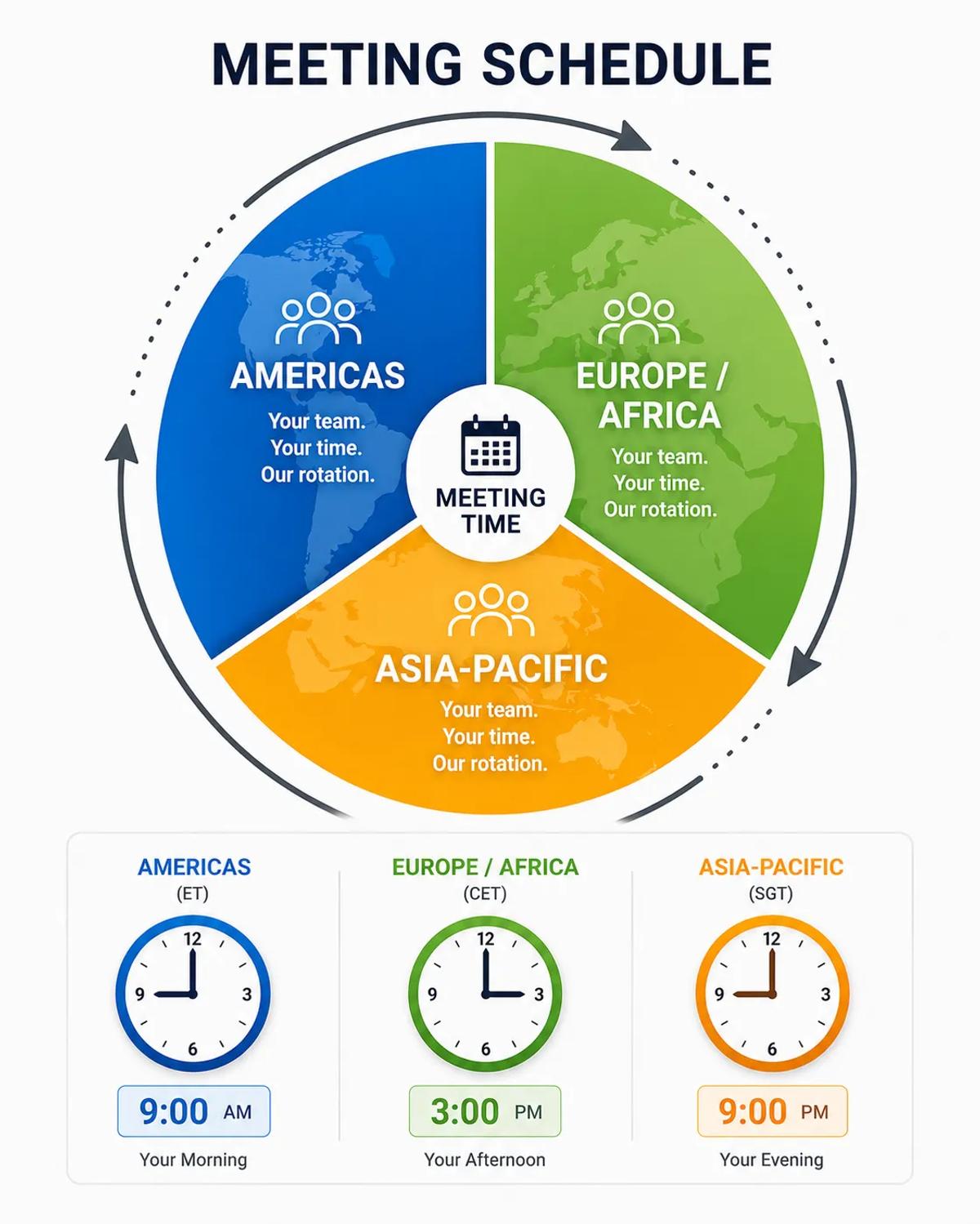
3: Move from Convenience Scheduling to Fairness Rotation
Every distributed team with more than two time zones faces a version of the same problem: if you pick a standard meeting time, it will be convenient for some team members and genuinely inconvenient for others. When the inconvenient time slot always falls on the same people, those people feel peripheral. When they feel peripheral long enough, they behave peripherally, which is how cohesion breaks down.
The fairness rotation shift changes the logic of meeting scheduling from "what time works best for most people" to "how do we share the inconvenience equitably over time?" A team with members in New York, London, and Lagos might rotate meeting times monthly so that no single group perpetually takes the late call or the early call. The total inconvenience in the system does not decrease, but its distribution becomes fair, which changes how people experience it.
This shift also changes how the team thinks about meetings that recorded content can address. If a meeting happens at an inconvenient time for a particular team member, making the recording available promptly and creating a structured way for them to contribute their input asynchronously is not a workaround. It is a built-in design choice that treats distributed participation as first-class.
We Work Remotely's guide to working across different time zones recommends establishing everyone's preferred working hours as a team agreement from the start and building meeting schedules around those preferences rather than defaulting to whoever holds the most meetings.
4: Move from Informal Culture to Intentional Connection
In a co-located team, culture and connection emerge from a hundred small, informal interactions: the conversation over coffee, the offhand comment in the hallway, the spontaneous lunch group. None of those happen naturally when you manage remote teams across different time zones. Culture does not disappear. It atrophies from lack of deliberate attention, and atrophied culture is where cohesion loss actually lives.
The intentional connection shift replaces the informal infrastructure with designed equivalents. Not scripted or forced, but given structure so they actually happen. This looks like:
A regular non-work channel where team members can share what they are reading, watching, or cooking, not as a performance exercise but as a genuine opt-in space for the kind of conversation that builds personal familiarity over time.
A periodic team call where the agenda is relationship rather than project review. Thirty minutes of a team quiz, a shared recommendation, or a round of structured personal updates does more for distributed cohesion than ten project status calls.
A new hire buddy program that introduces people joining the team to an existing member from a different time zone, with an explicit brief to have a few informal conversations in the first month. The goal is not productivity acceleration. It is the baseline human familiarity that makes async communication less transactional.
Bitwage's communication best practices for remote global teams recommends drafting a communication charter and scheduling quarterly clarity reviews as a team, which creates structured moments for the culture conversation to happen explicitly rather than hoping it emerges from tool adoption.
For more on how to build the onboarding experience that sets these norms from Day One, see our post on how to onboard remote employees for long-term retention.
(CTA 2: Place here as a text CTA: "Building a distributed team and want to get the culture foundation right from the start? Contact All Talentz to talk through how our placement and management model supports cohesion from Day One.
Making the Most of Overlap Hours
Even in teams with very different time zones, there is almost always some window of overlap, even if brief. How leaders use that window determines a great deal about team cohesion and decision velocity.
The highest-leverage use of overlap hours is not status updates. Status updates can and should travel asynchronously. The best use of shared real-time windows is the work that genuinely benefits from live exchange: resolving ambiguities that have been generating async back-and-forth, making decisions that need rapid input from multiple perspectives, and building the human connection that makes async work feel less isolated.
Remote Pass's guide to managing across time zones recommends documenting team communication guidelines formally and giving them to every new hire on Day One, covering preferred channels, response windows, and escalation paths for genuine emergencies. That documentation is the operational expression of all four shifts described above, turned into a reference every team member can return to when the default synchronous instinct reasserts itself.
For more on how to structure the full remote management approach as your team scales, see our post on the benefits of hiring remote employees.
How All Talentz Makes It Easier to Manage Remote Teams Across Different Time Zones
Managing a distributed team well requires a management system, not just good intentions. The four shifts described above are the leadership layer of that system. The operational layer, ensuring that the professionals placed in your team are ready to work within a distributed model from Day One, is where All Talentz contributes directly.
Every professional placed through All Talentz is pre-vetted for the communication discipline, async work habits, and tool proficiency that distributed team membership requires. They are not placed and left to figure out remote work culture independently. Every placement is supported by a dedicated relationship manager who monitors performance, checks in regularly, and addresses any concerns early, providing the management oversight layer that keeps distributed team dynamics from drifting.
We place pre-vetted professionals across six industries, all of whom arrive ready to operate within a distributed team model:
Our tech talent services place software developers, AI/ML specialists, UI/UX designers, data annotators, and QA engineers suited to distributed development environments.
Our healthcare talent services place medical billing specialists and healthcare support professionals.
Our finance talent services place accounts receivable specialists, financial analysts, and payroll specialists.
Our remediation talent services place estimators and operations professionals for restoration businesses.
Our legal talent services place legal researchers, paralegals, and legal receptionists.
Our pest control talent services place CSRs, accountants, and sales support professionals.

Conclusion
Managing remote teams across different time zones well is not primarily a scheduling or technology problem. It is a leadership challenge that requires four fundamental shifts: from synchronous default to async-first communication, from presence to output as the measure of contribution, from convenience scheduling to fairness rotation, and from informal to intentional culture-building. None of these shifts is complicated, but all of them require deliberate practice to replace the synchronous instincts that co-located management built. The teams that make these shifts consistently do not just survive the time zone spread. They gain from it: wider talent access, longer productive coverage windows, and professionals who bring perspectives and market knowledge that a single-time-zone team cannot generate. All Talentz places pre-vetted professionals who are ready to operate effectively within that distributed model from Day One, with the management support layer built in.
The most persistent challenge is the synchronous default: the assumption that good teamwork requires real-time availability. When teams spread across time zones try to operate on a synchronous model, some time zones are perpetually inconvenient, decisions slow down waiting for overlap windows, and team members who are regularly on early or late calls begin to disengage. The fix is an async-first culture where real-time meetings are reserved for work that genuinely requires them.
Cohesion in a distributed team does not emerge from shared physical space or informal hallway interactions. It has to be designed deliberately: a communication charter that sets clear norms, a fairness rotation for meeting times so no single time zone carries the early or late burden permanently, non-work channels that create space for personal familiarity, and periodic team calls where the agenda is relationship rather than task status.
The tools that consistently prove useful are asynchronous communication platforms like Slack or Microsoft Teams for structured channel-based updates, video recording tools like Loom for replacing update meetings with watchable recordings, shared documentation platforms like Notion or Confluence for maintaining team knowledge across time zones, and visual project management tools like Asana, Monday.com, or ClickUp for tracking deliverables against timelines without requiring synchronous check-ins.
Three practices make a significant difference. First, rotate meeting times so the inconvenience is shared fairly rather than falling on the same people repeatedly. Second, send meeting agendas asynchronously in advance so participants can prepare input before the meeting rather than during it. Third, record every synchronous meeting and make it available promptly so team members who could not attend can catch up and contribute their responses asynchronously.
Output-based management shifts the performance question from visibility to results. Instead of "are they online during business hours," the question becomes "did they deliver what they committed to, at the quality expected, within the agreed timeline?" This requires clearly defined deliverables and timelines for each team member, which is a management discipline that benefits distributed teams at every time zone spread. It also removes the perception problem that comes with measuring remote workers by availability rather than contribution.
All Talentz places pre-vetted professionals who are assessed for the async communication habits, documentation discipline, and tool proficiency that distributed team membership requires. Every placement is supported by a dedicated relationship manager who monitors performance and checks in regularly with both the professional and the client, providing the management layer that keeps distributed teams functioning well even as they scale. Placements are available in as little as seven days.