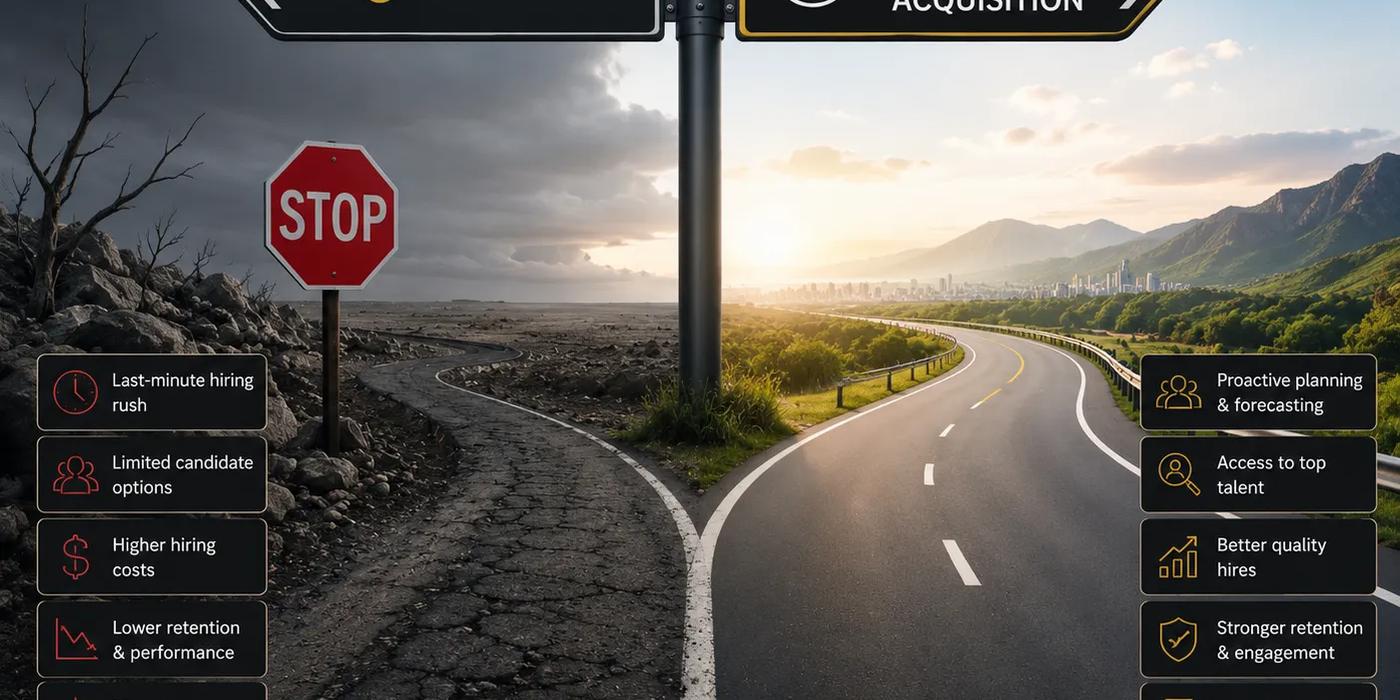
According to the 2025 Future of Talent Acquisition Report from Rival and HR.com, only 5% of organizations consider their talent acquisition strategy world-class, while 51% still rely on reactive hiring. That gap tells a story about how most businesses experience the hiring process: a role opens, the team scrambles, job boards get posted, candidates get screened, an offer gets made, and the cycle starts over when the next role opens. Strategic talent acquisition works differently. It anticipates demand before a vacancy becomes urgent, builds relationships with qualified candidates before a role is approved, and treats each hiring decision as a long-term business outcome rather than a short-term headcount problem. The difference in results between the two approaches is measurable, consistent, and significant. Organizations that make the shift from reactive recruitment to strategic talent acquisition reduce turnover by up to 65% and secure top candidates before competitors know positions are even open, according to data compiled by x0pa.com and Criteria Corp research.
This post is organized as a direct contrast between the reactive recruitment model and the strategic talent acquisition approach, stage by stage through the hiring lifecycle. It is designed for business owners and leaders who feel like they are perpetually behind on hiring, rather than ahead of it. For a foundational comparison of the terminology, our earlier post on talent acquisition vs recruitment services explains the definitional landscape. This post is about what the difference looks like when it shows up in practice and in outcomes.
When Reactive Recruitment Takes Over
Every business has experienced the reactive cycle at some point. A key team member gives notice. A project expands faster than planned. A role that was supposed to be filled months ago still has no candidate. In each case, the hiring process starts from urgency, which is the worst possible position to hire from.
Here is what the reactive recruitment cycle actually looks like from the inside.
The role opens unexpectedly or later than planned. The job description is adapted from the last time this role was hired for, which may have been years ago, and posted to the same job boards that produced the last batch of candidates. Screening begins under time pressure. Interviews are scheduled around competing priorities. The shortlist contains candidates who met the basic requirements but were not necessarily the best possible match for the current business context. An offer is extended. The candidate accepts, or does not. If not, the search restarts from near zero.
Even when the hire is made, the reactive model creates downstream problems. New hires brought on under time pressure are more likely to be mismatches for the role, the team, or the business stage. Research from a study of more than 1,000 US hiring managers found the average cost of a bad hire to be $36,000 when lost productivity and recruitment expenses are combined. One in five businesses in that same study reported annual turnover costs exceeding $100,000. These are not unusual outcomes from reactive hiring. They are the predictable result of making high-stakes talent decisions under urgency rather than strategy.
The Jobspikr talent acquisition analysis articulates the problem precisely: recruitment fills seats; strategic talent acquisition helps teams avoid repeating the same hiring mistakes under new market pressure. That distinction is the core of why the reactive model keeps producing the same problems at scale.
If your business is stuck in the reactive cycle, All Talentz can place a pre-vetted professional in as little as 7 days without you restarting the search from scratch each time. Request Talent from All Talentz to see how the strategic model works in practice.
What Strategic Talent Acquisition Looks Like Instead
Strategic talent acquisition does not start when a role opens. It starts with a question: what talent does this business need over the next 12 to 24 months to achieve its growth objectives, and how does hiring now position the organization to meet that demand ahead of time?
The Soteria HR strategic talent acquisition framework describes this as aligning hiring with business goals rather than openings. The talent acquisition process is continuous rather than episodic: employer brand is maintained, candidate pipelines are warmed before roles are approved, skills gaps are assessed against business plans rather than against current vacancies, and hiring timelines are scoped against the productive delivery dates the role needs to hit, not just the date the job is posted.
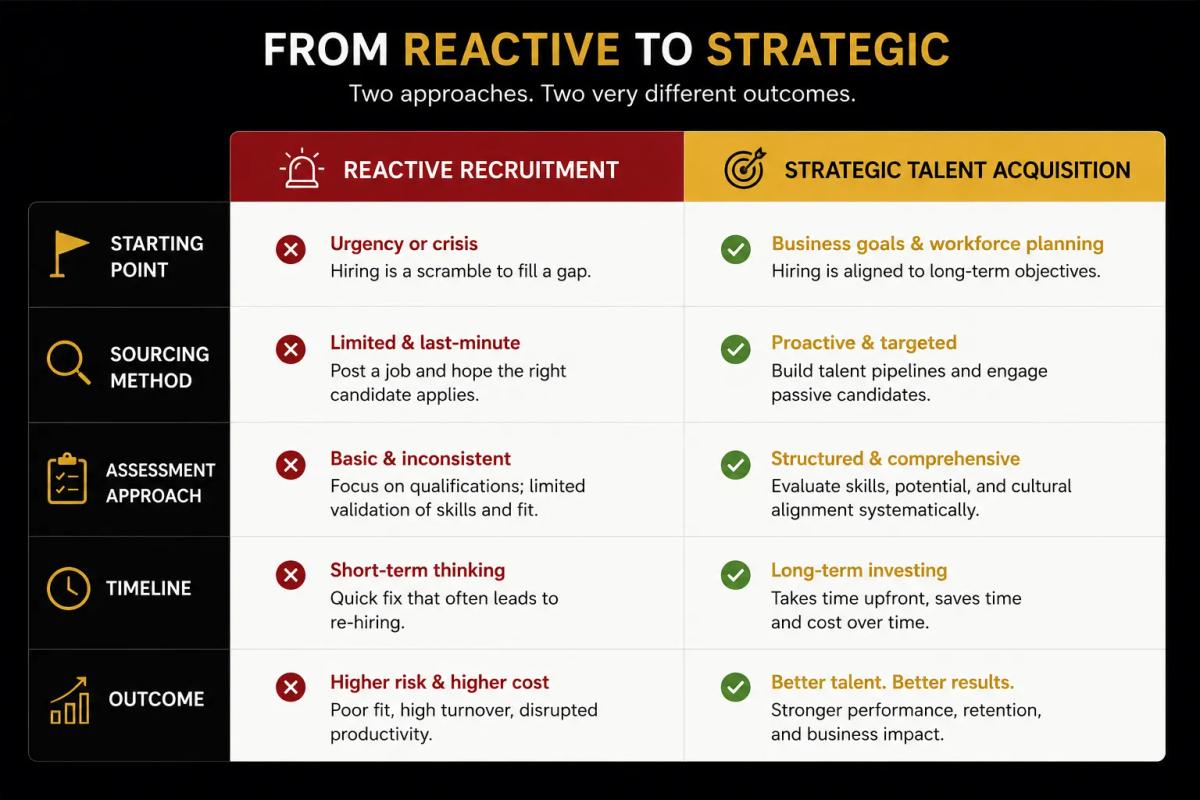
Here is what that looks like in contrast to the reactive model:
Instead of writing a job description when a role opens, strategic talent acquisition starts with a skills gap analysis against the business plan. Instead of posting to the same job boards, it uses targeted sourcing across the channels where the specific talent profile is active. Instead of screening under time pressure, it assesses candidates against a pre-defined competency framework. Instead of extending an offer and hoping for acceptance, it has maintained relationships with qualified candidates long enough that acceptance rates are materially higher. And instead of starting over when a hire does not work out, it has a pre-qualified pool to move through rather than an empty pipeline.
Deloitte Bersin research, cited by the Discovered.ai talent acquisition analysis, found that organizations with strategic, high-maturity talent acquisition consistently outperform their reactive peers in hiring quality, retention, and business performance. That outperformance is not incidental. It is the structural result of treating hiring as a business system rather than a reactive response to headcount problems.
The Five Markers That Separate Strategic Talent Acquisition From Reactive Hiring
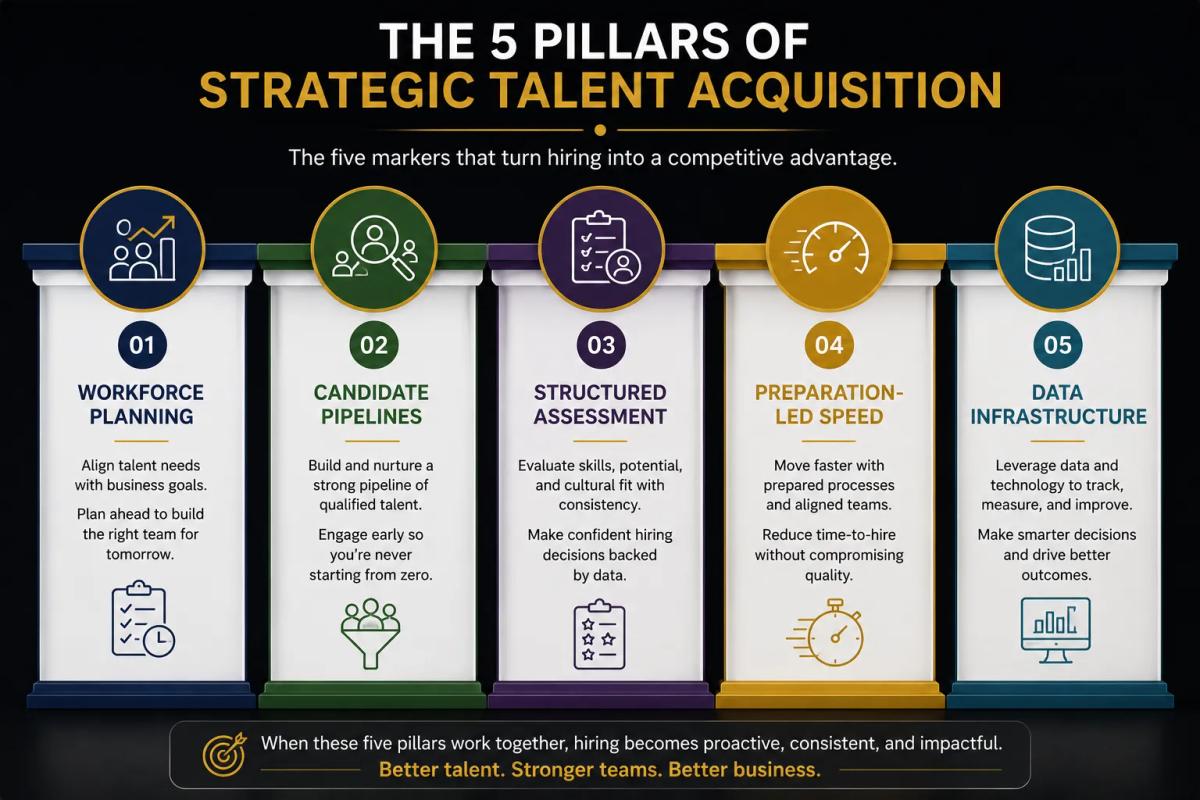
Moving from reactive to strategic is not a single change. It is a shift across several interconnected practices that, taken together, produce a fundamentally different hiring experience and a fundamentally different set of outcomes. These are the five markers research consistently identifies as distinguishing strategic talent acquisition from reactive recruitment.
Workforce Planning Comes Before the Vacancy
Strategic talent acquisition begins with a workforce plan tied to business objectives. This means modeling the talent needs implied by growth targets, new markets, or product launches 12 to 24 months out, and starting the sourcing and assessment process before those roles are formally approved. In practice, 76% of recruiters say they struggle to attract quality candidates, according to x0pa.com research, and a significant portion of that struggle comes from sourcing under urgency rather than from a maintained pipeline. Organizations that build pipelines in advance of need consistently fill roles faster and with higher quality candidates than those that start sourcing when the requisition is approved.
Candidate Pipelines Are Built Before They Are Needed
A reactive recruitment model has no pipeline. It has a posting. Strategic talent acquisition maintains warm relationships with qualified candidates in advance of specific needs, so when a role opens, the first call goes to someone who already knows the organization, not to an anonymous job board applicant. According to LinkedIn research cited by Phenom, internal mobility and employee referrals are among the most effective sources of high-quality hires, and both require relationship maintenance over time, not transactional urgency.
Assessment Is Structured, Not Instinctive
Reactive hiring frequently evaluates candidates through impressionistic interviews that measure confidence and communication rather than the specific competencies the role requires. Strategic talent acquisition uses structured competency-based assessment that reduces the influence of interviewer bias, improves the predictive accuracy of hiring decisions, and creates a consistent evaluation standard across roles and interviewers. This structural change alone produces measurable improvements in hiring quality. Organizations that move from impressionistic to structured hiring see measurably lower mis-hire rates and higher first-year retention, according to hiring science research compiled by Discovered.ai.
Speed Is a Function of Preparation, Not Pressure
In reactive recruitment, speed is the result of cutting corners. In strategic talent acquisition, speed is the result of preparation. Organizations with warm pipelines, clear competency profiles, and structured assessment processes fill roles faster than reactive organizations, not because they rush but because they have done the work before urgency appears. The top performing 5% of talent acquisition functions consistently outperform the reactive majority not by moving more urgently but by moving from a better prepared starting position.
Data Is Used to Improve the System, Not Just Report on It
Strategic talent acquisition uses hiring data to continuously improve the process: which sourcing channels produce the highest-quality candidates, which assessment criteria correlate with first-year performance, where in the funnel the most qualified candidates drop out, and what the cost per quality hire actually is across different roles and functions. This data orientation is what converts talent acquisition from a reactive support function into a business performance lever. Only 35% of organizations currently use recruitment analytics, according to HR.com research, which means businesses that build data infrastructure into their hiring process are immediately differentiated from the majority.
Already know what roles you need? Contact All Talentz to talk through how our pre-built pipeline and structured vetting matches the strategic talent acquisition approach described above.
Where the Talent Acquisition Vs Recruitment Distinction Matters Most by Industry
The gap between strategic talent acquisition and reactive recruitment does not show up equally across industries. In sectors where skills are scarce, compliance requirements are high, or project timelines are tight, the cost of reactive hiring is most acute. All Talentz places pre-vetted, pre-trained professionals across six industries where this distinction is most operationally consequential.
In Tech, developer shortages and AI/ML talent scarcity make reactive posting-and-hoping essentially non-functional. Our tech talent services place software developers, AI and ML specialists, UI/UX designers, data annotators, and QA engineers who are pre-vetted and match-ready before the client conversation begins.
In Healthcare, revenue cycle staffing gaps directly affect cash flow. Reactive hiring for billing and AR roles means claims go unsubmitted and collections stall. Our healthcare talent services place medical billing specialists and healthcare support professionals in days, not weeks.
In Finance, the accounting talent shortage documented by Robert Half means reactive search timelines are stretching to 95 or more days for qualified professionals. Our finance talent services place accounts receivable specialists, financial analysts, payroll specialists, and bookkeepers who are ready to contribute from Day One.
In Restoration, project pipelines cannot wait for a three-month estimator search. Our remediation talent services place estimators and operations professionals whose skills have been verified before placement.
In Legal, reactive hiring for legal research and paralegal support risks case timeline disruption and compliance exposure. Our legal talent services place legal researchers, paralegals, and legal receptionists who understand the legal operating environment.
In Pest Control, CSR and administrative hiring gaps directly reduce booking rates and customer retention. Our pest control talent services place customer service representatives, accountants, and sales support professionals positioned to contribute immediately.
For more on how the hiring model affects day-to-day business operations beyond the initial placement, see our post on how to onboard remote employees for long-term retention.
How All Talentz Delivers Strategic Talent Acquisition in Practice
Strategic talent acquisition requires infrastructure that most growing businesses have not built: maintained candidate pipelines, structured assessment frameworks, pre-verified skills databases, and an ongoing management layer that monitors placements after they are made. Building that infrastructure internally requires significant time, investment, and operational focus that most business owners cannot spare from running and growing the business itself.
All Talentz provides that infrastructure as a service. Every professional in our network has been pre-vetted, pre-trained, and assessed against specific role competency profiles before any client conversation begins. There is no pipeline-building phase when you place talent through All Talentz because our pipeline is already built and continuously maintained. When you come to us with a role, the sourcing and assessment work is already done.
Here is how the All Talentz strategic talent acquisition model works:
Pre-vetting that covers the full competency profile. Technical skills, communication discipline for remote work, tool proficiency, and role-fit are all assessed before a match is made. You receive a qualified professional, not a shortlist to screen from scratch.
Placement in as little as 7 days. The preparation that drives strategic talent acquisition speed is built into our model, not triggered by your urgency. Most placements are operational within a week of the initial request.
Work tools and equipment provided from Day One. The professional arrives ready to contribute immediately, without provisioning delays.
Health insurance and employment managed on the All Talentz side. You access the expertise without carrying the direct-hire employment overhead.
A dedicated relationship manager assigned to every placement. Our relationship managers provide the ongoing performance monitoring and check-in infrastructure that strategic talent acquisition requires after placement, not just before it. They flag concerns early, conduct regular structured check-ins, and facilitate immediate replacement if a placement is not the right fit.
For a deeper look at how the dedicated placement model compares to traditional recruitment agencies, see our post on what a dedicated remote staffing company does differently.
The Data Adds Up
The business case for strategic talent acquisition over reactive recruitment is not abstract. The numbers are specific and they compound. Strategic hiring reduces turnover by up to 65%, according to Criteria Corp case studies cited by Discovered.ai. Organizations with robust talent acquisition strategies fill roles faster and secure top talent before competitors even know positions are open, according to x0pa.com research. The average cost of a bad hire sits at $36,000, and one in five businesses reports annual turnover costs exceeding $100,000 driven by repeated poor hiring decisions made under reactive urgency.
The SHRM Human Capital Benchmarking study provides detailed benchmarks for cost-per-hire, time-to-fill, and quality-of-hire across industries that businesses can use to measure the gap between their current reactive approach and what strategic talent acquisition would deliver.
The LinkedIn Talent Solutions Global Talent Trends report also provides annual data on sourcing effectiveness, candidate pipeline quality, and the business outcomes associated with different talent acquisition maturity levels, making it a useful benchmark for businesses evaluating where their own approach sits.
The AIHR (Academy to Innovate HR) publishes practitioner-level research on talent acquisition strategy, assessment frameworks, and hiring maturity models that is particularly useful for businesses building their first structured talent acquisition approach.
Conclusion
The reactive recruitment cycle is expensive, unreliable, and self-perpetuating: urgency drives poor decisions, poor decisions drive turnover, turnover creates urgency. Strategic talent acquisition breaks that cycle by moving the starting point from the vacancy to the business plan, from urgency to preparation, and from individual hires to a managed, continuously improving talent function. The data consistently shows that organizations which make this shift outperform those that do not, across hiring speed, retention, and business performance. All Talentz delivers the infrastructure of strategic talent acquisition without requiring businesses to build it themselves: pre-built pipelines, structured pre-vetting, fast placement, dedicated management support, and immediate replacement when a match is ever not right. For growing businesses that cannot afford to keep losing time and money to the reactive cycle, working with a strategic talent partner is not an operational nice-to-have. It is a competitive decision.
Recruitment is the tactical process of filling open roles as they appear, typically starting from a vacancy and working backward to source candidates under urgency. Strategic talent acquisition is a proactive, long-term approach that starts from business goals and builds the hiring infrastructure to meet them before vacancies become urgent. It includes workforce planning, ongoing candidate pipeline development, structured assessment, employer brand management, and data-driven process improvement. Recruitment fills seats; strategic talent acquisition builds the hiring system that makes the right seats consistently fillable.
Reactive recruitment feels like the path of least resistance in the moment: a role opens, the business posts, candidates apply. The strategic alternative requires upfront investment in workforce planning, pipeline development, and assessment infrastructure that most growing businesses have not built. The cost of staying reactive is only fully visible over time, in repeated bad hires, high turnover, and the compounding cost of delays, which makes it easy to defer the shift to a strategic model until the pain is acute enough to force it.
Strategic hiring improves match quality at every stage: roles are scoped more accurately against real business needs, candidates are assessed against structured competency profiles rather than impressionistic interviews, and onboarding expectations are set against written 30/60/90-day plans rather than general orientation. Each of these improvements reduces the mismatch between what the hire was promised and what the role delivers, which is the primary driver of early voluntary departure. Research from Criteria Corp, cited by Discovered.ai, found that strategic hiring reduces turnover by up to 65% in some organizations.
Recruitment operates on the timeframe of the open vacancy. Strategic talent acquisition operates on a 12 to 24 month workforce planning horizon, sourcing and warming candidates against future projected needs rather than current approved requisitions. This time horizon difference is what allows strategic organizations to fill roles faster when they open: they are moving from a warmed pipeline, not from a cold start.
The most practical path for businesses without a dedicated talent acquisition function is to work with a full talent partner that has already built the infrastructure: pre-vetted pipelines, structured assessment, fast placement, and post-placement management support. All Talentz provides this model, delivering the outcomes of strategic talent acquisition, such as pre-vetted candidates placed in days rather than months, without requiring the business to build or staff a talent acquisition function internally.
Every industry benefits from moving away from reactive hiring, but the benefit is most acute in sectors where skilled talent is scarce, compliance requirements are high, or project timelines are tight. Tech, Healthcare, Finance, Restoration, Legal, and Pest Control are all sectors where reactive hiring consistently produces delays, mis-hires, and operational disruption that strategic talent acquisition prevents.