

outsourcing in business, global team working together". Suggested file name: what-is-outsourcing-in-business.webp
Picture a bakery owner in Manchester. Call her Sarah. She started with one oven and a dream. Three years later she runs five shops. Her sales are up. Her stress is up even more.
She now spends her evenings on payroll. She spends her weekends on hiring. She has not baked a loaf in months. Sound familiar?
Sarah is a composite example, but her story is real for thousands of owners. Growth brings paperwork. Paperwork steals time. Time was the one thing she could not buy.
Then a friend asked a simple question. "Why are you doing all of this yourself?"
That question is the heart of outsourcing. It is the moment a business owner stops doing everything and starts choosing what only they should do.
In this guide, you will learn exactly what is outsourcing in business, how it works, and why it has become one of the most powerful growth tools in the US, UK and Canada. You will also see the risks, the costs, and the steps to do it well.
Outsourcing in business means hiring an outside company or professional to handle a task, process or department that you would otherwise do in-house. You pay for the result. You keep your focus on your core work.
What Is Outsourcing in Business? A Simple Definition

Outsourcing is a business practice. A company hands over a function to an external provider. The provider delivers the work under a contract.
That function can be small. It might be bookkeeping for a dental clinic in Surrey. It can also be huge. It might be a full customer support centre for a retailer in Toronto.
The word itself comes from "outside resource using". It describes using outside resources to get work done.
Here is the simplest way to think about it:
- In-house: your own staff do the work.
- Outsourced: an external partner does the work for you.
Most people asking "what is outsourcing in business" want to know one thing. Does it mean losing control? Not if you do it right. Good outsourcing is a partnership. You set the goals. The partner delivers them.
Outsourcing in Business: Key Features
Every outsourcing deal shares a few features:
- A clear scope of work
- A contract or service level agreement (SLA)
- Measurable targets, such as speed, quality or cost
- A fee model, such as monthly, hourly or per task
- Regular reporting between both sides
What Outsourcing Is Not
Many people mix up outsourcing with other ideas. Let us clear that up.
Outsourcing is not always offshoring. You can outsource to a firm across the street. Outsourcing is also not the same as freelancing, although freelancers can be part of it. And it is not about "cheap labour". The best deals focus on skill, speed and value.
A Short History of Outsourcing in Business
Outsourcing feels modern. It is not. Businesses have always bought skills they did not have.
The idea took off in the late 1980s. In 1989, Eastman Kodak made headlines. It handed its IT operations to IBM. Other firms were involved too. Many analysts see this as the deal that made outsourcing mainstream in the US.
The message was bold. Even a giant could stop doing everything itself.
In the 1990s, the model spread fast. Companies outsourced payroll, call centres and manufacturing. Cheaper telecoms and the internet made it easy to work across borders. India, then the Philippines, became global hubs.
The 2000s added software and finance work. The 2010s brought cloud tools and remote teams. Then 2020 changed everything. Remote work became normal almost overnight. Businesses learned that great talent does not need to sit in the same office.
Today, outsourcing is a core strategy. It is no longer a cost-cutting trick used only by large firms. Small and mid-sized businesses across Texas, Greater London and Ontario now use it every day.
How Does Outsourcing in Business Work?
The process is simple on paper. It needs care in practice. Here is how it usually works.
- Identify the need. You decide which task, process or role to hand over.
- Define the scope. You write down what success looks like.
- Search for partners. You compare providers on skill, price and reputation.
- Run a trial or pilot. You test the partner on a small project first.
- Sign the contract. You agree on fees, deadlines, data rules and exit terms.
- Onboard the team. You share tools, brand rules and key contacts.
- Manage and review. You track results using agreed reports and regular calls.
Notice step seven. Outsourcing is not "set and forget". The best results come from steady communication.
Common Payment Models in Outsourcing
Providers usually charge in one of four ways:
- Time and materials: you pay for hours worked.
- Fixed price: you pay a set amount for a set project.
- Per-unit pricing: you pay per call answered, invoice processed or candidate placed.
- Dedicated team: you pay a monthly fee for staff who work only for you.
Not sure which model fits your business? Book a free outsourcing consultation with All Talentz.
Types of Outsourcing in Business You Should Know
Outsourcing comes in many forms. Understanding them helps you choose wisely.
1. Business Process Outsourcing (BPO)
BPO covers back-office and front-office tasks. Think customer service, data entry, payroll and order processing. It is the most common form of outsourcing in business.
2. Information Technology Outsourcing (ITO)
Here you hand over tech work. That includes software development, cybersecurity, cloud hosting and help desks. Many start-ups in San Francisco, Austin and London use ITO to build products faster.
3. Knowledge Process Outsourcing (KPO)
KPO needs deep expertise. Examples include market research, legal research, financial analysis and engineering design. It values brainpower over volume.
4. HR Outsourcing
Companies outsource payroll, benefits, compliance and employee support. Small firms love this model. It gives them big-company HR without the big-company cost. You can read more in our guide to HR outsourcing companies for small business.
5. Recruitment Process Outsourcing (RPO)
RPO means an outside firm runs part or all of your hiring. They source, screen and shortlist candidates. This is where recruitment specialists like All Talentz shine.
6. Legal Process Outsourcing (LPO)
Law firms and corporate teams outsource contract review, e-discovery and paperwork. It saves partners from low-value tasks.
7. Manufacturing Outsourcing
A company hires another to make its products. Apple's long-standing use of contract manufacturers is a famous example. Nike also relies heavily on partner factories.
8. Customer Support and Contact Centre Outsourcing
Providers handle calls, chat and email, often 24/7. This is vital for e-commerce brands that sell across time zones.
9. Finance and Accounting Outsourcing
Bookkeeping, tax prep, invoicing and audits are all common. A bakery, a law firm and a tech start-up all need clean books. Few need a full-time finance team.
10. Marketing and Creative Outsourcing
Design, content, SEO and social media are easy to outsource. A well-known example is the team at MetaLab. They designed key parts of Slack's early look and feel.
Outsourcing vs Offshoring vs Nearshoring vs Insourcing
These words get mixed up. The table below makes the difference clear.
| Term | Meaning | Typical Example |
|---|---|---|
| Outsourcing | Hiring an external company to do work, in any location | A Leeds shop uses a local accountant |
| Offshoring | Moving work to another country, with or without a third party | A US firm opens a support team in the Philippines |
| Nearshoring | Outsourcing to a nearby country in a similar time zone | A Texas company works with a team in Mexico |
| Onshoring | Outsourcing within your own country | A Toronto retailer hires a Calgary agency |
| Insourcing | Bringing work back in-house | A firm ends its vendor deal and builds its own team |
So when people ask "what is outsourcing in business", remember this. Outsourcing describes the relationship. Offshoring describes the location. They can overlap, but they are not twins.
What Is Outsourcing in Business in the United States?
The US is both the biggest buyer and a major provider of outsourcing services. Businesses here outsource for speed, skill and savings.
Where Outsourcing Happens in the US
Outsourcing activity is spread across the country. Some notable areas include:
- Texas: Harris County (Houston), Dallas County and Travis County (Austin) are strong in IT, energy services and finance support.
- California: Santa Clara County (Silicon Valley), Los Angeles County and Orange County lead in tech and creative outsourcing.
- New York: New York County (Manhattan) and Nassau County drive financial, legal and marketing outsourcing.
- Georgia and North Carolina: Fulton County (Atlanta) and Mecklenburg County (Charlotte) are known for banking and shared-services work.
- Illinois and Ohio: Cook County (Chicago) and Franklin County (Columbus) host many logistics and insurance back offices.
- Arizona and Florida: Maricopa County (Phoenix) and Miami-Dade County support call centres, healthcare billing and bilingual services.
- Washington and Massachusetts: King County (Seattle) and Middlesex County (Cambridge area) lean toward cloud and biotech outsourcing.
US Rules Every Business Owner Should Know
Outsourcing in the US comes with legal duties. Keep these in mind:
- Worker classification: The IRS and the Department of Labor look closely at whether a worker is an employee or a contractor. Getting this wrong can lead to penalties.
- Wage laws: The Fair Labor Standards Act (FLSA) sets minimum wage and overtime rules.
- Data privacy: The California Consumer Privacy Act (CCPA) and related state laws affect how vendors handle customer data. Healthcare firms must follow HIPAA.
- Co-employment: With models like PEOs, you and the provider may share some employer duties.
The US Small Business Administration reports that there are more than 33 million small businesses in the country. Small firms make up the vast majority of US employers. That is a huge market for flexible, affordable outsourcing.
What Is Outsourcing in Business in the United Kingdom?
The UK has a long outsourcing tradition. Its public and private sectors both use it. London is a global hub, but opportunity is spread widely.
Where Outsourcing Happens in the UK
- Greater London: Finance, legal, fintech and marketing outsourcing, especially around the City and Canary Wharf.
- Greater Manchester: A major base for digital, customer service and shared services.
- West Midlands: Birmingham and Coventry serve manufacturing, professional services and HR support.
- West Yorkshire: Leeds is a leading centre for financial and business services.
- Merseyside, Tyne and Wear, and South Yorkshire: Liverpool, Newcastle and Sheffield host contact centres and tech teams.
- Scotland and Wales: Edinburgh, Glasgow and Cardiff offer strong finance and public-sector outsourcing.
- Home Counties: Surrey, Kent, Essex, Hertfordshire and Berkshire (Reading) host many SMEs that outsource payroll, IT and HR.
UK Rules to Know
- TUPE: The Transfer of Undertakings (Protection of Employment) Regulations 2006 can apply when staff transfer to a new provider. It protects employee rights.
- UK GDPR and the Data Protection Act 2018: These set strict rules on personal data. You stay responsible for data your supplier handles.
- PAYE and HMRC: Payroll providers must follow Real Time Information reporting rules.
- Right to work checks: Employers must check this, even when a recruiter helps.
According to UK government business population figures, small and medium-sized enterprises make up over 99% of private sector businesses. That is why SME-friendly outsourcing is booming from Cornwall to Aberdeen.
What Is Outsourcing in Business in Canada?
Canada blends strong talent, bilingual skills and stable laws. It is a rising star for both buying and selling outsourced services. Montreal-based CGI is one of the largest IT and business consulting firms in the world, which shows how deep the local expertise runs.
Where Outsourcing Happens in Canada
- Greater Toronto Area: Toronto, Mississauga (Peel Region), Markham (York Region), Oakville (Halton) and Oshawa (Durham) lead in finance, tech and HR services.
- Quebec: Montreal and Quebec City offer bilingual French-English support, gaming, AI and aerospace work.
- British Columbia: Metro Vancouver, including Surrey and Burnaby, is strong in tech, film and green-economy outsourcing.
- Alberta: Calgary and Edmonton support energy, engineering and logistics outsourcing.
- Ontario's tech corridor: Waterloo Region, Kitchener and Ottawa are known for software and cybersecurity talent.
- Prairies and Atlantic Canada: Winnipeg, Saskatoon, Regina and Halifax offer lower-cost, high-quality contact centre and back-office services.
Canadian Rules to Know
- Employment standards: Each province sets its own rules. Ontario's Employment Standards Act, 2000 is one example. Federally regulated firms follow the Canada Labour Code.
- Privacy: PIPEDA and provincial laws, such as Quebec's Law 25, govern personal data.
- Payroll: Employers must withhold and remit CPP (or QPP in Quebec), EI and income tax to the Canada Revenue Agency or Revenu Québec.
- Language: In Quebec, rules on French in the workplace and customer service matter.
Government data shows that roughly 98% of employer businesses in Canada are small businesses with fewer than 100 employees. Like their US and UK peers, they need expert help without heavy overhead.
Hiring in the US, UK or Canada? All Talentz connects you with vetted talent and outsourcing teams. Get started today.
Business Functions Most Often Outsourced
So which tasks do companies hand over first? Surveys of small businesses, including studies by the research firm Clutch, regularly show the same favourites. Accounting, IT services, payroll, marketing and customer support sit at the top.
Here is why these functions work so well:
- They follow repeatable steps.
- They need specialist skills that are costly to hire full-time.
- They do not define your brand promise.
- Results are easy to measure.
Functions You Should Think Twice About Outsourcing
Not everything should leave the building. Be careful with:
- Your core product or secret recipe
- Strategic decisions
- Company culture and leadership
- Any work where a mistake would damage your brand beyond repair
A good rule is simple. Outsource what supports your business. Protect what defines it.
The Main Benefits of Outsourcing To Business
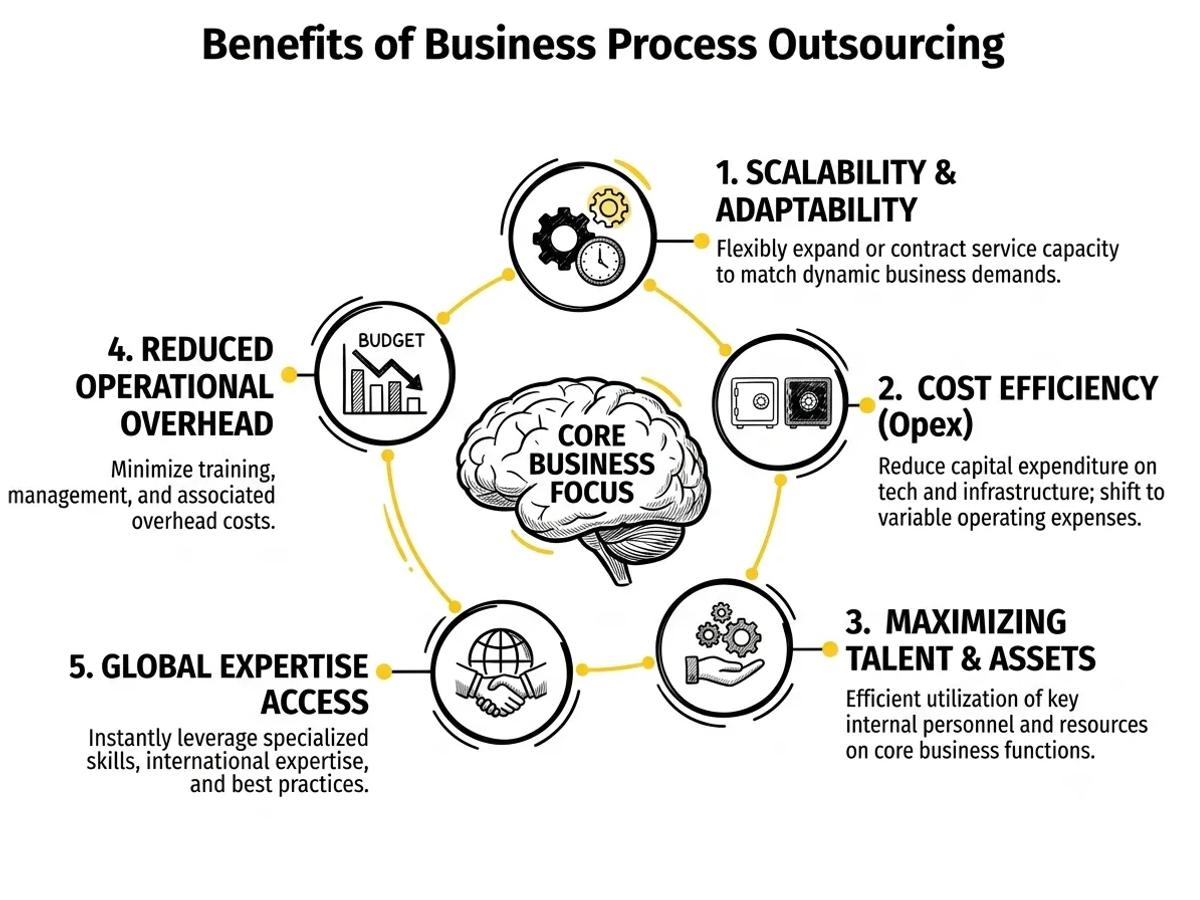
Now to the big question. Why do so many leaders choose this route? The advantages are strong.
- Lower costs: You avoid recruitment fees, office space, equipment and benefits for extra staff.
- Access to experts: You gain skills that may take months to find locally.
- Faster hiring: Providers already have talent pipelines.
- Scalability: You grow your team up or down as demand changes.
- Focus on core work: You spend time on strategy and customers.
- Round-the-clock service: Teams in different time zones can cover nights and weekends.
- Reduced risk: Providers carry compliance and training burdens.
We cover each of these in depth in our full guide to outsourcing advantages.
Why it matters: Gallup research has estimated that replacing an employee can cost between half and two times their annual salary. Outsourcing can lower that burden, especially for hard-to-fill roles.
Top reasons businesses outsource" (cost, expertise, speed, focus, scalability).
Risks and Challenges of Outsourcing in Business
Honest guides show both sides. Outsourcing has risks. Most can be managed with planning.
1. Loss of Control
You rely on someone else's team. Fix this with clear SLAs, weekly check-ins and shared dashboards.
2. Communication Gaps
Time zones and culture can cause delays. Agree on working hours, tools and escalation paths early.
3. Data Security and Privacy
Your partner will touch sensitive data. Ask about encryption, access controls and certifications such as ISO 27001 or SOC 2. Make sure they meet GDPR, CCPA, HIPAA or PIPEDA rules where they apply.
4. Hidden Costs
Setup, training, management time and contract changes can add up. Ask for a full cost breakdown before you sign.
5. Quality Problems
A low price can mean low quality. Run a pilot. Review samples. Set quality metrics.
6. Vendor Lock-In and Vendor Failure
Relying on one supplier is risky. The collapse of UK contractor Carillion in 2018 reminded the market how a single failure can ripple through clients and supply chains. Build exit clauses and backup plans into every deal.
7. Brand and Culture Risk
Outsourced staff may not feel part of your brand. Invest in onboarding. Share your story, values and goals.
Worried about quality or compliance? All Talentz pre-screens every candidate and partner. See how we protect your business.
Real-World Examples of Outsourcing in Business
Stories make ideas stick. Here are a few well-known examples.
Kodak and IBM (1989). Kodak outsourced much of its data centre work. This deal is widely cited as a turning point. It showed that even household names could rely on outside experts.
Slack and MetaLab. The design studio MetaLab helped shape Slack's early brand and interface. Slack later became one of the fastest-growing workplace tools in the world. The lesson? Outsourcing design to specialists can speed up launch.
Apple and contract manufacturers. Apple designs products in California. Partner factories assemble many of them. Apple keeps design and software control in-house. That is a classic "outsource the support, protect the core" move.
A typical small business. Take a dental practice in Mississauga. It outsources bookkeeping, payroll and online booking support. The dentists focus on patients. Admin costs stay predictable. The practice grows without hiring a large office team.
How Much Does Outsourcing Cost in the US, UK and Canada?
Costs vary by task, location and skill level. There is no single price tag. But there are patterns.
| Factor | How It Affects Price |
|---|---|
| Type of work | Specialist roles such as developers or accountants cost more than data entry |
| Location of provider | Onshore teams cost more than offshore or nearshore teams |
| Contract model | Dedicated teams cost more monthly but give more control |
| Volume | Higher volume often reduces the cost per task |
| Service level | 24/7 coverage and fast response times raise fees |
Typical Cost Savings
Many businesses report meaningful savings after outsourcing. Savings often come from lower overhead, no recruitment fees and flexible staffing. Results depend on how well the project is managed.
As a general guide, outsourcing a role can cost far less than a full-time hire in cities like New York, London or Vancouver. Once you add salary, benefits, taxes, equipment and office space, the gap grows. According to the Society for Human Resource Management (SHRM), the average cost per hire in the US has been around $4,700 in recent benchmarking. That figure excludes the ongoing cost of the employee.
Industries That Rely on Outsourcing in Business
Outsourcing is not limited to tech firms. Almost every sector uses it. Here is how different industries apply it.
Healthcare
Clinics and hospitals outsource medical billing, coding, transcription and staffing. In the US, practices in Miami-Dade County and Harris County use billing partners to chase insurance claims. In the UK, private clinics in Greater London and the Home Counties outsource payroll and compliance. In Canada, private health providers in the Greater Toronto Area rely on outside admin support.
Retail and E-commerce
Online shops outsource customer service, warehousing, delivery and digital marketing. Peak seasons such as Black Friday and Christmas need extra hands. Outsourcing lets a store scale for two months without long contracts.
Technology and Software
Start-ups hire outside developers, testers and cybersecurity experts. This helps them launch faster and keep costs lean. Tech hubs like Silicon Valley, Cambridge (UK), Waterloo Region and Austin all use this model.
Finance and Professional Services
Accounting firms, banks and consultancies outsource data processing, reporting and compliance checks. Charlotte, Edinburgh and Toronto's financial district are well-known examples of shared-services hubs.
Hospitality and Construction
Hotels outsource cleaning, security and recruitment. Construction firms outsource payroll, safety training and specialist trades. In both sectors, demand rises and falls. Flexible teams keep payroll under control.
Common Myths About Outsourcing in Business
Many owners hesitate because of old ideas. Let us bust the biggest ones.
Myth 1: Outsourcing is only for big companies. Wrong. Small firms often gain the most. A five-person agency can run payroll, IT support and recruitment through partners and look as polished as a much larger rival.
Myth 2: Outsourcing always means offshore. Wrong. Many deals are local. A London firm can outsource to a Leeds provider. A Vancouver business can outsource to a Calgary team.
Myth 3: Outsourced teams do poor work. Not true when you set clear standards. Quality depends on screening, training and management. It does not depend on geography.
Myth 4: You lose control completely. You do not. You decide the goals, tools, reports and review dates. Strong partners welcome oversight.
Myth 5: Outsourcing is only about saving money. Cost matters. But speed, skill and focus are just as valuable. Many leaders say time saved is the biggest win.
Myth 6: It is too complicated to start. It can be simple. Begin with one small task. Learn. Then expand.
Outsourcing in Business for Start-ups vs Established Companies
Different businesses use outsourcing in different ways.
Start-ups
Start-ups have little cash and big goals. They outsource to move fast. A founder may use outside experts for design, development, accounting and recruiting. This keeps the core team small and focused on the product.
Small and Medium-Sized Businesses
SMEs outsource to compete with larger rivals. They buy HR, payroll, IT and marketing support on demand. This lets them avoid costly full-time hires while keeping service quality high.
Large Enterprises
Large firms outsource at scale. They run shared service centres, global support desks and managed IT. They often manage dozens of vendors at once. Governance and risk control become key.
No matter the size, the rule stays the same. Outsource to gain speed, skill and focus. Do not outsource to escape management.
Should You Outsource? A Simple Decision Checklist
Ask yourself these questions.
- Is this task repeatable and well defined?
- Does it distract my team from higher-value work?
- Would hiring full-time be too expensive or slow?
- Can I measure the results?
- Is the task free from highly sensitive trade secrets?
- Do I have time to manage a partner properly?
If you answered yes to most, outsourcing is likely a good fit. If you answered no to several, start small. Test one process first.
How to Choose the Right Outsourcing Partner
The partner you pick decides whether the project soars or stalls. Use this framework.
Check Experience and Reputation
Ask for case studies, client references and reviews. Look for experience in your industry and region.
Confirm Security and Compliance
Request proof of data protection policies. Ask how they handle breaches. Verify that they understand US state laws, UK GDPR or Canadian privacy rules.
Test Communication
How quickly do they reply? Do they ask smart questions? Early behaviour predicts long-term behaviour.
Review Their Talent Process
How do they find and vet people? A strong partner screens skills, background and culture fit. This is a core strength of a recruitment and outsourcing firm like All Talentz.
Understand the Contract
Read the SLA, termination terms, intellectual property clauses and pricing. Never skip this step.
Start With a Pilot
A two-to-four-week trial shows how the partner works in real life.
A Step-by-Step Roadmap to Outsource Successfully
Ready to act? Follow this roadmap.
- Audit your workload. List every task your team performs. Mark which ones drain time without adding strategic value.
- Set goals. Choose clear targets, such as "cut hiring time by 40%" or "reduce invoice errors to under 1%".
- Pick one process. Start with a single function. Success builds confidence.
- Document the process. Write simple guides and checklists. Great documentation speeds onboarding.
- Select the partner. Use the framework above.
- Onboard fully. Treat the outsourced team like part of yours. Invite them to meetings and share wins.
- Track metrics. Review results weekly at first, then monthly.
- Improve and expand. Fix gaps. Then consider outsourcing more.
Outsourcing Trends Shaping 2026 and Beyond
The market keeps moving. Here is what leaders are watching.
- AI-assisted outsourcing: Providers now use AI for screening, support and reporting. Humans handle judgement and relationships.
- Hybrid teams: Companies blend in-house staff with outsourced specialists.
- Nearshoring: Firms want teams closer in time zone to cut delays.
- Outcome-based contracts: Clients pay for results, not hours.
- Focus on security: Cyber risk is shaping vendor choices.
- Talent from emerging regions: Strong English skills and fast-growing tech communities in parts of Africa, Asia and Eastern Europe are widening the talent pool.
Industry analysts estimate that the global business process outsourcing market is worth well over USD 250 billion, with steady growth expected. Exact figures differ by research firm, but the direction is clear.
Why Businesses in the US, UK and Canada Choose All Talentz
All Talentz is a recruitment and outsourcing firm built for growing businesses. We help you find the right people and the right support, faster.
Here is what that means for you:
- Vetted talent: Every candidate goes through careful screening.
- Flexible models: Choose recruitment, outsourced teams or a blend.
- Local awareness: We understand the hiring landscape and rules in the US, the UK and Canada.
- Clear communication: You always know who is doing what.
- Scalable support: Start with one role. Grow to a full team.
Whether you run a shop in Birmingham, a clinic in Calgary or a start-up in Austin, we match you with people who fit your goals.
Ready to stop doing everything yourself? Let All Talentz build your outsourced team.
Conclusion: What Is Outsourcing in Business and Is It Right for You?
Let us return to Sarah, our bakery owner in Manchester.
She took her friend's advice. She outsourced payroll first. Then bookkeeping. Then part of her hiring. Within a year, she opened two more shops. And she baked again on Saturday mornings.
That is the real answer to what is outsourcing in business. It is not about giving up control. It is about gaining the freedom to do your best work.
Outsourcing is a smart strategy for firms of every size across the US, UK and Canada. Start small. Choose a trusted partner. Measure everything. Then grow.
All Talentz is ready to help you take that first step.
Your next great hire, or your whole outsourced team, is one conversation away.
Frequently Asked Questions About Outsourcing in Business
Outsourcing in business means paying an outside company or expert to do work for you. Instead of hiring staff to handle a task, you hire a provider. The provider delivers the result under a contract. Common examples include payroll, customer service, IT support and recruitment.
A good example is a small clinic that hires an outside firm to handle payroll and bookkeeping. Another is an online store that uses a contact centre to answer customer chats. Large firms do it too. Apple uses partner factories to assemble products, and Kodak outsourced IT work to IBM in 1989.
The main types are business process outsourcing (BPO), IT outsourcing (ITO), knowledge process outsourcing (KPO), HR outsourcing, recruitment process outsourcing (RPO), legal process outsourcing (LPO) and manufacturing outsourcing. Each type covers a different kind of work. Many companies use more than one.
Outsourcing is about who does the work. Offshoring is about where the work is done. You can outsource to a company in your own city. You can also offshore by opening your own team in another country. Many firms combine both, which is called offshore outsourcing.
Businesses outsource to cut costs, access expert skills, hire faster and scale easily. They also want to focus on core activities such as sales, product and strategy. Outsourcing can reduce compliance and training burdens too, since the provider handles part of that work.
Common downsides include loss of control, communication gaps, data security risks, hidden costs and quality issues. Dependence on a single provider is also risky. You can reduce these problems with strong contracts, clear metrics, a pilot phase and regular reviews.
Yes. Outsourcing is legal in all three countries. But each has rules you must follow. In the US, worker classification, wage laws and state privacy laws matter. In the UK, TUPE and UK GDPR apply in many cases. In Canada, provincial employment standards and privacy laws such as PIPEDA apply. Always seek legal advice for your situation.
It depends on the task, provider location, contract type and service level. Hourly and monthly rates can range widely. Onshore specialists cost more than offshore teams. The best approach is to request quotes, compare the total cost and run a small pilot before signing a long contract.
Almost any support function can be outsourced. Popular choices include accounting, payroll, HR, recruitment, IT support, software development, marketing, design, customer service and logistics. Core strategy and brand-defining work are usually better kept in-house.
Yes. Small businesses often benefit most. They get access to skills and systems they could not afford to build alone. With over 33 million small businesses in the US and over 99% of private sector firms in the UK being SMEs, outsourcing is a common growth tool. In Canada, about 98% of employer businesses are small.
BPO stands for business process outsourcing. It means handing a business process, such as customer support, data entry, billing or payroll, to a third-party provider. BPO is one of the largest segments of the global outsourcing industry.
Recruitment outsourcing, or RPO, lets an outside firm manage some or all of your hiring. The provider writes job ads, sources talent, screens candidates and arranges interviews. It saves time and often speeds up hiring. All Talentz offers recruitment and outsourcing support for this purpose.
Check experience, client references, security standards and communication style. Review the contract carefully. Ask how the provider vets its people. Then run a short pilot before committing. Choose a partner that treats your goals as their own.
Freelancers are individual workers who take on projects. Outsourcing usually involves a company that provides a team, management, systems and accountability. Freelancers can be a good fit for small, one-off tasks. A firm is often better for ongoing or complex work.
The debate is complex. Outsourcing can shift work between locations and companies. It can also create new roles, support business growth and open job opportunities for skilled workers worldwide. Many firms report that outsourcing helps them grow and hire more in their core teams.
The biggest risks are data breaches, misuse of data and weak security practices. You remain responsible for protecting customer data even when a vendor handles it. Choose providers with strong certifications, sign data protection agreements and limit access to only what is needed.
Start by listing your tasks and picking one repeatable process. Set clear goals. Research providers and request quotes. Run a pilot, then sign a contract with clear terms. Track results weekly. A recruitment and outsourcing partner like All Talentz can guide you through each step.
Yes. Many businesses do. Offshore outsourcing can lower costs and widen your talent pool. You must still follow your home country's tax, privacy and employment rules. Time zone differences and language skills also matter, so plan communication carefully.