

Daniel had a problem most founders would love. His online store in Toronto was booming. Orders doubled in six months. Then the wheels came off.
Customer emails piled up. Invoices went out late. Two key hires quit in the same week. Daniel was working 80 hours and still falling behind.
Daniel is a composite example. But his story is common. Fast growth exposes every weak spot in a small team.
So he tried something new. He outsourced customer support and bookkeeping to a reliable partner. Within eight weeks, replies took minutes instead of days. His books were clean. And Daniel finally slept.
That change did not come from working harder. It came from the outsourcing advantages that smart leaders use every day.
In this guide, you will discover 12 proven benefits of outsourcing. You will see real numbers, real examples, and practical tips for businesses in the US, UK and Canada.
The main outsourcing advantages are lower costs, access to expert talent, faster hiring, better focus on core work, easy scaling, 24/7 coverage, reduced risk and stronger efficiency. Done well, outsourcing helps a business grow faster with less strain.
What Are the Main Outsourcing Advantages for Business?
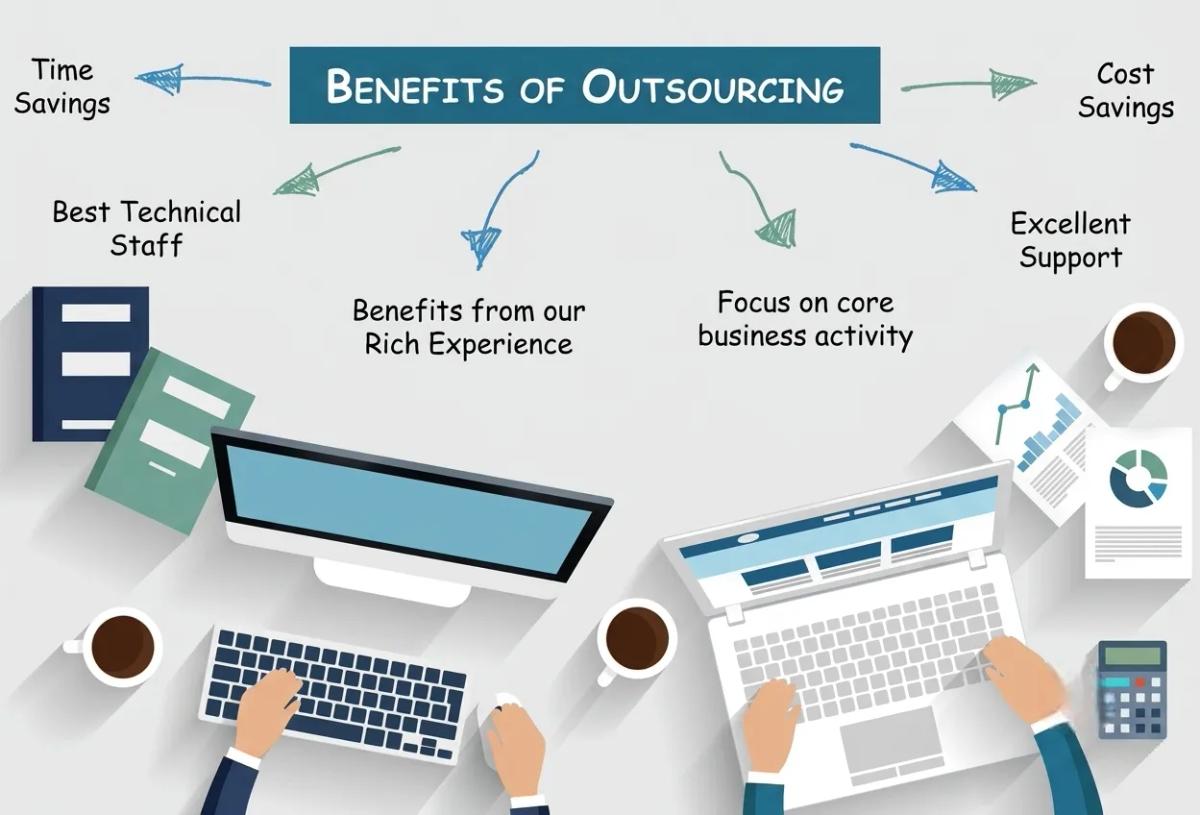
Outsourcing means hiring an outside provider to do work you would normally do in-house. The advantages come from what that provider already has. They have trained people. They have tools. They have proven processes.
You get all of that without building it yourself.
Think of it like renting a fully equipped kitchen instead of building one. You still serve great food. You just skip the construction.
Research backs the trend. The Deloitte Global Outsourcing Survey has repeatedly found that cost reduction remains a leading driver. It also points to access to talent, a sharper focus on core activities and the ability to scale. A Clutch survey of small businesses found that around 37 percent outsource at least one business process. Accounting, IT and customer support are popular choices.
If you are new to the topic, start with our guide on what outsourcing in business means. Then come back here to see the benefits in action.
Outsourcing Advantages at a Glance
Here is a quick view of the 12 benefits we will cover.
| # | Outsourcing Advantage | What You Gain |
|---|---|---|
| 1 | Cost savings | Lower payroll, office and recruitment costs |
| 2 | Expert talent | Skills you cannot easily hire locally |
| 3 | Faster hiring | Ready-to-work people in days, not months |
| 4 | Core focus | More time for strategy, sales and customers |
| 5 | Scalability | Grow or shrink your team on demand |
| 6 | 24/7 coverage | Support across time zones |
| 7 | Lower risk | Shared compliance and legal burdens |
| 8 | Better technology | Tools without heavy investment |
| 9 | Higher quality | Proven processes and quality checks |
| 10 | Less training | Providers handle onboarding |
| 11 | Business continuity | Backup teams when staff leave |
| 12 | Competitive edge | Move faster than rivals |
Outsourcing Advantage #1: Significant Cost Savings
This is the benefit most people think of first. And it is real.
Hiring a full-time employee costs far more than their salary. You also pay for:
- Employer payroll taxes
- Health insurance and pension contributions
- Paid leave and sick pay
- Equipment and software licences
- Office space and utilities
- Recruitment fees and job ads
- Training time
What an In-House Hire Really Costs
The numbers add up quickly. In the US, employers pay 7.65% in Social Security and Medicare taxes on wages. That is before state unemployment taxes and benefits. Data from the US Bureau of Labor Statistics shows that benefits make up close to 30 percent of total compensation for private industry workers.
In the UK, employer National Insurance contributions rose to 15% from April 2025 on earnings above a lower threshold. Employers must also fund workplace pensions through auto-enrolment.
In Canada, employers match Canada Pension Plan contributions. They also pay Employment Insurance premiums at 1.4 times the employee rate.
Now add recruiting. SHRM benchmarking puts the average US cost per hire at around $4,700. Gallup has estimated that replacing an employee can cost anywhere from half to two times their annual salary.
How Outsourcing Cuts Those Costs
With outsourcing, you usually pay one fee for the service. You skip most of the extras.
- No recruitment fees for each new hire
- No office or equipment costs for remote teams
- No long-term benefits packages for outsourced staff
- Lower training costs, since providers handle it
An Illustrative Example
Let us use simple, hypothetical numbers. Suppose a US firm hires an in-house administrator at $55,000. Add roughly 25 to 30 percent for taxes and benefits. The real cost lands near $70,000 or more. Add equipment and space. It climbs higher.
An outsourced administrative partner may charge a monthly fee that is significantly lower. The firm also avoids paying for downtime. Results differ by provider and region, so always compare quotes.
Remember: The goal is not the cheapest price. It is the best value. Always compare total cost of ownership, not just hourly rates.
Outsourcing Advantage #2: Access to Specialised Talent and Expertise
Some skills are rare. Cybersecurity analysts, data engineers, bilingual support agents and certified accountants are hard to find. In busy markets like Greater London, the San Francisco Bay Area and the Greater Toronto Area, competition for them is fierce.
Outsourcing widens your search. You are no longer limited to people who live within commuting distance.
Why Expertise Matters
A specialist has seen your problem before. They solve it faster. They avoid costly mistakes. They bring best practices from many clients.
A small law practice in Cook County, Illinois, may need contract review support. An outsourcing partner can supply trained legal support staff immediately. A manufacturer in the West Midlands may need a part-time finance director. An outsourced professional can fill that role without a full-time salary.
A Global Talent Pool
Today's providers recruit from many regions. Strong English skills and growing tech communities in parts of Africa, Asia and Eastern Europe are expanding the choices. This gives you more people to choose from and better odds of finding the perfect fit.
Need a specialist fast? All Talentz sources pre-vetted professionals for your team.
Outsourcing Advantage #3: Faster Hiring and Speed to Market
Time is money. And hiring is slow.
SHRM research suggests the average time to fill a role in the US is often around 40 to 45 days. For senior or niche roles, it can take longer. In the meantime, work piles up.
Outsourcing partners already have talent pipelines. They have screened candidates. They can often place people in days.
Why Speed Gives You an Edge
- You launch products sooner.
- You respond to customers faster.
- You fill gaps before they hurt revenue.
- You avoid burnout in your current team.
Imagine a retailer in Greater Manchester preparing for the Christmas rush. Hiring and training seasonal staff in-house takes weeks. An outsourced team can start in days. The store captures sales it might have missed.
Speed is also why fast-moving start-ups in Austin, Vancouver and Cambridge love outsourcing. They need to ship, test and learn quickly. Waiting for a hire is not an option.
Outsourcing Advantage #4: Focus on Core Business Activities
Every business has a "genius zone". It is the thing customers pay you for.
For Sarah's bakery, it is the bread. For Daniel's store, it is the product range and brand. For a law firm, it is legal strategy.
Everything else is support work. It matters. But it should not eat your day.
The Hidden Cost of Distraction
When owners spend hours on payroll, IT problems or recruiting, they lose time for sales, strategy and innovation. That is an opportunity cost. It rarely shows on a spreadsheet. Yet it shapes growth.
Outsourcing frees leaders to:
- Talk to customers
- Improve products and services
- Plan expansion
- Build partnerships
- Lead their people
A simple test helps. Ask, "Is this task something only I or my team can do?" If not, consider outsourcing it.
Outsourcing Advantage #5: Scalability and Flexibility
Demand is never steady. Seasons change. Contracts start and end. Markets rise and fall.
In-house teams are slow to adjust. Hiring takes weeks. Letting people go is costly and painful. Outsourcing offers another path.
Scale Up Without Stress
Need five more support agents for a product launch? An outsourcing partner can add them quickly. Need to cut back after the peak? You can scale down under the agreed contract terms.
Real-World Use Cases
- Tax season: Accounting firms in New York County and Greater London add temporary processing staff.
- Holiday retail: E-commerce brands add chat and email agents for November and December.
- Project-based work: Construction and engineering firms in Alberta bring in specialists only for peak project phases.
- New market entry: A US company expanding into the UK can test the market with an outsourced sales or support team before opening an office.
This flexibility reduces risk. You pay for what you need, when you need it.
Outsourcing Advantage #6: 24/7 Operations and Time-Zone Coverage
Customers expect answers at any hour. A late-night email from a shopper in Vancouver should not wait until morning in London.
Outsourcing across time zones makes round-the-clock service possible. When your team in Chicago logs off, a partner team in another region can pick up the work.
Benefits of Follow-the-Sun Support
- Faster response times
- Better customer satisfaction scores
- Fewer overnight emergencies for your in-house staff
- Continuous progress on projects
This model suits e-commerce brands, software companies and financial services firms. It also helps healthcare billing teams and IT help desks that serve clients across the US, UK and Canada.
Of course, coordination matters. Set clear handover rules and shared tools. Then the advantage becomes a real competitive weapon.
Outsourcing Advantage #7: Reduced Risk and Easier Compliance
Rules change. Penalties are real. Small firms rarely have a full legal and compliance team.
An experienced outsourcing partner stays up to date. They know the rules that matter in your region.
Compliance Areas Where Outsourcing Helps
- United States: Payroll tax filing, worker classification, wage and hour rules, state-by-state employment laws and benefits reporting.
- United Kingdom: PAYE and Real Time Information reporting, pension auto-enrolment, right to work checks and UK GDPR. UK employment law is also being updated through government reforms, so expert support is valuable.
- Canada: Payroll source deductions for CRA, provincial employment standards in places like Ontario, British Columbia and Alberta, and privacy rules under PIPEDA and Quebec's Law 25.
A good provider carries part of that burden. They train their people. They run audits. They carry insurance. This lowers your exposure to fines and mistakes.
Note one point. You remain responsible for your legal duties. Outsourcing shares the workload. It does not remove accountability. Always include compliance clauses in your contract.
Outsourcing Advantage #8: Access to Advanced Technology and Tools
Modern tools are expensive. Applicant tracking systems, payroll platforms, customer relationship software, analytics dashboards and cybersecurity tools can cost thousands each year.
Outsourcing partners already pay for these tools. You use them as part of the service.
Examples of Technology You Gain
- Recruitment platforms and AI-assisted screening
- Cloud-based accounting and payroll systems
- Help desk and live-chat software
- Project management and reporting dashboards
- Security monitoring tools
This is especially valuable for small firms in places like Leeds, Sacramento and Winnipeg. They can compete with bigger rivals on tools and service without buying everything outright.
Also, providers keep upgrading. You benefit from new features without extra project costs.
Want enterprise-level tools without the enterprise price? Explore All Talentz outsourcing services.
Outsourcing Advantage #9: Higher Quality and Better Efficiency
Specialists work faster and make fewer mistakes. They do the same type of task all day. They have checklists, quality controls and trained backups.
Consider a bookkeeping provider. They process invoices for dozens of clients. They have seen every odd case. They know the shortcuts. They catch errors early.
How Quality Improves
- Repeatable processes: Standard steps reduce errors.
- Quality assurance: Many providers audit work before delivery.
- Performance targets: SLAs make results measurable.
- Continuous improvement: Providers refine methods across many clients.
Efficiency also improves. Tasks that took your team days may take hours. You see faster turnarounds and fewer reworks.
The key is setting standards. Share examples of excellent work. Agree on metrics. Review them often.
Outsourcing Advantage #10: Lower Recruitment and Training Burden
Hiring is only the beginning. Then comes onboarding, training and management. If the person leaves, you start again.
Outsourcing reduces this cycle. The provider recruits, trains and manages the staff. If one person leaves, the provider replaces them.
Why This Matters
Turnover is expensive. It drains time, knowledge and morale. With outsourcing, the vendor carries that risk.
For example, a customer service outsourcing partner trains its agents on your products and tone. When an agent resigns, the provider finds and trains a replacement. Your service stays steady.
This is where a recruitment and outsourcing firm like All Talentz adds special value. We source and screen talent as part of the process. That means less admin for you and quicker results.
Outsourcing Advantage #11: Business Continuity and Resilience
Sick leave. Resignations. Maternity leave. Unexpected spikes. Every business faces gaps.
When one person owns a critical task, their absence creates a crisis. Outsourced teams offer depth. Several trained people can cover the same work.
Continuity in Action
- Payroll still runs on time when your finance manager is away.
- Customer support stays open during holidays.
- IT problems are fixed even if your tech lead resigns.
The pandemic showed how valuable this is. Businesses with flexible, remote-ready partners adapted faster. Many outsourced teams kept working while offices were closed.
Resilience also covers location risk. A snowstorm in Ontario, a hurricane in Florida or a transport strike in the UK should not stop your operations. Spreading work across teams and regions reduces that threat.
Outsourcing Advantage #12: A Stronger Competitive Edge
All the earlier advantages combine into one big win. You move faster, serve better and spend smarter than rivals who do everything alone.
How Outsourcing Creates Advantage
- Speed: You launch, hire and respond quicker.
- Quality: You use experts, not generalists.
- Cost control: You keep fixed costs low.
- Innovation: You free up time to improve your offer.
- Market reach: You can serve more customers across more time zones.
Think of two competing cafes in Edinburgh. One owner handles everything. The other outsources payroll, bookkeeping and recruitment. Which one has more time to open a second location?
Outsourcing Advantages for Small Businesses in the US, UK and Canada
Small firms are the backbone of all three economies. The US Small Business Administration reports more than 33 million small businesses. Small firms employ close to half of US private sector workers. In the UK, SMEs account for over 99% of the private sector business population. In Canada, around 98% of employer businesses are small.
These owners wear many hats. Outsourcing lets them take a few off.
Outsourcing Advantages for US Small Businesses
- Texas and the Sun Belt: Business owners in Harris County, Dallas County, Maricopa County and Fulton County use outsourcing to handle fast growth and a tight labour market.
- Coastal hubs: Firms in Los Angeles County, King County and New York County use it to access niche tech and creative skills.
- Midwest: Companies in Cook County, Franklin County and Hennepin County (Minneapolis) outsource accounting, HR and logistics support.
Outsourcing Advantages for UK Small Businesses
- London and the South East: Surrey, Kent, Essex, Hertfordshire and Berkshire firms use outsourcing for payroll, IT and HR.
- Northern powerhouses: Greater Manchester, West Yorkshire and Merseyside businesses use outsourced customer care and digital marketing.
- Devolved nations: Firms in Glasgow, Edinburgh, Cardiff and Belfast use outsourcing to win national contracts without large head offices.
Outsourcing Advantages for Canadian Small Businesses
- Ontario: Toronto, Mississauga, Brampton, Hamilton and Ottawa firms outsource HR, bookkeeping and tech support.
- Quebec: Montreal businesses use bilingual outsourcing partners to serve customers in French and English.
- Western and Atlantic Canada: Companies in Metro Vancouver, Calgary, Edmonton, Saskatoon and Halifax access talent outside their local labour pools.
Run a small business in the US, UK or Canada? Get a tailored outsourcing plan from All Talentz.
Outsourcing Advantages by Industry
The benefits show up everywhere. Here are quick examples.
- Healthcare: Medical billing partners speed up claims and reduce denials, which helps clinics in places like Miami-Dade County and Greater Toronto.
- E-commerce: Outsourced support and fulfilment handle peak seasons without permanent hires.
- Technology: Outsourced developers and testers shorten release cycles.
- Finance: Back-office teams process transactions and reports while advisers focus on clients.
- Hospitality: Outsourced recruitment and cleaning staff cover seasonal spikes at hotels and venues.
- Construction: Specialist trades and safety trainers join projects only when needed.
- Education and non-profits: Outsourced admin and fundraising support stretch limited budgets.
Outsourcing Advantages for Remote and Hybrid Teams
Remote work changed how companies think about talent. Your next great hire may live in another county, province or country.
Outsourcing fits this world perfectly. Providers already run remote teams. They know the tools, the habits and the pitfalls.
What Remote-Ready Providers Bring
- Secure cloud systems for file sharing and communication
- Clear daily reporting and project tracking
- Proven onboarding for virtual staff
- Backup plans for power cuts, illness or internet problems
A hybrid model works well too. Keep your strategy team close. Add outsourced specialists for finance, support or recruitment. The result is a lean core with flexible muscle around it.
This approach suits growing firms in the Greater Toronto Area, the Home Counties and Texas suburbs alike. Office rents are high. Commutes are long. Remote-friendly outsourcing helps you reach talent without adding square footage.
Common Mistakes That Waste Outsourcing Advantages
Even great opportunities can fail. Avoid these traps.
Choosing on price alone. The cheapest quote often hides weak quality or extra fees. Compare value, not only cost.
Skipping the brief. Vague instructions lead to vague results. Write down goals, standards and deadlines.
Outsourcing a broken process. If a task is messy in-house, it will be messy outside. Fix and document it first.
Ignoring onboarding. Outsourced staff need context. Share your brand voice, customers and tools.
Weak contracts. Always cover scope, fees, data protection, exit terms and intellectual property.
No ongoing management. Outsourcing is a relationship. Schedule regular reviews and give honest feedback.
Outsourcing everything at once. Start small. Test. Learn. Then expand.
Fix these seven mistakes and your odds of success rise sharply.
What the Data Says About Outsourcing Advantages
Numbers help build trust. Here is what reputable research and government sources highlight.
- The Deloitte Global Outsourcing Survey has repeatedly ranked cost reduction among the top reasons companies outsource. It also shows growing interest in access to talent, speed and innovation.
- A Clutch survey of small businesses found that around 37 percent outsource at least one business process.
- The US Small Business Administration reports more than 33 million small businesses in the United States.
- UK government figures show SMEs make up over 99 percent of private sector businesses.
- Canadian government data shows that about 98 percent of employer businesses are small.
- Industry analysts estimate the global BPO market is worth well over USD 250 billion, although exact figures differ by research firm.
Please note that survey results change from year to year. Always check the latest editions before quoting a statistic in a proposal or presentation.
Outsourcing Advantages for Employees and Company Culture
Many leaders worry that outsourcing hurts team spirit. In fact, it can help.
When routine tasks leave the building, your people can do more meaningful work. A manager who used to chase invoices now coaches the team. A recruiter who used to screen hundreds of CVs now builds relationships with top candidates.
This can improve morale and reduce burnout. People feel valued for their skills, not buried in admin.
Outsourced staff benefit too. Many providers offer training, career paths and steady work. That supports engagement and quality.
To make it work, treat outsourced colleagues with respect. Invite them to team calls. Share wins. Use their names. Culture grows from habits, not job titles.
Outsourcing Advantages vs Disadvantages: A Balanced View
Smart readers want the full picture. Outsourcing is powerful, but it is not perfect.
| Advantage | Possible Downside | How to Manage It |
|---|---|---|
| Lower costs | Hidden fees or setup costs | Request a full cost breakdown upfront |
| Access to experts | Less direct control | Use SLAs and weekly reviews |
| Faster hiring | Culture fit may take time | Onboard the team into your brand and values |
| 24/7 coverage | Time-zone friction | Agree on handover rules and shared tools |
| Reduced compliance risk | You still carry legal responsibility | Add compliance clauses and audit rights |
| Scalability | Over-reliance on one vendor | Keep backup providers and exit clauses |
The message is clear. Most downsides are manageable with planning. Strong contracts and open communication turn risks into routine tasks.
Outsourcing Advantages vs In-House Hiring: When Each Makes Sense
Outsourcing is not always the answer. Sometimes in-house is better. Knowing the difference saves money and headaches.
Choose Outsourcing When
- The task is repeatable, such as payroll, data entry or first-line support.
- You need a rare skill for a short time, such as a security audit.
- Demand rises and falls through the year.
- You need to hire quickly and cannot wait for a long search.
- You want to test a new market before committing to an office.
Choose In-House When
- The work shapes your brand, culture or secret sauce.
- You need daily, close collaboration between small teams.
- The role involves deep, long-term relationships with key clients.
- Your legal or security rules require staff on your own payroll.
The Hybrid Sweet Spot
Most winning companies blend both. They keep strategy, product and leadership in-house. They outsource support, specialist and seasonal work. That mix delivers control and flexibility at the same time.
Take a growing accountancy firm in Hertfordshire. Partners and senior advisers stay in-house, because client trust is personal. Data entry, payroll processing and recruitment are outsourced. Partners spend more time with clients. Costs stay under control. Growth feels manageable.
Take a SaaS start-up in Austin. Product managers and core engineers are in-house. Quality testing, customer support and recruiting are outsourced. The team ships faster and keeps its culture tight.
The pattern repeats from Ottawa to Orange County. Outsource the support. Protect the core.
How to Maximise Outsourcing Advantages: 9 Practical Tips
Great results are not automatic. Use these tips to get the most from outsourcing.
- Start with a clear goal. Know what you want to improve: cost, speed, quality or coverage.
- Choose the right tasks. Pick repeatable, measurable work first.
- Pick a partner, not just a vendor. Look for people who care about your success.
- Run a pilot. Test with a small project before scaling.
- Set measurable KPIs. Examples include response time, accuracy rate and cost per task.
- Invest in onboarding. Share your brand voice, tools and values.
- Communicate often. Hold weekly check-ins and share feedback.
- Protect your data. Use secure tools and signed data agreements.
- Review and refine. Update scope and goals as you grow.
How to Measure the ROI of Outsourcing
You cannot improve what you do not measure. Track a handful of simple metrics.
- Cost per task or per hire: Compare before and after.
- Time saved: Count hours your team regains each month.
- Speed: Measure time to hire or time to resolve a ticket.
- Quality: Track error rates and customer satisfaction scores.
- Revenue impact: Note new sales or projects enabled by freed-up time.
A Simple ROI Formula
ROI = (Savings and gains from outsourcing minus outsourcing cost) divided by outsourcing cost.
Here is a hypothetical example. A firm spends $60,000 a year on outsourced services. It saves $90,000 in salaries, benefits and recruitment, and gains $20,000 through faster project delivery. Net gain is $50,000. ROI is about 83 percent. Your numbers will differ, but the method stays the same.
Real Examples of Outsourcing Advantages in Action
Slack and MetaLab. The start-up worked with the design studio MetaLab on early brand and interface design. Slack reached a fast launch with polished design, without building a large design team first.
Kodak and IBM. In 1989, Kodak outsourced data centre operations to IBM. The move showed that even large firms can gain focus by trusting specialist partners.
A small clinic in Mississauga. The practice outsources billing and payroll. Doctors see more patients. Cash flow improves because claims are processed on time.
A retail brand in Greater Manchester. Seasonal support is outsourced every November. Customer satisfaction stays high. Permanent payroll stays flat.
Why Choose All Talentz for Outsourcing Service?
All Talentz is a recruitment and outsourcing firm. We help businesses in the US, UK and Canada turn the advantages above into real results.
Here is how we help:
- Talent sourcing: We find skilled, pre-screened professionals for your needs.
- Outsourced teams: We build teams that fit your goals and culture.
- Fast turnaround: We move quickly so you can too.
- Flexible engagement: Hire one person or a whole department.
- Honest guidance: We tell you if outsourcing is not the right fit.
Our approach is simple. We listen first. We match carefully. We support you every step.
Ready to unlock the outsourcing advantages for your business? Speak to the All Talentz team.
Conclusion: Outsourcing Advantages Are Your Shortcut to Growth
Back to Daniel in Toronto.
Six months after outsourcing, his store had doubled again. His team was happy. His customers left better reviews. And he finally had time to plan his next product line.
Daniel did not become a better worker overnight. He became a better leader. He chose where his time mattered most.
That is the real power of outsourcing advantages. They give you time, talent and room to grow. Whether you run a firm in Houston, Birmingham or Calgary, the same truth applies.
Start small. Choose wisely. Measure results. Then scale.
And if you want a partner who will walk with you, All Talentz is ready.
Frequently Asked Questions About Outsourcing Advantages
The main advantages are cost savings, access to specialist talent, faster hiring, more focus on core activities, scalability, 24/7 coverage, reduced compliance risk, better technology, higher quality and business continuity. Together, they help companies grow with less strain.
The top five benefits are lower costs, access to expert skills, faster hiring, better focus on your core business and flexible scaling. These are the benefits most businesses mention first. Many also add reduced risk and round-the-clock support.
Outsourcing saves money by cutting recruitment fees, payroll taxes, benefits, office space, equipment and training costs. You usually pay a single service fee. You also avoid paying for idle time. Savings vary, so compare the full cost of an in-house hire with a provider's quote.
Small businesses gain access to skills and systems they could not afford alone. They can compete with larger firms, handle growth spurts and free up owners from admin tasks. With millions of small firms across the US, UK and Canada, outsourcing is a common growth tool.
Advantages include lower costs, expert skills, speed and flexibility. Disadvantages include reduced control, possible communication gaps, data security risks and hidden costs. Most disadvantages can be reduced through clear contracts, good communication, security checks and regular reviews.
For many small businesses, yes. It is especially worthwhile when tasks are repetitive, specialist or time-consuming, and when hiring full-time would be too costly. Start with one task, measure the results and expand if it works well.
Recruitment outsourcing speeds up hiring, widens your talent pool and reduces admin. A specialist firm writes job ads, screens candidates and shortlists the best. This frees your managers to focus on interviews and onboarding. It can also reduce the cost of bad hires.
HR outsourcing gives small firms expert help with payroll, benefits, compliance and employee support. It reduces errors and legal risks. It also saves time and offers access to better tools. See our guide on HR outsourcing companies for small business to learn more.
Offshore outsourcing can reduce costs, expand your talent pool and enable round-the-clock operations. It lets you tap skills that may be scarce locally. You must plan for time zones, communication and compliance, but many firms find the trade-off worthwhile.
It can. Specialist providers use proven processes, quality checks and trained teams. They handle the same tasks daily and know common pitfalls. Quality still depends on clear standards, good onboarding and regular reviews from your side.
Outsourcing lets you add or reduce capacity quickly. You can bring in more people for busy seasons or new projects without long hiring cycles. This flexibility helps you grow without heavy fixed costs.
Accounting, payroll, HR, IT support, customer service, marketing, design, software development and recruitment benefit the most. These functions are repeatable, specialist and easy to measure. Core strategy and brand-defining work usually stay in-house.
Yes. Large companies use outsourcing to reduce costs, run shared service centres, cover multiple time zones and access niche skills. Kodak's 1989 outsourcing of IT operations to IBM is a well-known example of a big firm gaining focus through partners.
Set clear goals, choose repeatable tasks and pick a trusted partner. Run a pilot, track KPIs and communicate often. Protect your data with strong contracts. Review results regularly and adjust. A recruitment and outsourcing firm like All Talentz can guide you.
It can reduce workload and error risk because providers stay up to date on rules. However, you still hold legal responsibility. Include compliance clauses, audit rights and data protection terms in your contract. Seek legal advice for your location and industry.
It can be, if you choose carefully. Look for providers with strong security practices, such as encryption, access controls and recognised certifications like ISO 27001 or SOC 2. Sign data protection agreements and comply with GDPR, CCPA, HIPAA or PIPEDA where they apply.
For most businesses, it is the combination of time and focus. Cost savings matter. But the ability to spend your energy on customers, product and strategy often creates the biggest long-term gain.
Some benefits, such as faster response times or cleaner books, can appear within weeks. Larger gains, like cost savings and growth, often show over several months. A pilot project helps you see early results and decide how to expand.
Your growth story starts with one smart decision. Contact All Talentz today.