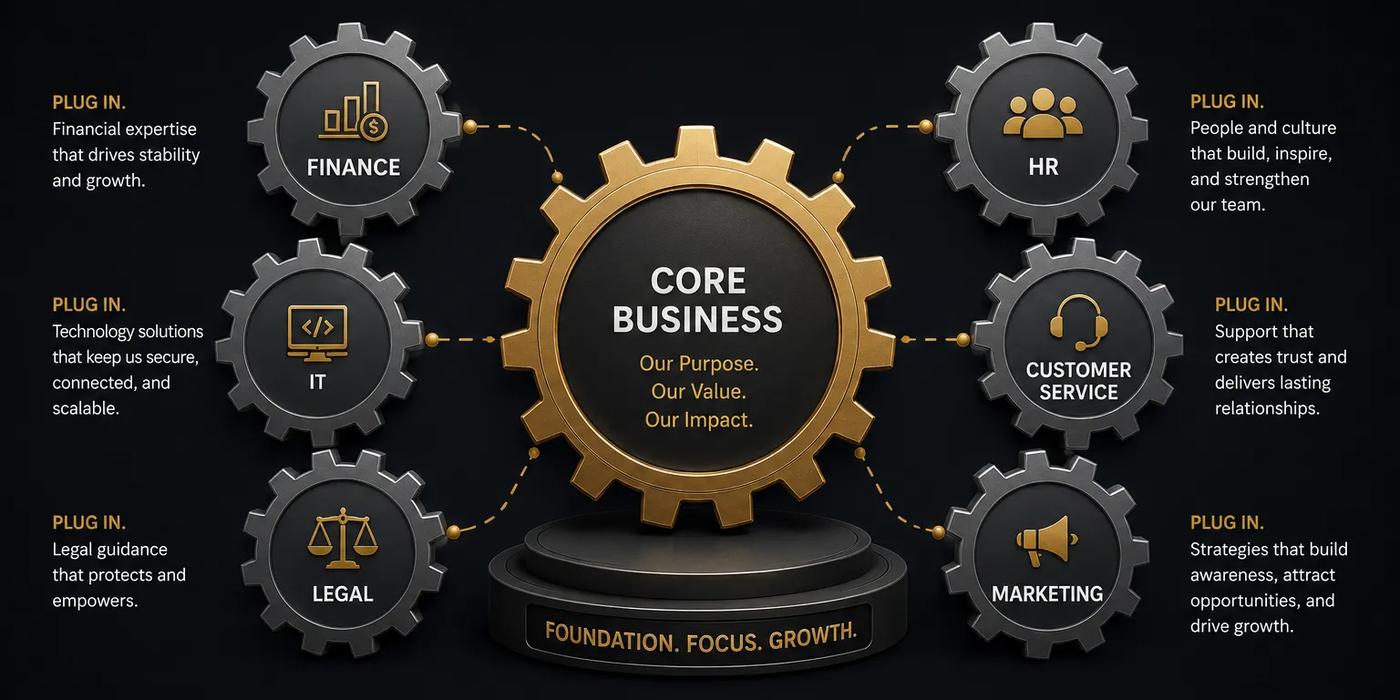
Most business owners arrive at outsourcing business functions through urgency rather than strategy: a function breaks down, a key hire leaves, a cost line becomes impossible to justify, and outsourcing emerges as the fastest available fix. That approach works sometimes. But it also produces the pattern that causes most outsourcing decisions to underperform: the wrong function gets outsourced, or the right function gets outsourced to the wrong partner, and the business ends up managing the arrangement more than the function it was supposed to remove from management's plate.
The data on outsourcing business functions at scale is clear about the outcomes when the decision is made strategically. Companies report average cost savings of 15% to 30% through outsourcing, according to the International Association of Outsourcing Professionals (IAOP) 2023 Global Outsourcing Report cited by MyOutDesk. Businesses that outsource finance functions specifically save 20% to 60% on operational costs while improving accuracy, according to Insignia Resources. Cost reduction, however, is no longer the primary driver: only 34% of executives now cite cost reduction as their main outsourcing motivation, down from 70% in 2020, according to Deloitte's Global Outsourcing Survey 2024. What replaced it is access to specialized talent, digital transformation capabilities, and operational flexibility that growing companies cannot build in-house at the speed their business demands.
This post provides a decision framework for outsourcing business functions: a set of clear criteria to evaluate any function in your business, an evidence-based breakdown of which functions are most effectively outsourced and why, and a clear-eyed view of what belongs in-house regardless of cost pressure. For a foundational overview of what outsourcing is and why businesses use it, our post on what outsourcing is and seven critical things every business owner must know covers that ground thoroughly.
The Principle Behind Every Outsourcing Business Functions Decision
Before applying any framework, there is a single distinction that underlies every good outsourcing decision: the difference between core and non-core functions.
Core functions are the capabilities that define what your business does and that directly determine whether you win or lose competitively. They are the functions that, if they were suddenly operated by a competitor instead of by you, would remove your competitive advantage. A law firm's legal judgment is core. A software company's product architecture is core. A healthcare business's clinical protocols are core.
Non-core functions are the operational functions that every business needs to run but that do not create competitive differentiation. Every business needs accurate accounting. Every business needs IT infrastructure. Every business needs customer communications handled well. These are not lower-priority functions. Done poorly, they create operational failures that undermine everything else. But they are not where competitive advantage is built, and they are therefore where outsourcing business functions produces the highest return without the highest risk.
The complication is that the line between core and non-core is not universal. It depends on your business model, your growth stage, and your competitive landscape. The framework below gives you the criteria to draw that line for your specific operation.
The Four-Criteria Framework for Outsourcing Business Functions
Apply these four criteria to any function in your business to determine whether outsourcing it makes strategic sense.
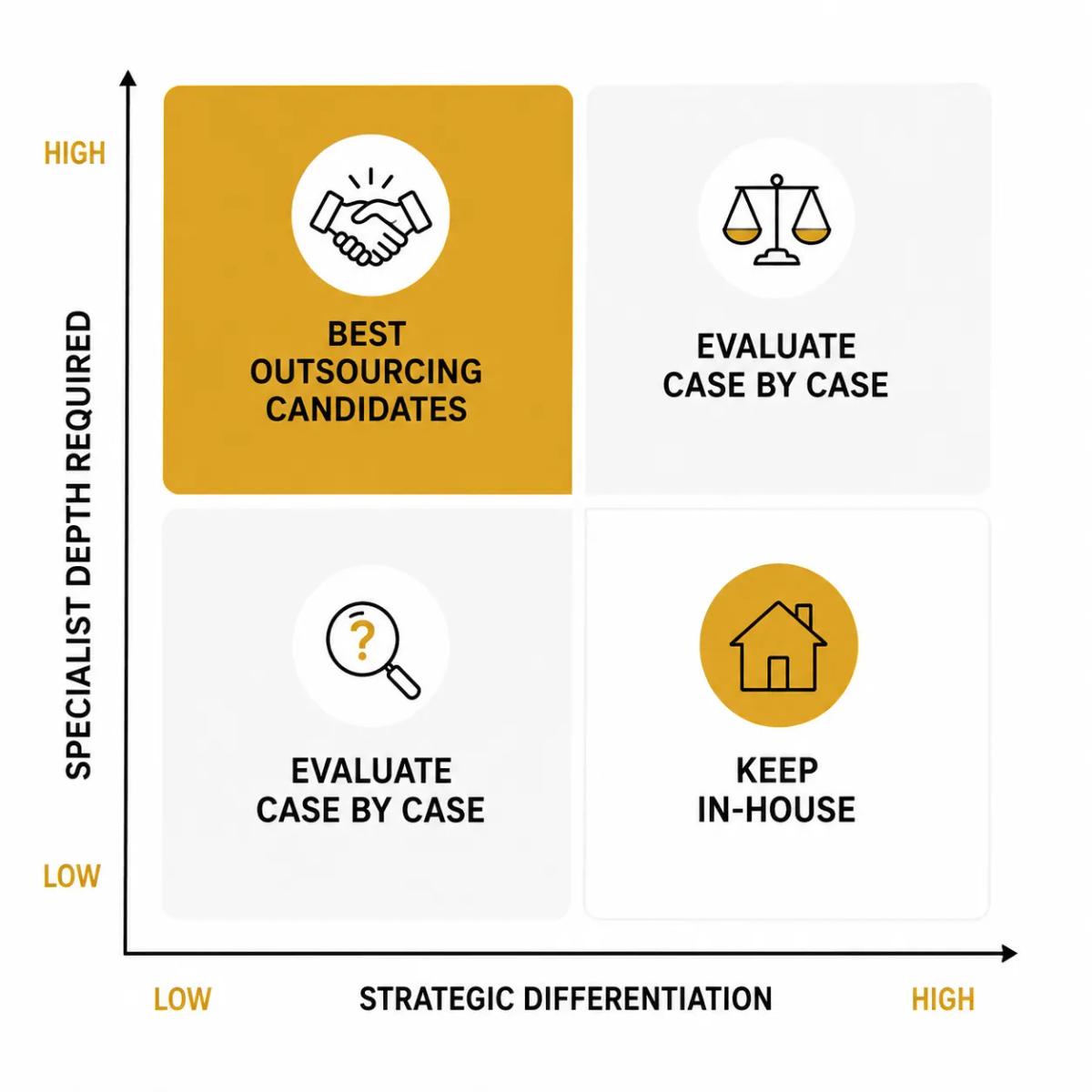
Criterion 1: Does this function require deep knowledge of your proprietary systems, strategy, or competitive IP? If the answer is yes, the function likely belongs in-house, at least at the leadership and decision-making level. If the answer is no, it is a strong candidate for outsourcing business functions to a specialist.
Criterion 2: Is this function better served by depth of expertise than by institutional context? Some functions require a professional who is simply better at the specific discipline than anyone you could justify hiring full-time. Tax compliance, AI development, cybersecurity, and legal research are all examples where specialist depth consistently outperforms generalist internal knowledge. If specialist depth matters more than institutional familiarity, outsourcing the function to a pre-vetted expert will almost always produce better outcomes.
Criterion 3: Does demand for this function fluctuate enough that fixed full-time headcount is inefficient? If your need for a function scales up and down with your business cycle, project pipeline, or seasonal demand, outsourcing it gives you capacity that flexes without the overhead of fixed employment during low-demand periods.
Criterion 4: Is the full cost of running this function in-house disproportionate to its strategic impact? This is not just salary. It is the sum of salary, employer taxes, benefits, equipment, management time, and recruitment cost each time the role turns over. For functions where that full cost is high relative to the competitive differentiation the function creates, outsourcing business functions almost always pencils out strongly.
If you have identified functions that meet these criteria, All Talentz places pre-vetted remote professionals across finance, technology, legal, and operations in as little as 7 days. Request Talent from All Talentz to start the conversation.
The Functions That Outsourcing Serves Best
Finance and Accounting
Finance and accounting is the second most outsourced business function globally, with 37% of small businesses outsourcing accounting services, according to Insignia Resources. IT services rank first. For most growing businesses, finance is a perfect candidate for outsourcing: it requires deep specialist knowledge of tax compliance, regulatory standards, and financial reporting; demand for it remains relatively consistent; and the full cost of an in-house accounting team at the level required to manage it properly is significant.
The specific finance functions that outsource best include accounts receivable, accounts payable, payroll, financial analysis, and bookkeeping. Payroll is particularly well-established: 73% of US businesses already outsource payroll, according to Emapta's outsourcing statistics research, reflecting how widely recognized the compliance and accuracy benefits of specialist handling have become. Companies that outsource HR functions including payroll save an average of 27.2%, according to Microsourcing.
All Talentz places pre-vetted accounts receivable specialists, financial analysts, payroll specialists, and bookkeepers through our finance talent services.
Information Technology
IT outsourcing is the single largest category in the global outsourcing market, accounting for approximately 72% of all global outsourcing contract values, according to MyOutDesk. On average, 76% of IT work including development, infrastructure, and support is delivered by external providers or shared services in organizations that have adopted a multi-sourced operating model, according to Deloitte's Global Outsourcing Survey.
Technology roles are strong outsourcing candidates because specialist depth is the primary value driver: a developer who has mastered a specific language, framework, or AI discipline is more valuable than a generalist who can do a bit of everything, and building that depth across every technology your business needs would require a team most growing companies cannot justify. The specific roles that outsource most effectively in technology include software developers, AI and ML specialists, UI/UX designers, data annotators, and QA engineers.
All Talentz places pre-vetted technology professionals through our tech talent services.
Customer Service and Call Handling
Customer service is the most outsourced function globally, with 38% of businesses outsourcing it, according to Insignia Resources. The case for outsourcing this function is built around coverage, consistency, and scalability: a dedicated remote customer service professional can provide extended coverage at a fraction of the cost of maintaining equivalent in-house coverage, and the function scales without proportional headcount growth as the business expands.
The distinction that matters here is between shared and dedicated customer service arrangements. A shared call center pool produces agents who know multiple clients' products superficially. A dedicated remote CSR assigned exclusively to your business builds the product knowledge, tone familiarity, and customer relationship quality that drives repeat business and positive reviews. All Talentz places dedicated call center support and client outreach professionals who work exclusively for one client, building the contextual knowledge that makes customer interactions genuinely useful rather than scripted.
Legal Research and Paralegal Support
Legal support outsourcing is one of the fastest-growing categories in professional services outsourcing. For businesses in the legal industry, the case for outsourcing legal research and paralegal functions is particularly strong: these are expertise-intensive roles where specialist depth matters enormously, and the demand fluctuates with caseload in ways that make fixed full-time headcount chronically either over or under-resourced.
For businesses outside the legal industry that have recurring legal support needs, outsourcing these functions to trained remote professionals provides compliance coverage and document management capability without the cost of in-house legal staff. Our legal talent services place legal researchers, paralegals, and legal receptionists who understand the operating environment of legal practice.
Healthcare Billing and Revenue Cycle
Medical billing and healthcare revenue cycle functions are among the most technically demanding and compliance-intensive in any industry. 71% of companies outsource tax preparation because it requires specialized expertise, according to Insignia Resources, and the same principle applies to healthcare billing: the complexity of insurance claims, denial management, coding accuracy, and HIPAA compliance requirements means that generalist handling consistently produces errors that cost the practice significantly more than specialist handling would.
Our healthcare talent services place medical billing specialists and healthcare support professionals who understand the specific compliance and revenue cycle environment of healthcare operations.
Restoration Estimating and Operations Support
Restoration businesses face an outsourcing business functions decision that is shaped by the project-based nature of their work: estimating, billing, and operations support demand surges with the project pipeline and falls when it contracts. Maintaining full-time in-house estimators and billing staff at the headcount needed during peak periods creates fixed overhead against variable revenue that erodes margins over the business cycle.
Our remediation talent services place estimators and operations professionals whose skills are pre-verified before placement.
Pest Control Support Functions
Pest control businesses carry administrative functions, including CSR coverage, recurring billing management, and multi-location accounting, that are strong outsourcing candidates: they are non-core to the technical service delivered, they require consistent specialist handling, and they represent significant fixed cost against a business model that has seasonal revenue variation.
Our pest control talent services place CSRs, accountants, and sales support professionals for pest control operations.
The Functions That Should Stay In-House
Not every function passes the four-criteria test. These are the categories where outsourcing business functions typically creates more problems than it solves.
Core leadership and strategic decision-making. The judgment calls that determine your company's direction, culture, product positioning, and competitive strategy belong with people who have deep ownership in the outcomes and deep context about the business. These are not functions to outsource.
Proprietary product development at the architecture level. For technology businesses, the architectural decisions about how your product is built are competitive IP. External developers can build features, integrate systems, and manage QA. The product vision and core architecture decisions are different.
Client relationship ownership for key accounts. The relationship between your business and its most important clients is a core asset. Support functions within that relationship, billing, logistics, follow-up communication, can be handled by dedicated remote professionals. The relationship itself, the senior conversations about strategy and value, belongs with your internal team.
Anything where full institutional context is the primary value. Some roles create value almost entirely through accumulated knowledge of your specific systems, processes, and history. Those roles are better served by people who build that knowledge inside the organization over time.
For more on how to navigate the in-house vs outsourced decision across specific business functions with cost data included, see our post on in-house hiring vs outsourcing remote talent.
Not sure which functions in your specific business are the right outsourcing candidates? Contact All Talentz and talk through your operation with our team. We will tell you where our pre-vetted professionals deliver the most impact.
Why the Partner Choice Matters as Much as the Function Choice
Once the decision about which business functions to outsource is made, the variable that most determines whether the arrangement delivers what it promised is the partner through which the outsourcing is done. The data on this is specific: 52% of businesses prefer professional outsourcing providers over freelance platforms because structure, accountability, and system fit matter more than cost in determining outcomes, according to Microsourcing.
The markers that separate a partner who delivers from one who creates a management problem:
Pre-vetting that covers the specific function, not just general professionalism. The partner should be able to tell you exactly what assessment they ran on the professional they are placing with you, specifically relevant to the function your business needs.
Dedicated placement rather than a shared resource model. A professional working across multiple clients cannot build the functional knowledge of your specific business that makes them genuinely useful rather than generally competent.
Management infrastructure that continues after placement. The arrangement needs ongoing oversight, not just an initial match.
Replacement guarantees that remove the risk of a bad match dragging on. The cost of an underperforming outsourced professional is the same as the cost of an underperforming in-house hire, minus the severance complications, but only if the partner replaces quickly.
All Talentz is built around all four of these markers. Every professional placed through All Talentz is pre-vetted and pre-trained before the client conversation begins, exclusively assigned to one business, supported by a dedicated relationship manager who monitors performance after placement, and replaceable immediately when a placement is not the right fit. For more on what this model looks like compared to a traditional staffing agency, see our post on what a dedicated remote staffing company does differently.
Conclusion
Outsourcing business functions works when three conditions are met: the right function is chosen based on a clear evaluation of core versus non-core, the specialist depth available through outsourcing genuinely exceeds what the business could build internally at comparable cost, and the partner used to execute the placement provides the vetting, management, and replacement infrastructure to make the arrangement reliable rather than risky. Most outsourcing decisions that fail do not fail because outsourcing does not work. They fail because one of these three conditions was not met. The framework in this post gives growing companies the criteria to meet all three before the decision is made, rather than discovering through experience which condition was skipped. All Talentz provides the partner infrastructure that makes the third condition straightforward: pre-vetted dedicated professionals placed across finance, technology, legal, healthcare, restoration, and pest control operations, with management support and replacement guarantees that remove the execution risk from the arrangement.
Outsourcing a business function to a managed service provider means handing a process to an external firm that owns and delivers it. Hiring a dedicated remote professional through a full talent partner like All Talentz means the professional is exclusively assigned to your business, works within your tools and workflows, and builds institutional knowledge over time, exactly like an in-house hire but without the direct employment overhead and recruitment delay.
IT services and technology development lead globally, accounting for approximately 72% of all global outsourcing contract values. Finance and accounting are second, with 37% of small businesses outsourcing accounting services. Customer service is the most outsourced single function, with 38% of businesses using external providers. Payroll is outsourced by 73% of US businesses, digital marketing by 34% of small businesses, and legal research and HR functions are among the fastest-growing outsourcing categories.
Apply the four criteria described in this post: does the function require proprietary strategic knowledge, is specialist depth more valuable than institutional context, does demand fluctuate enough to make fixed headcount inefficient, and is the full in-house cost disproportionate to the strategic impact the function creates? Functions that score low on criteria one and high on criteria two through four are strong outsourcing candidates.
Core leadership and strategic decision-making, proprietary product architecture for technology businesses, senior client relationship management, and any role where accumulated institutional knowledge is the primary source of value should remain in-house. The common thread is that these functions derive their value from deep business context and strategic ownership that external professionals cannot replicate.
Cost savings range significantly depending on the function and the provider model. IAOP research shows average savings of 15% to 30% across outsourcing arrangements generally. Finance-specific outsourcing produces savings of 20% to 60% on operational costs, according to Insignia Resources. Payroll outsourcing saves an average of 22% per Insignia Resources data. HR function outsourcing saves an average of 27.2% per Microsourcing data. The savings are highest when the outsourced professional is dedicated and pre-vetted, rather than shared or unscreened.
All Talentz pre-vets and pre-trains every professional before placement, matches them exclusively to one client business, provides work tools and employment infrastructure on the All Talentz side, assigns a dedicated relationship manager to monitor performance after placement, and replaces immediately if the match is not right. The model addresses the three conditions that determine whether outsourcing succeeds: function fit, specialist quality, and partner infrastructure.