
Most content about data entry outsourcing is written from one direction: here are all the reasons to do it, here is how much you will save, here is why it is always the right move. That framing is useful if the decision has already been made. It is not useful if you are genuinely trying to figure out whether you should outsource data entry for your business right now, or whether it would create more friction than it solves.
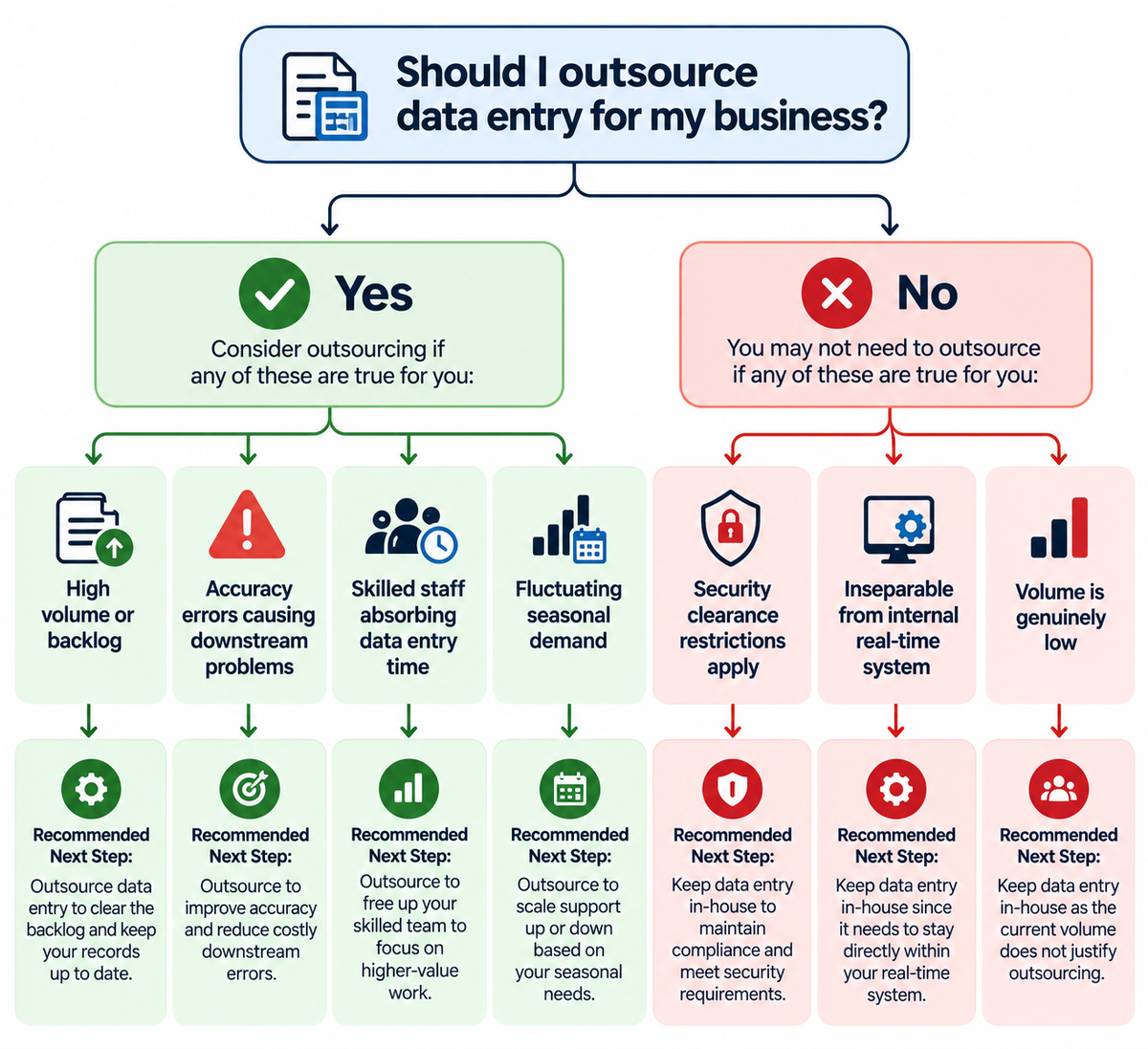
This post covers both directions honestly. Four situations where the decision to outsource data entry for business operations is clearly the right call. Three situations where it is not. And once the answer is yes, what to put in place before day one so the arrangement actually delivers.
The goal is a real decision framework rather than a sales pitch, because a data entry outsourcing arrangement that is not the right fit produces wasted cost and management headaches, and one that is the right fit produces measurable operational improvement. Knowing which situation you are in is what matters before you commit.
When the Answer Is Yes: Four Signs to Outsource Data Entry for Business
1: Your Team Is Spending Skilled Hours on Work That Does Not Require Their Skills
This is the most common and most overlooked reason businesses should outsource data entry for business operations. Not because data entry is unimportant, but because the people currently doing it were hired for something else entirely.
A July 2025 survey of 500 US professionals conducted by Parseur and QuestionPro, covered by Tab Service, found that employees spend an average of more than nine hours per week transferring data between systems, and that manual data entry costs US companies an average of $28,500 per employee per year when labor time is fully accounted for. These are not data entry specialists absorbing those hours. They are salespeople, account managers, practice coordinators, and operations staff whose actual job is not data entry but who are doing it anyway because no one else is.
When you outsource data entry for business, the immediate change is not always data quality or speed, though both typically improve. The immediate change is that the people you hired for specialized work are available for specialized work again. That reallocation of skilled labor is almost always worth more to the business than the direct cost of the data entry itself.
2: Data Accuracy Errors Are Creating Downstream Consequences
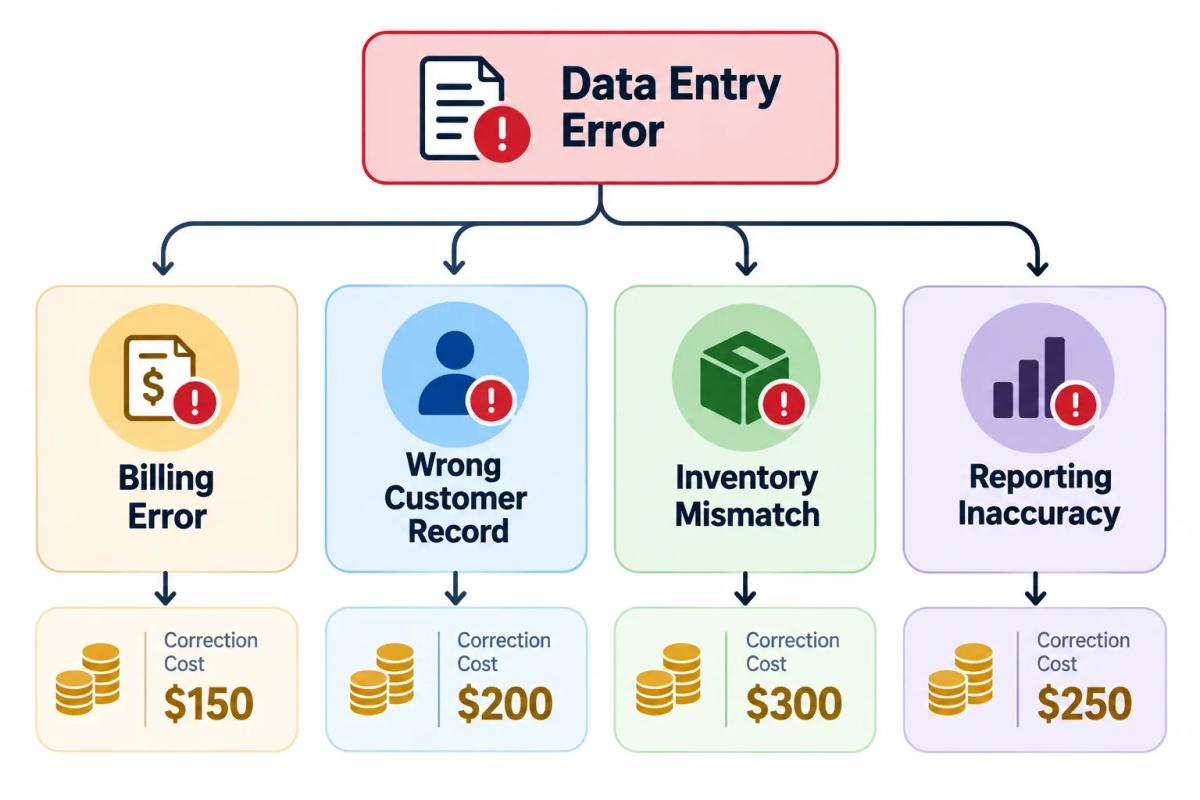
A data error is rarely contained to the data itself. An incorrect customer address in the CRM generates a returned shipment. A wrong billing code produces a denied claim. A duplicate inventory entry creates a phantom fulfillment error. A transposition in a financial record produces a reconciliation exception that takes three people an afternoon to trace and correct.
According to ARDEM's data entry outsourcing research, the average human error rate is approximately 1% per data entry field. Professional outsourcing providers operating with quality control processes maintain error rates below 1%. Applied across 10,000 records per month, the difference between a 1% error rate and a below-1% rate is dozens of prevented errors monthly, and each error carries a correction cost measured in staff hours, delayed payments, or customer service interactions.
When data accuracy errors have moved from an occasional nuisance to a recurring operational problem, the issue is almost never carelessness. It is volume, divided attention, or absence of a quality control process. All three are addressed structurally when you outsource data entry for business to a specialist whose entire function is accurate, quality-checked data processing.
All Talentz places dedicated data entry professionals whose accuracy and tool proficiency are verified before placement. Request Talent from All Talentz and have a qualified data entry specialist working for your business in less than 48 hours.
3: Your Data Entry Volume Fluctuates Too Much for a Fixed Full-Time Hire
Many businesses experience data entry demands that vary meaningfully across the year. A retail business that processes thousands of product records during a seasonal expansion and far fewer in quieter months. A legal firm that receives a large document production set on one matter and then operates at lower volume before the next significant case. A construction business with concentrated estimating and project data during active build periods.
In each scenario, the business needs more data processing capacity than its current team has, but the demand is not steady enough to justify a permanent full-time hire at full employment overhead. An in-house hire for a variable-demand function costs the same during quiet periods as during peak ones.
When businesses outsource data entry for business needs in this situation, they access the capacity they need when they need it, without maintaining fixed overhead when the demand is lower. The outsourced arrangement scales with actual data volume rather than being sized for average or peak demand and leaving one extreme overstaffed and the other understaffed.
4: You Have a Specific Backlog That Needs Clearing Without Disrupting Current Operations
Data backlogs are a distinct category from ongoing data entry demand. A business that has accumulated months of unprocessed customer records, a legal department that needs historical case files digitized for a new matter management system, a healthcare practice that needs paper charts converted to electronic records for an EHR migration: each is a defined project with a clear scope and an endpoint.
Asking current staff to clear a significant backlog while managing their ongoing responsibilities is a reliable way to produce neither the backlog clearance nor the ongoing work being done well. When businesses outsource data entry for business backlog projects, they get a professional whose full attention is on clearing the backlog without pulling their existing team off the functions they currently manage.
When the Answer Is No: Three Situations Where Outsourcing Data Entry Is Not the Right Move
Honest frameworks include what does not work, not just what does.
1: The Data Requires Security Clearance or Access Restrictions That Remote Staff Cannot Satisfy
Some data is subject to security requirements, regulatory access controls, or client contractual restrictions that limit who can handle it and under what conditions. Defense contractors with classified information obligations, financial institutions with specific data residency requirements under regulations such as GDPR for European data or specific government security frameworks, or client agreements that contractually prohibit third-party data access are cases where the security constraint takes precedence over the operational case for outsourcing.
Before deciding to outsource data entry for business operations, verify whether any of the data involved is subject to such constraints. If it is, the question is not whether outsourcing is operationally efficient but whether it is compliant, and compliance wins that analysis.
2: The Data Entry Is Inseparable From a Real-Time System That Requires Direct Internal Access
Some data entry workflows are deeply integrated with live internal systems, proprietary databases, or real-time operational tools in ways that make remote access impractical without significant IT infrastructure changes. If every entry requires a decision that only a deeply experienced internal team member can make in context, or if the system cannot be accessed securely by a remote professional without creating compliance exposure, the friction cost of outsourcing may genuinely exceed its benefit.
The practical test: can the data entry workflow be documented clearly enough that a qualified external professional could follow it accurately without requiring constant supervision? If the answer is no, the workflow needs to be simplified and documented before it is outsourced rather than handed off as-is.
3: The Volume Is Genuinely Too Low to Justify a Dedicated Placement
If a business's data entry needs amount to two to three hours of straightforward work per week that an existing team member can absorb without meaningful disruption to their actual role, adding a dedicated outsourced professional introduces a coordination layer that is not justified by the workload.
The threshold is not a fixed number of hours or records. It is the point at which data entry demand is creating real operational problems: backlogs, accuracy issues, or meaningful diversion of skilled staff time. Below that threshold, the case for a dedicated placement is weak. At or above it, the case becomes clear.
Not sure which side of that threshold your business sits on? Contact All Talentz and talk through your data situation with our team. We will tell you honestly whether a dedicated placement fits your current needs.
How to Do It Right When the Decision Is Yes
Once a business confirms that outsourcing data entry is the right move, the outcome depends on how the arrangement is set up. These are the specifics that separate a data entry outsourcing arrangement that works from one that creates new management headaches.
Document the process before the professional starts. The most common failure when businesses outsource data entry for business operations is placing a professional without a clearly documented workflow. Describe the data sources, the destination systems, the format requirements, the quality standards, and any categorization or validation rules that apply. A specialist who receives clear documentation produces accurate, consistent work from Day One. A specialist who starts without documentation produces output of whatever quality their best assumptions generate.
Specify the tools the professional needs to be proficient in. Whether the work involves Microsoft Excel, Google Sheets, a CRM, an accounting platform, an EHR system, or a custom database, confirm tool proficiency before placement. A data entry specialist who needs to learn your primary tool while processing your live data creates a quality and timeline risk.
Define the quality control mechanism. Specify what accuracy level is required, how errors will be identified, whether a double-entry or verification process applies, and how discrepancies will be escalated. A professional working without a defined quality check produces output of whatever accuracy their individual attention generates on a given day. A professional working within a defined quality framework produces consistent, measurable output.
Start with a contained pilot before scaling. If the data volume is large or the processes are complex, run a pilot batch first. Evaluate accuracy, turnaround time, and communication before committing the full volume to the arrangement. This one step removes most of the risk from outsourcing data entry for business at scale.
For more on how growing businesses approach outsourcing decisions across multiple functions using a clear strategic framework, see our post on outsourcing business functions and the decision framework for growing companies.
How All Talentz Places Data Entry and Administrative Professionals
All Talentz is a full talent partner. Every data entry and administrative professional placed through All Talentz is pre-vetted across tool proficiency, accuracy discipline, data handling protocols, and role fit before the match is made. The professional placed works exclusively for your business, learns your workflow standards and system preferences, and is supported by a dedicated relationship manager who monitors performance and facilitates an immediate replacement if the placement is not the right fit.
Work tools and equipment are provided by All Talentz. Employment and health insurance are managed on our side. Placements start in as little as seven days.
All Talentz serves every industry where data entry and administrative support create operational value:
Our tech talent services include data annotators and operational support professionals for tech businesses.
Our healthcare talent services include patient data entry specialists, medical records coordinators, and healthcare administrative support.
Our finance talent services include bookkeepers, accounts receivable data specialists, and financial data entry professionals.
Our remediation talent services include documentation and operations support for restoration businesses.
Our pest control talent services include CSRs and administrative support for pest control operations.
Our legal talent services include document management and legal administrative support for law firms.
Conclusion
The decision to outsource data entry for business is not a universal yes or a universal no. It is the right move when skilled staff are absorbing work that does not require their expertise, when accuracy errors are creating real downstream consequences, when volume fluctuates beyond what fixed headcount handles efficiently, or when a specific backlog needs clearing without disrupting current operations. It is not the right move when security restrictions prohibit external access, when the process is inseparable from internal systems without restructuring, or when the volume is genuinely too low to justify a dedicated professional. For businesses that land clearly on the yes side, a dedicated, pre-vetted data entry specialist placed through All Talentz provides consistent accuracy, verified tool proficiency, and a management layer that keeps the arrangement performing well after Day One, with placements starting in less than 48 hours across the US, Canada, and Europe.
Outsource Data Entry for Your Business Through All Talentz
Businesses can outsource a wide range of data entry functions including customer record entry and CRM management, invoice and financial transaction processing, inventory and product data management, document digitization and indexing, medical records and patient data entry, legal document processing, spreadsheet population and database updates, and e-commerce product listing management. The common thread is any data input function that follows a defined process and can be performed by a skilled professional working remotely within your systems.
According to research compiled by ARDEM citing InsideA data, businesses can save up to 60% on operational data entry costs compared to equivalent in-house staffing. For a business requiring 160 hours of data entry monthly, outsourcing at specialist rates typically costs significantly less than maintaining an in-house employee at the equivalent hourly rate, before employment overhead costs are added.
Professional outsourcing providers operating with quality control processes consistently achieve accuracy rates below 1% error, according to ARDEM's research on outsourced data entry performance. All Talentz places data entry specialists whose accuracy is assessed before placement and monitored through ongoing relationship manager oversight throughout the engagement.
Before starting, provide a documented workflow that covers the data sources and destination systems, format requirements, categorization or validation rules, tool access credentials, the quality standard expected, and the escalation process for unclear or ambiguous entries. A professional who receives clear documentation produces consistent, accurate output from Day One. One who starts without documentation produces whatever their best
OCR and automation software handle clean, structured, consistently formatted data inputs efficiently. They struggle with handwritten documents, complex formatting, contextual categorization decisions, and data that requires judgment rather than simple recognition. Outsourced data entry specialists handle the full range including the exceptions and edge cases that automation misclassifies or cannot process. The highest-performing data operations combine automation for first-pass processing with human specialist verification for quality control.
All Talentz can place a pre-vetted, dedicated data entry specialist in as little as seven days. Because every professional in our network is assessed before any client requirement arrives, the match-and-place process is fast relative to a traditional administrative hiring search.
All Talentz provides an immediate replacement guarantee. If a placement is not delivering the accuracy or output the business needs for any reason, we replace the professional promptly with no delay, no penalty, and no need to restart a search. Our dedicated relationship manager monitors performance throughout the engagement and addresses concerns early.