
A business can be profitable on paper and still be running out of cash. The culprit, more often than most finance leaders initially suspect, is sitting in the accounts receivable ledger: invoices that went out late, follow-up that did not happen on schedule, disputes that sat unresolved for weeks, and payments that came in but took three days to get applied because no one had the time. Days sales outstanding climbs. Cash flow tightens. The team knows the problem exists but does not have the capacity to fix it while also managing everything else.
When businesses choose to outsource accounts receivable management, they are not simply handing off a back-office task. They are assigning dedicated, systematic professional attention to the function that determines when cash actually arrives, not when it is theoretically owed. According to a case study published by Integrative Systems' AR collections practice, one client reduced DSO from 78 to 40 days in under three months after placing a dedicated AR outsourcing team, while seeing a 25% increase in overall collections and a 35% drop in overdue receivables within 60 days.
That kind of result does not come from working harder on the same broken process. It comes from applying a structured, systematic AR approach at each stage of the receivable lifecycle. This post walks through what that looks like at the four stages where outsourced AR management produces the most impact, and what typically breaks at each stage when the function is handled by an overloaded in-house team.

1: Invoice Generation and Delivery
The accounts receivable cycle begins the moment a sale is made, not the moment an invoice is sent. The gap between those two events is the first place where most in-house AR processes lose ground.
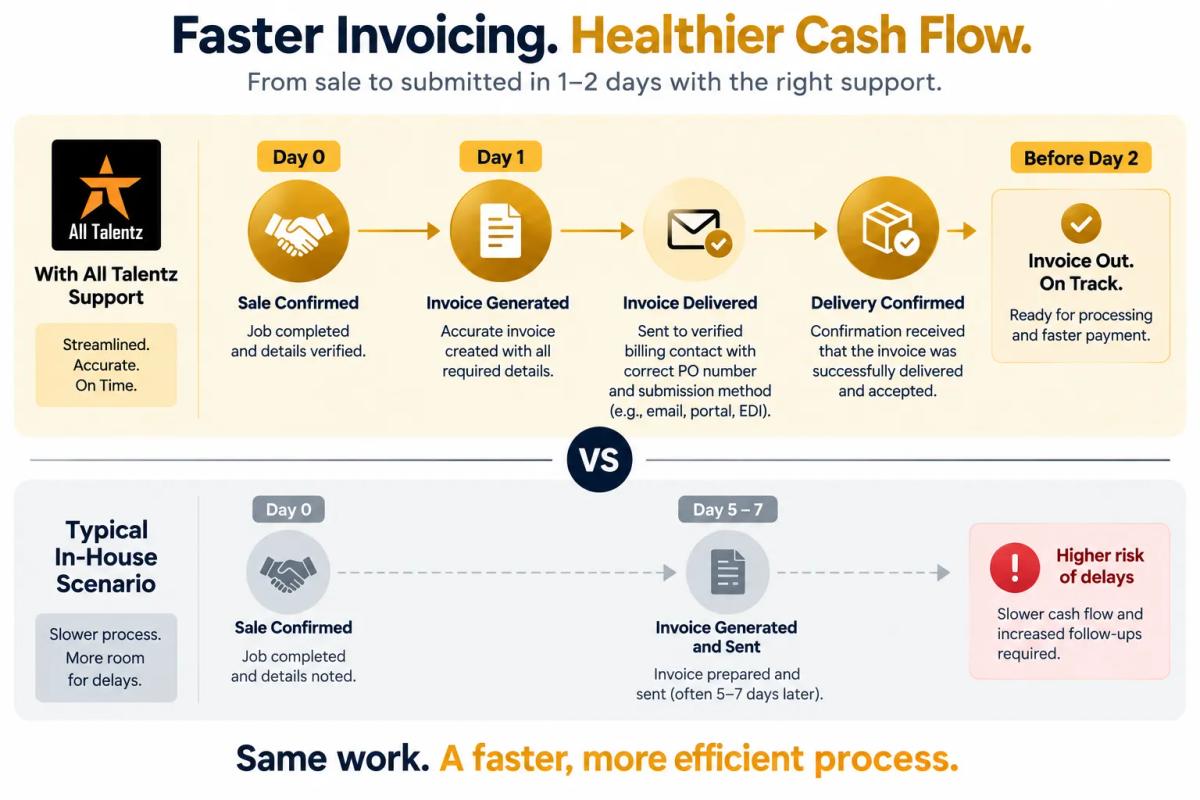
In businesses where AR is a shared responsibility, invoices are generated on a schedule that depends on when someone has time rather than when the sale triggers them. A week's delay in invoice generation is a week added to DSO before the customer has had any opportunity to pay. A billing error caught after an invoice is sent restarts the clock. An invoice sent to the wrong contact at a client's organization sits unopened until someone figures out who should have received it.
A dedicated AR professional manages invoice generation as a systematic, triggered function. Every sale generates an invoice within the defined turnaround window. Invoice accuracy is verified before sending. Each client's billing contacts, PO requirements, and submission portal preferences are maintained in the system and applied correctly from the first invoice. The difference between an invoice that arrives clean on Day One and one that arrives with errors on Day Seven is a week of avoidable DSO on every affected account.
According to NACM's credit management standards and research, timely and accurate invoice delivery is one of the most consistent predictors of collection performance across industries. Businesses that bill within 24 hours of service or delivery collect faster and write off less than those that bill on irregular cycles.
2: Proactive Follow-Up Before Invoices Become Overdue
This is the stage that most in-house AR operations skip, and skipping it is expensive.
In a reactive AR process, the team responds to overdue invoices after they become overdue. In a proactive AR process, a dedicated AR specialist reaches out to customers before the invoice due date to confirm receipt, verify that there are no disputes or processing issues, and prompt any internal approval workflows the customer needs to complete before payment is released. This proactive contact does two things simultaneously: it accelerates payment from customers who intend to pay but need a prompt, and it surfaces disputes or blockers early enough to resolve them before the due date rather than after it.
According to BPM's analysis of AR management effectiveness, dedicated AR teams bring systematic follow-up processes that improve collection rates without straining customer relationships. The distinction is between a professional who calls at Day 35 to ask why an invoice is overdue and one who calls at Day 25 to confirm everything is on track. The first call is reactive and sometimes uncomfortable. The second is proactive and professional, and it almost always produces a faster result.
When a business outsources accounts receivable management to a dedicated professional, this proactive contact becomes systematic rather than aspirational. The AR specialist knows when each invoice was sent, when it is due, and when to make contact at each point in the follow-up schedule. That schedule is maintained consistently because managing it is the professional's entire job, not an item that gets deprioritized when something more urgent arrives.
All Talentz places dedicated AR specialists whose systematic follow-up process and collection discipline are assessed before placement.
3: Collections Management for Overdue Accounts
When an invoice passes its due date without payment, the process requires both professional discipline and genuine persistence. This is the stage where the gap between a dedicated AR specialist and an overloaded in-house team is most visible.
In most in-house AR arrangements, overdue accounts receive one or two follow-up attempts before they age into a backlog that grows quietly while the team manages more immediate priorities. According to a survey of 100 finance decision-makers by The Kaplan Group's collections research, companies that treat collections as a strategic function rather than a reactive one recover significantly more overdue revenue. The research identified companies that outsource at scale as consistently outperforming those that manage collections reactively in-house.
A dedicated AR specialist working overdue accounts applies a structured escalation sequence: a defined cadence of contact attempts at specific intervals, escalating from reminder to formal notice to executive escalation at each stage, with documentation of every contact attempt and response. That documentation is critical because it creates the record needed if the account eventually requires formal collection proceedings, and it ensures that no account ages silently while the team assumes someone else is handling it.
The specific mechanics that produce DSO improvement at this stage are not complex. They are the application of consistent, documented, professional contact to every overdue account without exception. What prevents in-house teams from doing this consistently is not willingness. It is capacity. A dedicated AR professional has no competing priorities. Every overdue account gets worked.
4: Dispute Resolution and Cash Application
The final stage of the AR lifecycle is the one most businesses discover is costing them money only when they audit their aging report and find accounts that have been sitting in "disputed" status for months. Disputes do not resolve themselves. They require a professional who identifies the root cause, coordinates with the relevant internal or external parties to resolve it, and closes the account in the system with accurate documentation.
Cash application is the companion problem: payments that arrive and sit unposted because no one has time to match them to the correct invoice, apply any credits or discounts, and close the receivable in the system. Unposted cash creates ghost AR: the aging report shows outstanding balances that are not actually outstanding, which inflates apparent DSO and undermines the accuracy of financial reporting.
According to Dun & Bradstreet and the Credit Research Foundation's 2025 report cited by Integrative Systems, some industries experience up to 60% of accounts being more than 90 days overdue, partly because disputes and cash application issues create aging that does not reflect the actual cash position. Cleaning up that aging requires dedicated, systematic attention to the resolution and posting process.
A dedicated AR specialist outsourced to manage accounts receivable handles both: disputes are logged, tracked, escalated to the right parties, and resolved within defined timelines; cash received is applied to the correct open items daily so the AR ledger reflects the actual position at any given time. When these two functions are performed consistently, the aging report becomes a reliable management tool rather than a source of confusion.
Want to talk through which stages of your AR process are costing the most in DSO and write-offs? Contact All Talentz and speak with our team about the right AR specialist profile for your business and industry.
Industries That Benefit Most When They Outsource Accounts Receivable Management
While every business that sells on credit terms can benefit from dedicated AR management, some industries carry AR complexity that makes the case particularly strong.
Professional services and B2B businesses deal with high-value individual invoices where a single overdue account meaningfully affects cash flow. A law firm, a consulting business, a marketing agency, or a technology company with enterprise clients typically has relatively few but high-value receivables. Each requires relationship-aware professional contact rather than generic dunning, and each dispute requires specific knowledge of the engagement and the client's internal approval processes.
Healthcare practices carry AR complexity specific to insurance claims, denied remittances, and patient balance collections that require specialized billing knowledge. For healthcare businesses, outsourcing AR management means placing professionals who understand the healthcare billing environment including medical billing AR cycles, payer-specific collection timelines, and denial management as part of the receivable resolution process. Our healthcare talent services cover medical billing specialists and AR professionals who understand the healthcare revenue cycle specifically.
Construction and restoration businesses deal with contract-based billing, retainage, and subcontractor payment complexity that makes AR management significantly more demanding than standard invoice follow-up. Project-based billing requires knowledge of contract milestones, lien rights, and the specific documentation that triggers payment in construction relationships. Our remediation talent services cover AR professionals who understand project-based billing, retainage schedules, insurance claim reconciliation, and subcontractor payment timelines, which are the specific AR demands that make construction and restoration receivables significantly more complex than standard invoice follow-up
Wholesale and distribution businesses often manage high transaction volumes with varied payment terms across a large customer base. Systematic AR management at scale, including credit limit monitoring, payment term adherence, and early payment discount management, is difficult to maintain without dedicated AR capacity.
How All Talentz Places Outsourced AR Specialists
All Talentz is a full talent partner, not a shared AR service or a managed billing platform. When a business chooses to outsource accounts receivable management through All Talentz, the AR professional placed is pre-vetted across technical AR competency, collections discipline, software platform proficiency, and industry experience before the match is made.
The AR specialist works exclusively for your business. They learn your customer base, your payment terms, your payer mix, and your collections preferences. They are not rotating across fifteen client accounts simultaneously. They are building the institutional knowledge of your specific receivable portfolio that makes their follow-up professional, accurate, and effective.
Work tools and equipment are provided by All Talentz. Employment and health insurance are managed on our side. A dedicated relationship manager monitors performance, reviews AR metrics with the client regularly, and facilitates an immediate replacement if the placement is not producing the results the business needs.
Our finance talent services cover accounts receivable specialists, accounts payable specialists, bookkeepers, payroll specialists, and financial analysts, all placed as dedicated resources exclusively assigned to the businesses they serve.
For more on what to evaluate before placing a finance professional of any kind, see our post on what to look for when you hire skilled finance professionals.
Conclusion
Most businesses with high DSO and collection problems do not have bad customers. They have an AR process that is being managed reactively by people who have too many other responsibilities to give it systematic attention at every stage of the receivable lifecycle. When businesses outsource accounts receivable management to a dedicated, pre-vetted professional, four things change: invoices go out accurately and on time, proactive follow-up happens before accounts become overdue, collections are worked systematically with documented escalation rather than intermittently when time allows, and disputes and cash application are handled promptly rather than left to age. The result is lower DSO, higher collection rates, and a receivable ledger that reflects what the business actually owns rather than what it has been too busy to chase. All Talentz places dedicated AR specialists across industries in the US, Canada, and Europe, with placements starting in as little as seven days and full employment infrastructure managed on our side.
Outsourcing accounts receivable management means engaging a dedicated external professional to manage the full AR cycle for your business: generating and delivering invoices, following up proactively before due dates, working overdue accounts through a systematic collections process, resolving disputes, and applying cash receipts accurately. In the All Talentz model, the AR professional is exclusively dedicated to one business and builds knowledge of its customer base and payment patterns over time.
DSO is reduced by addressing the specific process gaps that cause it to climb: invoices sent late, follow-up that starts only after accounts become overdue, disputes that sit unresolved, and cash that goes unapplied. A dedicated AR specialist manages each stage systematically. When invoices go out on Day One, proactive contact happens at Day 25, and overdue accounts are worked on a documented escalation schedule, the average collection window narrows because each stage is managed rather than missed.
Any business that sells on credit terms and is experiencing high DSO, inconsistent collections, a growing aged receivables backlog, or an overloaded in-house team absorbing AR as a secondary responsibility. The model is particularly valuable for professional services firms, healthcare practices, construction and restoration businesses, and wholesale or distribution companies where AR complexity is high relative to the in-house team's dedicated AR capacity.
Yes. All Talentz AR specialists are assessed for proficiency in the accounting and AR management platforms their clients use, including QuickBooks, NetSuite, Xero, Sage, and similar systems. The specialist works within your existing software environment from Day One rather than requiring you to change platforms or implement new tools.
A professional AR specialist manages collections with the same relationship awareness that a strong in-house team member would apply. Contact is professional, documented, and calibrated to the relationship's value and history rather than scripted and generic. The goal is to recover outstanding balances while preserving the customer relationship, which means escalating urgency gradually and professionally rather than immediately adversarially.
All Talentz can place a pre-vetted, dedicated AR specialist in as little as seven days. Because every professional in our network is assessed before any client requirement arrives, the match-and-place process is fast relative to a traditional finance staffing search.
All Talentz provides an immediate replacement guarantee. If a placement is not delivering the AR outcomes the business needs, we replace the professional promptly with no delay, no penalty, and no need to restart a search. Our dedicated relationship manager monitors AR performance metrics throughout the engagement and flags concerns early.