

It is 4:45 pm on a Friday in Chicago. A founder is buried in payroll spreadsheets. A benefits renewal is due. An employee has just raised a complaint. And two roles are still unfilled.
In Birmingham, a factory owner faces a similar Friday. Statutory sick pay questions. A pension auto-enrolment deadline. A tribunal letter.
In Calgary, a growing energy services firm has hired twelve people in a month. Nobody has issued Records of Employment or set up provincial workers' compensation properly.
Different cities. Same headache. HR has become too big, too legal and too fast-moving for one overworked manager to carry.
That is why so many employers now turn to human resources outsourcing companies in the US, UK and Canada. This guide explains what they do, what they cost, how the three countries differ and how to choose well.
What Is Human Resources Outsourcing (HRO)?

Human resources outsourcing means handing some or all of your HR work to an outside specialist. The provider takes on tasks such as payroll, benefits, hiring, onboarding, compliance and employee relations.
You keep control of the big decisions. The partner handles the heavy lifting.
There are three common ways to do it.
- Full HR outsourcing. The provider acts as your entire HR department.
- Selective (functional) outsourcing. You outsource only certain tasks, such as payroll or recruitment.
- Co-managed HR. Your team and the provider share duties, often using shared software.
HR outsourcing is not new. Yet the pace has picked up. Remote work, changing labour laws and skills shortages have pushed many employers to look for expert help.
Why Employers Are Choosing HR Outsourcing Companies in the US, UK and Canada
Here are the main reasons.
1. Cost control. A full-time HR director in a major city can cost well over six figures once benefits are added. Outsourcing turns that into a predictable monthly fee.
2. Compliance protection. Employment law is complex and changes often. Mistakes bring fines, claims and reputation damage.
3. Access to expertise. Outsourcing firms employ specialists in benefits, payroll, employee relations, immigration and learning.
4. Technology. Modern HR platforms are expensive. Providers spread the cost across many clients.
5. Focus. Owners and managers can concentrate on customers and growth.
6. Scalability. Adding 5 or 50 employees does not mean hiring an HR team.
7. Multi-country support. Businesses expanding across the US, UK and Canada need local knowledge in each place.
Unsure which HR tasks to outsource? Get a free HR needs review from All Talentz.
How Big Is the HR Outsourcing Market?
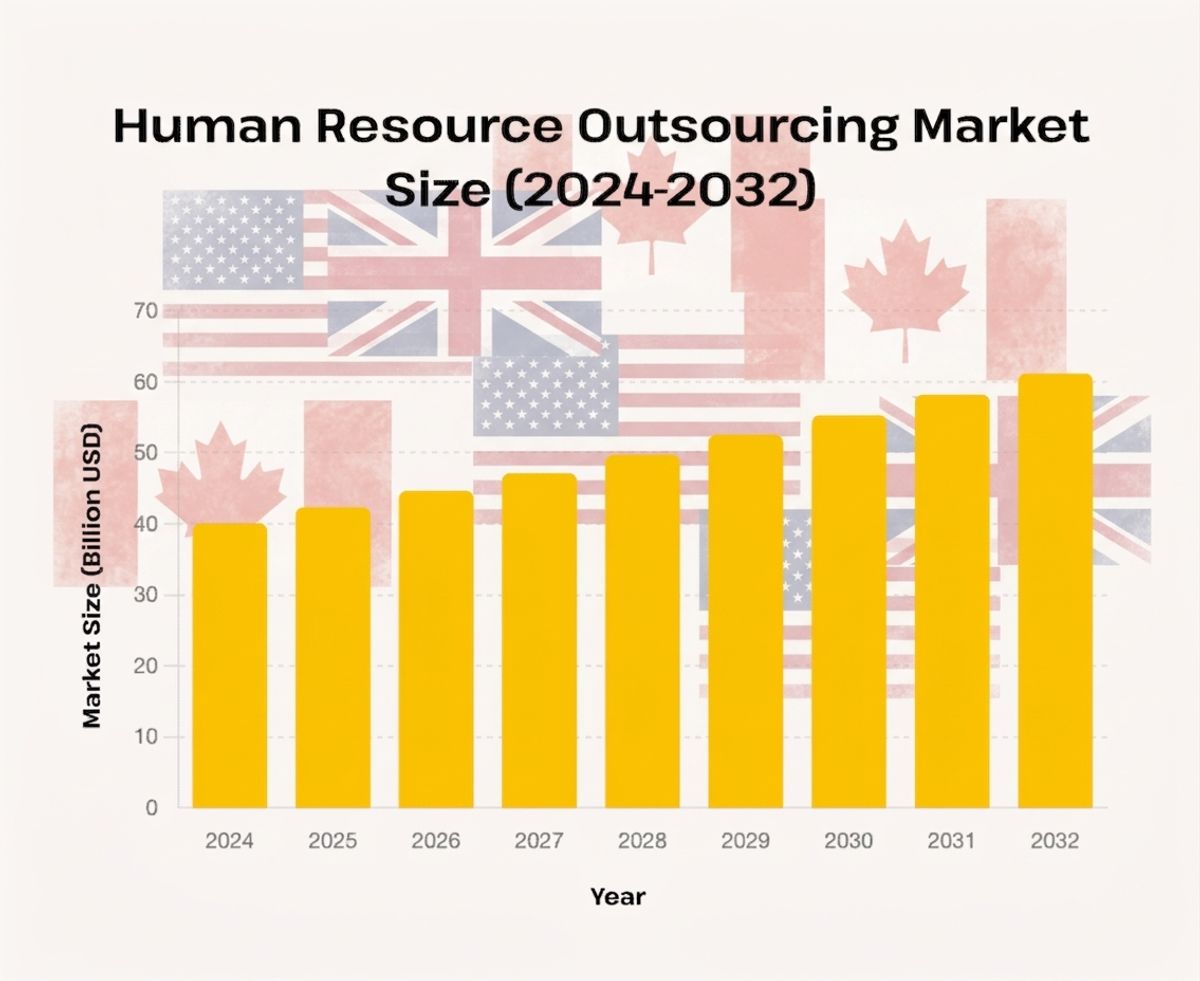
The global HR outsourcing market is worth tens of billions of dollars, and analysts expect steady growth through the decade. North America is the largest region. Europe follows closely.
In the US, industry groups such as the National Association of Professional Employer Organizations (NAPEO) report that PEOs support millions of worksite employees. In the UK, outsourced payroll, HR consultancy and employer-of-record services have expanded fast, helped by contractor and flexible workforce growth. In Canada, small and mid-sized businesses have driven demand for outsourced payroll and HR advisory, especially in Ontario, British Columbia and Alberta.
Smaller firms are the biggest users. Businesses with fewer than 250 employees often lack a dedicated HR function. Outsourcing fills that gap.
The Core Services Offered by HR Outsourcing Companies
Not all providers offer the same menu. Here is what you can usually expect.
Payroll Outsourcing
Payroll is the most commonly outsourced HR task. The provider calculates pay, deducts taxes, files returns and issues payslips.
- US: Federal, state and local taxes, FICA, FUTA, W-2 and 1099 reporting.
- UK: PAYE, National Insurance, Real Time Information (RTI) submissions to HMRC, pension deductions and P60s.
- Canada: CPP, EI, income tax remittances to the CRA, T4 slips and Records of Employment.
Benefits Administration
Providers manage health insurance, retirement plans, leave and perks.
- US: Health plans, 401(k), COBRA, ACA reporting and FMLA leave tracking.
- UK: Workplace pension auto-enrolment, private medical schemes, life cover and statutory leave.
- Canada: Extended health and dental, RRSP and group plans, plus provincial leave entitlements.
Recruitment and Onboarding
Many HR outsourcing companies also offer recruitment. This includes job advertising, screening, interviewing support and background checks. They then handle contracts, right-to-work documents and induction.
Compliance and Risk Management
This covers handbooks, policies, audits, health and safety, and employment record keeping. It is one of the most valuable services.
Employee Relations
Expert advisers guide managers through disciplinary matters, grievances, redundancies and terminations. They help reduce legal exposure.
Learning and Development
Providers deliver training, leadership programmes and compliance courses. Many use online learning libraries.
HR Technology and Analytics
Cloud platforms give employees self-service access. Leaders get dashboards on turnover, absence and headcount cost.
Workforce Planning
Providers help you plan hiring, restructure teams and model costs.
[IMAGE PLACEMENT] Service wheel graphic showing eight HR outsourcing services: payroll, benefits, recruitment, compliance, employee relations, training, technology, workforce planning.
Types of HR Outsourcing Companies You Will Meet
The market uses many labels. Understanding them saves time.
Professional Employer Organizations (PEOs)
Common in the US. A PEO enters a co-employment relationship. The PEO becomes the employer of record for tax and benefits purposes. You keep day-to-day control of your staff. Small businesses gain access to large-group health plans and shared compliance support.
Administrative Services Organizations (ASOs)
Also mostly US. An ASO gives you HR services without co-employment. You remain the sole employer. It is a lighter-touch option.
Employer of Record (EOR) Providers
Popular in all three countries. An EOR legally employs your worker on your behalf in a specific country. This lets you hire in the UK, Canada or a US state without setting up a local entity.
Payroll Bureaus and Payroll Outsourcers
Focused on payroll and related filings. Strong in the UK, where payroll bureaus are well established.
HR Consultancies
Offer advice, audits and project work. Good for one-off needs such as writing a handbook or managing a restructure.
Recruitment and Talent Outsourcing Firms
Firms such as All Talentz combine recruitment, workforce solutions and outsourcing. They help you find the people and manage them.
Business Process Outsourcing (BPO) Providers
Large providers running HR shared services for big corporations, often across many countries.
| Provider Type | Best For | Typical Countries | Level of Control |
|---|---|---|---|
| PEO | Small to mid-sized US employers wanting benefits and compliance | US | Shared (co-employment) |
| ASO | Employers wanting HR support without co-employment | US | High |
| EOR | Hiring in a new country or state without an entity | US, UK, Canada and global | Shared |
| Payroll bureau | Payroll accuracy and tax filings | UK, US, Canada | High |
| HR consultancy | One-off projects and advice | All three | High |
| Recruitment and talent outsourcer | Hiring plus wider workforce support | All three | Flexible |
Human Resources Outsourcing in the United States
The US has the most complex HR environment of the three. Laws come from federal, state, county and city levels.
Key US Laws Your HR Partner Should Know
- Fair Labor Standards Act (FLSA): minimum wage, overtime and child labour rules.
- Family and Medical Leave Act (FMLA): unpaid, job-protected leave for eligible employees.
- Affordable Care Act (ACA): employer health coverage rules for applicable large employers with 50 or more full-time equivalent employees.
- Title VII, ADA and ADEA: anti-discrimination laws enforced by the EEOC.
- Form I-9: identity and work authorisation checks.
- State laws: California's strict wage and hour rules, New York's paid family leave, Illinois's biometric privacy law and paid leave rules, and many state-level pay transparency rules.
US Regions Where Demand for HR Outsourcing Is Strong
- California (Los Angeles County, Orange County, Santa Clara County, San Diego County): start-ups, entertainment and healthcare.
- Texas (Harris County, Dallas County, Travis County, Bexar County): energy, tech and rapid corporate relocations.
- New York (New York County, Kings County, Nassau County): finance, media and professional services.
- Florida (Miami-Dade, Orange County, Hillsborough County): tourism, healthcare and logistics.
- Illinois (Cook County, DuPage County): logistics and manufacturing.
- Georgia (Fulton County, Gwinnett County): fintech, film and supply chain.
- Washington (King County): cloud, aerospace and retail.
- Massachusetts (Middlesex County, Suffolk County): biotech and higher education.
- Arizona (Maricopa County): semiconductors and healthcare.
- North Carolina (Wake County, Mecklenburg County): research and banking.
PEO or Not? A US Decision Guide
A PEO may suit you if you have between 5 and 250 employees, want better benefits pricing and lack in-house HR. An ASO may suit you if you want to remain the sole employer. Payroll-only services suit stable firms that mainly want accuracy and speed.
For the US, always ask whether the provider is certified, for example by the IRS as a Certified Professional Employer Organization (CPEO). Ask about state licensing too.
Link to All Talentz page "HR Outsourcing Services in the US".
Human Resources Outsourcing in the United Kingdom
The UK model is different. The PEO structure is rare. Instead, employers use HR consultancies, payroll bureaus, employer-of-record services and umbrella companies.
Key UK Rules Your HR Partner Should Know
- Employment Rights Act 1996 and related reforms: unfair dismissal, notice and redundancy.
- Equality Act 2010: protection against discrimination.
- Working Time Regulations 1998: working hours and holiday entitlement.
- Right to work checks: employers must check and keep records, and penalties for illegal working are heavy.
- Workplace pensions: automatic enrolment for eligible staff.
- TUPE: protects employees when a business or service transfers.
- IR35: off-payroll working rules for contractors.
- ACAS: the Advisory, Conciliation and Arbitration Service publishes a statutory Code of Practice on disciplinary and grievance procedures.
Employer National Insurance contributions rose from April 2025, which increased the real cost of each hire. Many small employers have reviewed staffing costs since. Check current rates on GOV.UK.
UK Regions Where HR Outsourcing Is Growing
- Greater London: professional services, tech and media.
- South East (Surrey, Kent, Hampshire, Berkshire): tech parks, pharma and logistics.
- East of England (Cambridgeshire, Hertfordshire, Essex, Norfolk): life sciences and agri-food.
- West Midlands (Birmingham, Coventry): manufacturing and automotive.
- North West (Greater Manchester, Merseyside, Cheshire): digital, healthcare and logistics.
- Yorkshire (West Yorkshire, South Yorkshire): finance, steel and retail.
- Scotland (Edinburgh, Glasgow, Aberdeenshire): finance and energy.
- Wales and Northern Ireland: advanced manufacturing and cyber.
Human Resources Outsourcing in Canada
Canada is a federation. Most private-sector employers follow provincial employment standards. Some industries, such as banking, telecommunications and interprovincial transport, fall under the federal Canada Labour Code.
Key Canadian Rules Your HR Partner Should Know
- Provincial employment standards: minimum wage, overtime, vacation pay and notice of termination differ by province.
- Canada Pension Plan (CPP) and Employment Insurance (EI): payroll contributions and reporting.
- Records of Employment (ROE): required when employment is interrupted.
- Workers' compensation: for example, WSIB in Ontario and WorkSafeBC in British Columbia.
- Human rights codes: each province has its own, plus the Canadian Human Rights Act federally.
- Pay transparency and job posting rules: British Columbia and Ontario have specific requirements.
- Québec: French-language obligations under Bill 96 and separate payroll and pension systems, including the Québec Pension Plan.
- Common-law reasonable notice: courts can award more than statutory minimums on termination.
Canadian Regions Where HR Outsourcing Is Growing
- Greater Toronto Area: Toronto, Mississauga (Peel Region), Markham (York Region), Oakville (Halton).
- Waterloo Region: Kitchener, Waterloo and Cambridge.
- Ottawa-Gatineau: technology and government suppliers.
- Metro Vancouver: Burnaby, Surrey, Richmond and Vancouver.
- Calgary and Edmonton: energy, logistics and agri-tech.
- Montréal: AI, aerospace and gaming.
- Winnipeg, Saskatoon, Halifax: growing service and industrial sectors.
US vs UK vs Canada: A Side-by-Side HR Comparison
| HR Area | United States | United Kingdom | Canada |
|---|---|---|---|
| Employment default | At-will in most states | Statutory rights after qualifying service | Provincial standards plus common-law notice |
| Popular outsourcing model | PEO, ASO, payroll provider | Payroll bureau, HR consultancy, EOR | Payroll provider, HR consultancy, EOR |
| Payroll authority | IRS and state agencies | HMRC | Canada Revenue Agency |
| Health benefits | Often employer-sponsored | NHS provides base cover; private medical is a perk | Provincial health plans; extended benefits via employers |
| Retirement | 401(k) and IRA | Workplace pension auto-enrolment | CPP/QPP plus RRSP and group plans |
| Leave | FMLA, state paid leave, no federal paid vacation | Statutory holiday, sick pay, maternity and paternity | Provincial vacation, maternity and parental leave with EI support |
| Termination | Contract and state law | Statutory notice and redundancy pay | Statutory notice, severance and reasonable notice |
Expanding across the US, UK and Canada? Let All Talentz simplify HR in every market."
The Benefits of Outsourcing HR
Let us break down the gains in plain language.
Lower and More Predictable Costs
You avoid salaries for multiple HR specialists. You also avoid software licences, training costs and recruitment fees for HR staff. Monthly fees are easy to budget.
Reduced Legal Risk
A good partner stays current on changing rules. When a new law lands, they update your policies. That protects you from expensive claims.
Faster Hiring
Providers with recruitment arms can source, screen and onboard quickly. That means fewer empty seats.
Better Employee Experience
Self-service portals let staff check payslips, book leave and update details. Payroll errors fall. Trust rises.
Data You Can Use
Dashboards show turnover, absence, overtime and hiring cost. Leaders can act on facts.
Stronger Focus on Core Business
When HR admin moves off your desk, you can put attention on customers, product and growth.
The Risks and Drawbacks You Should Know About
Outsourcing is not perfect. Be honest with yourself about the trade-offs.
- Loss of control. Some decisions move outside your walls. Set clear approval rules.
- Cultural fit. An outsider may not fully grasp your values. Choose a partner who listens.
- Data security. Payroll and personnel data are sensitive. Check certifications such as SOC 2 and ISO 27001 and confirm privacy compliance under GDPR and UK GDPR in the UK, PIPEDA and provincial laws in Canada, and applicable state privacy laws in the US.
- Hidden fees. Some contracts charge extra for changes, off-cycle payrolls or terminations.
- Vendor lock-in. Ask how you can exit and how you will get your data back.
- Service quality. Response times matter. Ask for service level agreements.
Ask hard questions early. A good provider will welcome them.
How Much Do Human Resources Outsourcing Companies Charge?
Pricing depends on services, company size and country. Here are the common models.
- Per employee per month (PEPM). Typical for PEOs and payroll services. Fees are often quoted in the tens of dollars or pounds per employee per month, and rise with added services.
- Percentage of payroll. Some PEOs charge a percentage of gross payroll.
- Flat monthly retainer. Common for HR consultancies and advisory support.
- Project fees. One-off work such as handbooks or restructures.
- Placement fees. For recruitment, usually a percentage of first-year salary.
- EOR fees. Often a monthly per-worker fee on top of salary and statutory costs.
Do not pick on price alone. A cheap provider that gets payroll wrong will cost you far more.
Seven Signs It Is Time to Outsource Your HR
Watch for these warning signals.
1. You spend hours each week on payroll and paperwork.
2. Managers make people decisions without guidance.
3. You have grown quickly and policies have not kept up.
4. You are hiring in a new country or state.
5. You have had a compliance scare, audit or claim.
6. Employee turnover is rising.
7. You cannot justify a full-time HR hire yet.
If three or more apply, talk to a partner.
How to Choose Among Human Resources Outsourcing Companies in the US, UK and Canada
Selecting a partner is a big decision. Use this checklist.
Step 1: Define What You Need
List the tasks you want to outsource. Rank them by pain and cost. Decide whether you need a single country or several.
Step 2: Check Local Expertise
Ask how many clients they serve in your state, province or region. Ask who advises on local law. A partner strong in Ontario may not be strong in Texas.
Step 3: Review Compliance and Security
Ask for proof of licences, insurance and security certifications. Ask how they handle data breaches.
Step 4: Test the Technology
Request a demo. Check the employee and manager experience. Look at reporting tools.
Step 5: Speak to References
Ask for clients of similar size and sector. Call them.
Step 6: Read the Contract Carefully
Check term length, fees, service levels, liability and exit terms. Seek legal advice if needed.
Step 7: Look for a Human Partner
Technology matters. But people solve problems. Choose a team that answers the phone and knows your name.
Questions to Ask Every HR Outsourcing Provider
Take this list to your first meeting.
- Which countries, states or provinces do you support directly?
- Who is my day-to-day contact, and how quickly will they respond?
- What is included in the base fee, and what costs extra?
- How do you keep up with changes in employment law?
- What happens if there is a payroll error?
- How do you protect employee data?
- Can you support recruitment as well as HR administration?
- How long does onboarding take?
- What does exit look like?
- Can I speak to three current clients?
Cross-Border HR: Special Points for Firms in the US, UK and Canada
Running one team across three countries adds a layer of complexity. Keep these points in mind.
Local contracts matter. A US offer letter that says "at-will" does not work in the UK or Canada. Each country needs a contract that fits its law.
Payroll calendars differ. US firms often pay bi-weekly. UK firms often pay monthly. Canadian pay cycles vary by province and sector. Align them carefully.
Holidays are not the same. The US has federal holidays. The UK has bank holidays that differ between England, Scotland, Wales and Northern Ireland. Canada has statutory holidays that vary by province.
Currency and tax treaties. Staff paid in one currency but working in another may face extra tax filings. Get advice early.
Data transfers. Moving employee data between the UK, Canada and the US triggers privacy rules. Use approved transfer mechanisms.
A single outsourcing partner with local expertise in all three countries keeps these moving parts in sync.
HR Outsourcing Contract Red Flags to Watch For
Read the fine print. These clauses deserve extra attention.
- Long auto-renewal terms. Some contracts roll over for a year unless you give ninety days' notice. Diarise the date.
- Vague scope. If a service is not listed, assume it costs extra.
- Weak liability wording. Check who pays penalties caused by the provider's mistake.
- No data return clause. You should be able to export your data in a usable format when you leave.
- Unclear subcontracting. Ask whether work is done by the provider's own staff or by third parties in other countries.
- Minimum headcount fees. Some providers charge for a set number of employees even if you shrink.
- Price escalators. Look for annual increases tied to inflation or set percentages.
A short call with an employment lawyer before signing is a small price for peace of mind.
HR Outsourcing for Small Businesses vs Large Enterprises
Small Businesses
A small firm in Nashville or Nottingham faces the same laws as a large one. Yet it lacks the budget for specialists. Outsourcing gives it access to expertise at a fraction of the cost. Small firms often benefit most from bundled services: payroll, benefits, compliance and hiring support.
Mid-Sized Firms
Firms with 100 to 500 staff often have an HR generalist who is overloaded. Co-managed HR works well. The partner handles payroll and compliance while the internal team focuses on culture and talent.
Large Enterprises
Large employers tend to outsource specific functions such as payroll, recruitment or benefits administration. They often use global providers or several regional partners across the US, UK and Canada.
HR Outsourcing and Recruitment: Why the Two Belong Together
Hiring is the front door of HR. If it is broken, everything behind it strains.
When a single partner handles both recruitment and HR administration, benefits multiply.
- Faster onboarding. New hire data flows straight into payroll and benefits.
- Better fit. The partner understands your policies and culture and recruits for them.
- Fewer errors. No re-keying of data between systems.
- One accountable partner. You avoid finger-pointing between vendors.
This is where recruitment and outsourcing firms have an edge. They see the whole employee lifecycle.
For deeper detail on the hiring side, read our guide to recruitment process outsourcing for US, UK and Canadian businesses.
A Story From the Field: From HR Chaos to HR Confidence
Here is a typical, fictional scenario based on what growing firms experience.
A 60-person software company had offices in Boston, London and Toronto. The founders ran HR themselves. Payroll ran on three different systems. Offer letters used templates from the internet. One Canadian employee did not receive a proper Record of Employment after leaving. One UK contractor was likely misclassified.
The founders realised the risk. They brought in an outsourcing partner.
In ninety days, the partner:
1. Moved payroll onto one platform with local compliance in each country.
2. Reissued employment contracts that reflected local law.
3. Reviewed contractor status in the UK.
4. Built a single handbook with country-specific addenda.
5. Set up a recruitment pipeline for future hires.
The founders got their evenings back. Errors dropped. Staff felt cared for.
Ready for HR confidence across borders? All Talentz can help." Button: Speak to Our Team.
Trends Shaping HR Outsourcing in 2026 and Beyond
AI-assisted HR. Chatbots answer employee questions. Analytics flag flight risks. Regulators expect fairness and transparency.
Global and remote workforces. Employer-of-record services are booming as firms hire across borders.
Wellbeing as a core service. Providers now offer employee assistance programmes, financial wellness tools and mental health support.
Pay transparency. Providers now help build salary bands and audit gender pay gaps.
Stronger data privacy. More states and provinces are passing privacy laws. HR data is a prime target.
Consolidation. Larger providers are acquiring smaller ones. Choose a partner with staying power.
Common Myths About HR Outsourcing
Myth 1: "Outsourcing means losing control." In truth, you decide policy. The partner carries out the work.
Myth 2: "It is only for tiny companies." Large firms outsource too, often more than small ones.
Myth 3: "It is always cheaper." It is often cheaper, but savings depend on scope and contract. Value matters more than the lowest price.
Myth 4: "Employees will feel abandoned." Good providers improve service. Self-service tools and quick support can make people feel more valued.
Myth 5: "It is risky for compliance." The opposite is usually true. Specialists reduce risk, though you remain responsible for oversight.
HR Outsourcing by Industry: What Each Sector Needs
Different sectors carry different HR risks. A good partner adapts.
Healthcare. Licence tracking, credential checks, shift scheduling and safe staffing ratios matter most. Hospitals in Houston, clinics in Manchester and long-term care homes in Ontario all face heavy compliance loads. Outsourced HR helps keep records audit-ready.
Technology. Fast hiring, equity plans and remote teams dominate. Tech firms in Austin, Cambridge and Waterloo often need help with stock option administration, global payroll and contractor management.
Manufacturing and logistics. Shift work, overtime rules and health and safety are the priorities. Employers around Detroit, the West Midlands and Southern Ontario use outsourced partners for payroll accuracy and safety training.
Retail and hospitality. High turnover and seasonal peaks create constant hiring. Outsourced onboarding and scheduling tools save hours each week.
Financial services. Background screening, regulatory training and record keeping are critical. Firms in New York, the City of London and Toronto need partners with strong security credentials.
Construction and energy. Site safety, union agreements and mobile workforces need careful handling. Calgary, Aberdeen and Houston employers often rely on specialists.
Non-profits and education. Tight budgets and grant reporting make shared HR services attractive.
Your First 90 Days With an HR Outsourcing Partner
A clear roadmap helps you avoid surprises. Here is what a typical start looks like.
Days 1 to 15: Discovery. The provider reviews your contracts, policies, payroll set-up and headcount. You agree scope, service levels and key contacts.
Days 16 to 45: Set-up and migration. Data moves to the new platform. Payroll runs in parallel to test accuracy. Policies and handbooks are updated to reflect local law.
Days 46 to 75: Go-live. The partner takes over live payroll and HR support. Managers and staff receive training on the portal.
Days 76 to 90: Review and improve. You review early results. Fix gaps. Agree on reports and quarterly business reviews.
Communication is the secret. Tell your staff what is changing and why. Give them a clear place to ask questions.
HR Metrics That Prove Your Outsourcing Investment Is Working
Do not just hope it works. Measure it.
- Payroll accuracy rate. The percentage of payslips issued without errors.
- Time to hire. The days from job posting to accepted offer.
- Employee turnover. Track overall and first-year turnover.
- Absence rate. Sudden increases can signal morale problems.
- HR cost per employee. Compare with your old in-house cost.
- Compliance audit results. Count missed deadlines, filings and training completions.
- Employee satisfaction. Short pulse surveys show how staff feel about HR service.
- Ticket response time. How quickly the provider answers queries.
Review these figures every quarter with your partner. A good provider welcomes the scrutiny.
Why Choose All Talentz as Your HR Outsourcing Partner
All Talentz is a recruitment and outsourcing firm that supports employers in the United States, the United Kingdom and Canada. We know that HR is about people first and paperwork second.
Here is what you can expect.
- A single partner for hiring and HR support. Recruitment, onboarding and outsourced HR work together.
- Tailored services. Outsource one task or the whole function.
- Local awareness. We respect the differences between Texas and Toronto, or Manchester and Miami.
- Transparent fees. No surprises. No jargon.
- Responsive support. Real people who answer.
- Scalable solutions. We grow as you grow.
Take HR off your plate. Talk to All Talentz about outsourced HR that fits your business.
Conclusion: Make HR a Strength, Not a Struggle
Human resources outsourcing companies in the US, UK and Canada help businesses of every size manage people work with skill and confidence. They cut cost, reduce risk, speed up hiring and free leaders to lead.
But the right partner matters. Choose one that understands your market, respects your culture and communicates clearly.
If HR feels heavy right now, you are not alone. And you do not have to carry it alone.
Frequently Asked Questions About Human Resources Outsourcing Companies in the US, UK and Canada
They take on HR tasks for your business. These include payroll, benefits administration, recruitment, onboarding, compliance, employee relations, training and HR technology. You can outsource one task or the whole HR function.
Costs vary with services, company size and country. Fees are often charged per employee per month, as a percentage of payroll or as a flat retainer. Recruitment is usually charged as a percentage of first-year salary. Request a written quote that lists all fees.
A PEO, or professional employer organization, is a type of HR outsourcing found mainly in the US. It enters a co-employment relationship with you. The PEO handles payroll taxes, benefits and compliance while you manage daily work. Other HR outsourcing models do not share employer status.
Yes. In the UK, employers use payroll bureaus, HR consultancies and employer-of-record providers. In Canada, employers use payroll services, HR consultancies and employer-of-record firms. The PEO model is less common in both countries.
An employer of record legally employs a worker on your behalf in a particular country or region. It handles payroll, tax, benefits and local compliance. You direct the worker's tasks. EORs let you hire in the US, UK or Canada without a local entity.
Often yes. Small firms face the same laws as large firms but lack specialists. Outsourcing gives access to expertise, technology and better benefits pricing at a predictable cost. It is most useful when you have around 5 to 250 employees and no dedicated HR team.
Payroll is the most common. Benefits administration, recruitment, compliance support and employee relations advice follow. Many firms also outsource onboarding and training.
Risks include loss of some control, cultural mismatch, data security concerns, hidden fees, lock-in and inconsistent service. You reduce them by checking references, reading contracts closely and setting service levels.
Not entirely. You remain responsible as the employer for many duties. A good provider reduces risk and guides compliance, but you must still oversee decisions and keep accurate records.
Define your needs. Check local expertise in your state, province or region. Review security and compliance credentials. Test the technology. Speak to references. Read the contract carefully. Choose a partner whose people you trust.
Yes, many can. Some HR outsourcers include recruitment. Recruitment and outsourcing firms such as All Talentz combine sourcing, screening and onboarding with HR administration, so the whole employee journey is joined up.
The provider manages HR processes across several countries, often through a mix of local teams, partners and technology. Payroll, benefits and legal requirements are handled according to each country's rules. This helps firms with staff in the US, UK and Canada.
Consulting gives advice or project support, such as writing a handbook. Outsourcing takes over ongoing tasks, such as running payroll every month. Some providers offer both.
Onboarding often takes between four and twelve weeks, depending on complexity. Payroll migration usually needs at least one full pay cycle of testing. Plan ahead and avoid switching at year-end where possible.
It should be, if you choose carefully. Look for certifications such as SOC 2 or ISO 27001, encryption, access controls and clear breach procedures. Confirm compliance with privacy laws such as GDPR and UK GDPR, PIPEDA and relevant US state laws.
Yes. Payroll-only outsourcing is very common. You keep other HR functions in-house while the provider handles calculations, tax filings and payslips.
Staffing supplies workers or candidates. HR outsourcing manages HR processes for your own employees. Some firms offer both.
Your contract should say. Most reputable providers correct errors quickly and cover penalties caused by their fault, subject to the agreement. Ask about error-handling and liability before you sign.
Yes. Cloud platforms, digital onboarding and global payroll suit remote teams well. Providers can also manage remote worker compliance across states, provinces and countries.
All Talentz supports employers across the US, UK and Canada with recruitment and outsourcing services. We can help you hire, onboard and manage people work, or take on specific HR tasks. Contact us for a free consultation.