
There is a moment most small business owners recognise. The month-end is approaching, the bank reconciliation has not been touched, the invoices are stacking up, and the owner is sitting at their kitchen table at 10pm trying to figure out where the money went. That moment is usually when the decision to hire a remote bookkeeper for small business stops being a nice idea and becomes an urgent one.
This post is not a generic list of bookkeeping tips. It is for the business owner who has already decided they need help with their books and wants to understand what hiring a remote bookkeeper actually looks like, what it costs, and whether it is right for the stage their business is at.

The Problem With Doing Your Own Books as a Small Business Owner
Most small business owners start out managing their own bookkeeping because it seems manageable. A few transactions a week, a basic spreadsheet, maybe QuickBooks. But as the business grows, the complexity compounds. More clients, more vendors, more expense categories, payroll, GST or sales tax filings, and the task that once took an hour on a Sunday afternoon now needs a whole day that nobody has.
The real cost of doing your own books is not the time itself, though that is significant. It is the errors that accumulate when someone without formal bookkeeping training is reconciling accounts under pressure. Miscategorised expenses, missed deductions, late remittances, and inaccurate cash flow reports all carry downstream consequences that are more expensive to fix than to prevent.
When small business owners choose to hire a remote bookkeeper for small business, they are not outsourcing a low-value task. They are removing a high-risk function from a person who was never the right person to be doing it.
What a Remote Bookkeeper Actually Does Day to Day
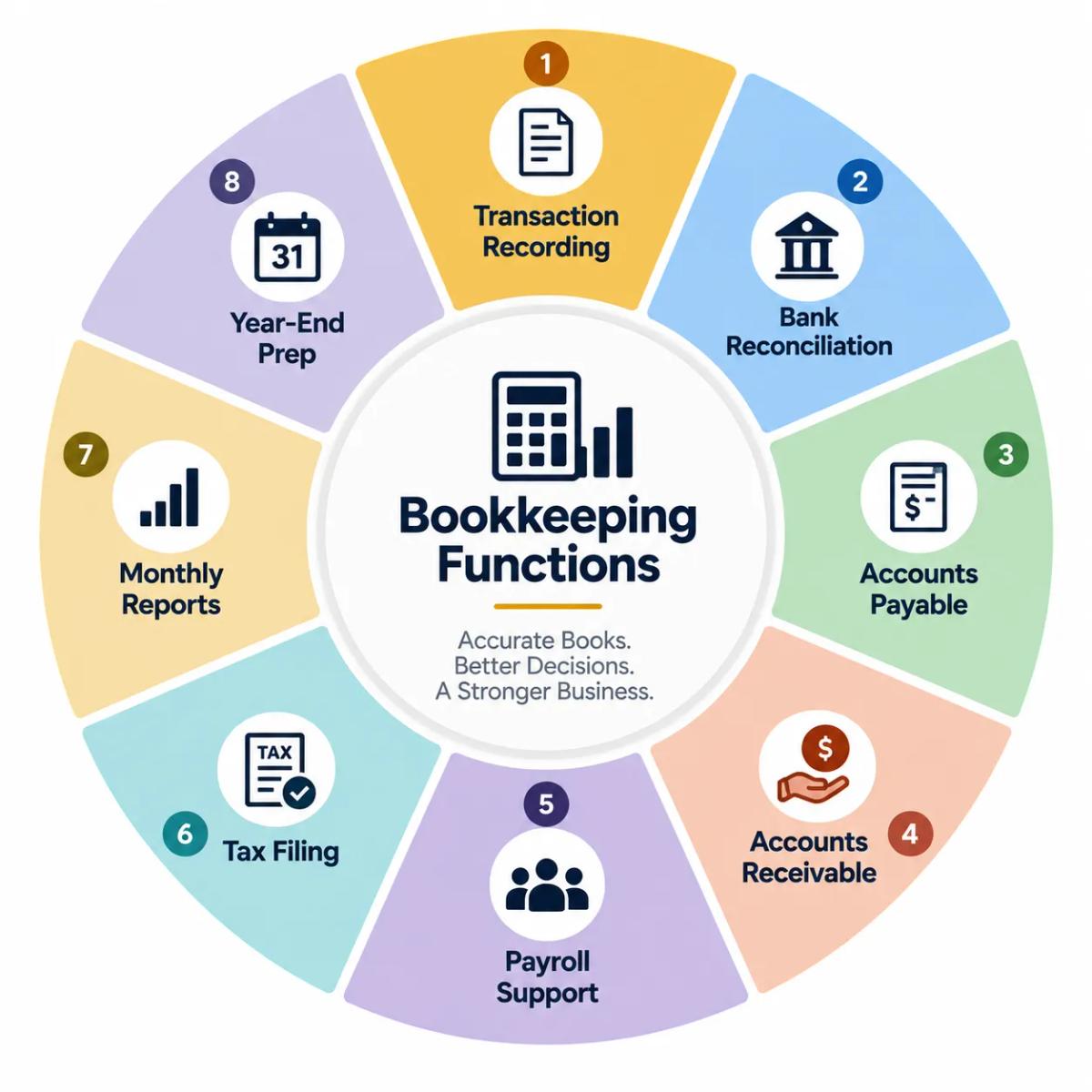
A common misconception is that a remote bookkeeper is just someone who enters transactions. The scope is broader than that, and the value comes precisely from that broader scope. A well-matched remote bookkeeper handles:
•Weekly or monthly transaction recording and categorisation across all accounts
•Bank and credit card reconciliation to ensure your records match actual cash movements
•Accounts payable tracking, making sure vendor bills are recorded and paid on time
•Accounts receivable monitoring, following up on outstanding invoices and flagging overdue payments
•Payroll processing support, calculating pay runs and ensuring remittances are filed correctly
•GST, HST, VAT, or sales tax preparation and filing, depending on the business's jurisdiction
•Monthly financial reports including profit and loss statements, balance sheets, and cash flow summaries
•Year-end preparation, organising records for tax filing and liaising with the business's accountant or CPA
The specific mix depends on the business. Some small businesses need full-cycle bookkeeping from transaction entry through to financial reporting. Others have a part-time owner who handles invoicing but needs someone to take over reconciliation and reporting. A remote bookkeeper can be scoped to fit either model.
The Numbers That Make the Decision Clear
An in-house bookkeeper in the US earns between $45,000 and $58,000 per year in base salary according to the Bureau of Labor Statistics. Add employer payroll taxes, benefits, and equipment and the total loaded cost for a single in-house bookkeeping hire typically exceeds $65,000 to $75,000 per year. That is for a role that most small businesses do not need full-time coverage for.
A remote bookkeeper engaged through All Talentz starts from $400 per month. For a business with straightforward bookkeeping needs, that is less than $5,000 per year for the same function. Even for businesses with more complex requirements, the saving compared to an in-house hire is substantial.
In Canada, the picture is similar. CPA Canada consistently highlights the cost burden that in-house bookkeeping places on growing SMBs, particularly those dealing with HST and multi-province payroll. Remote bookkeeping gives Canadian small businesses the same professional oversight at a cost structure that makes it practical to maintain consistently, rather than only when the business can afford it.
This cost advantage is one of the clearest expressions of the benefits of hiring remotely, where the structural difference between a remote and in-house engagement goes beyond wages to include everything a full-time employee costs beyond their salary.
Hire a Remote Bookkeeper for Your Small Business Through All Talentz
Trained, vetted finance professionals starting from $400 per month.
How to Know If Your Business Is Ready to Hire a Remote Bookkeeper
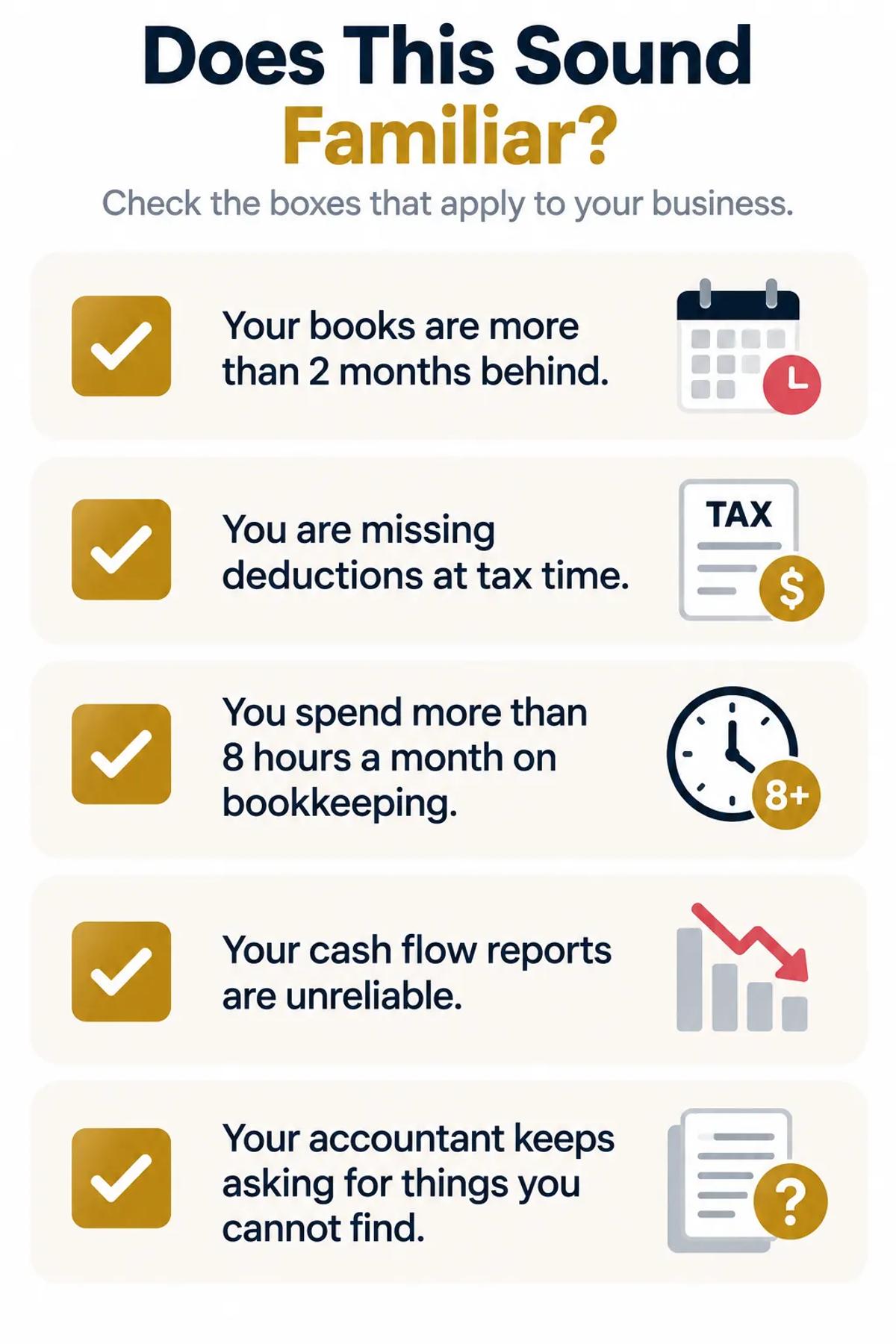
Not every small business needs a remote bookkeeper from day one. But there are clear signals that indicate the time has come. If two or more of the following are true, the cost of not hiring a bookkeeper is almost certainly higher than the cost of hiring one:
•Your books are more than two months behind and you have stopped feeling guilty about it because it has become the norm
•You are missing deductions at tax time because expenses were miscategorised or not recorded at all
•You are spending more than eight hours a month on bookkeeping yourself, time that would be more valuable focused on running the business
•Your cash flow reports, if you have them, do not give you confidence about what is actually happening financially
•Your accountant or CPA regularly asks for information you cannot quickly locate
The business does not need to be large to benefit from professional bookkeeping. In fact, the earlier a business gets its books into a consistent, professional structure, the easier it is to manage growth, secure financing, and avoid the expensive process of cleaning up years of disorganised records when it becomes unavoidable.
What to Define Before You Start the Search
The businesses that get the most from a remote bookkeeper are the ones who have done some thinking before the first conversation. That does not mean you need to know everything about bookkeeping. It means being able to answer a few practical questions:
•Which accounting software does your business use or are you open to adopting? QuickBooks, Xero, Wave, Sage, and FreshBooks each have their own learning curve and capabilities.
•How many transactions does your business process monthly? This determines the complexity and scope of the engagement.
•Do you need payroll support, or just general bookkeeping? Payroll adds compliance obligations in both the US and Canada that require specific experience.
•Do you have a CPA or accountant already? A remote bookkeeper typically works alongside your accountant rather than replacing them.
•What time zone coverage matters to you? For real-time collaboration, you may want a bookkeeper working hours that overlap with your own.
Having clear answers to these questions before submitting a talent request means the shortlist you receive will be matched to your actual situation rather than a generic finance profile.
Not Sure Where to Start? Talk to Us First
All Talentz matches every finance placement to your industry, software, and workflow. Contact us and we will guide you through the process.
How All Talentz Handles the Hiring Process
All Talentz operates as a remote staffing partner specifically built for businesses that need to hire a remote bookkeeper for small business without the overhead of a traditional recruitment process. Every finance candidate on our platform has been assessed for software proficiency, accuracy under pressure, and the ability to work independently in a remote environment before being presented to any client. You can see the full scope of finance and accounting roles we cover on our finance and accounting talent page.
The process: submit a talent request describing your accounting software, transaction volume, and any specific compliance requirements. All Talentz presents a shortlist of pre-vetted remote bookkeepers matched to your profile. You interview and select. Structured onboarding follows, and your bookkeeper is typically deployed within seven business days. Every placement is backed by a 30-day replacement guarantee.
For businesses that need more than bookkeeping, such as a virtual assistant to handle administrative functions alongside the finance function, All Talentz places both, through the same structured process. Once your remote finance team is in place, our guide on managing a remote finance team covers the management practices that sustain consistent performance over time.
Conclusion
The decision to hire a remote bookkeeper for small business is rarely about cutting costs alone. It is about removing a function that was never a good use of the owner's time, getting consistent and accurate financial records, and giving the business a clearer view of its own performance.
The cost advantage over an in-house hire is real and significant, particularly in the US and Canada where loaded employment costs make in-house bookkeeping one of the more expensive ways to keep books that do not need to be expensive. But the deeper value is in what accurate, timely bookkeeping makes possible: better cash flow decisions, cleaner tax filings, stronger credit applications, and a business owner who is not spending Sunday evenings trying to reconcile last quarter.
Your Books Could Be in Order Within a Week
All Talentz places remote bookkeepers who are trained, vetted, and ready to integrate.
A remote bookkeeper handles the day-to-day recording of financial transactions, reconciliation, accounts payable and receivable, payroll support, and tax filing preparation. An accountant or CPA typically handles higher-level analysis, tax strategy, financial planning, and sign-off on formal financial statements. Most small businesses need both, with the bookkeeper handling the ongoing work and the accountant handling strategic and compliance-level decisions.
Through All Talentz, remote bookkeeper engagements start from $400 per month. In-house bookkeepers in the US cost $65,000 to $75,000 or more per year once salary, benefits, and overhead are included. In Canada, mid-tier monthly retainer bookkeeping ranges from $500 to $1,200 per month through local firms. An All Talentz remote bookkeeper delivers the same professional service at a significantly lower cost.
Yes. All Talentz vets each finance placement for jurisdiction-specific knowledge relevant to the client's location. US placements are assessed for familiarity with federal and state tax filing requirements, and Canadian placements are assessed for HST, GST, and provincial payroll remittance obligations.
The most common platforms used by small businesses are QuickBooks Online, Xero, Wave, Sage, and FreshBooks. All Talentz assesses candidates for proficiency in the platform your business uses, or can source a bookkeeper with the right platform background if you are considering a switch.
All Talentz typically deploys a placed bookkeeper within seven business days of receiving a talent request, which is significantly faster than traditional recruitment for in-house finance roles.
No. A remote bookkeeper works from their own location using their own equipment. You provide secure, permission-based access to your accounting software and relevant financial documents. All Talentz operates within an ISO 27001 and SOC-2 Type 2 certified security framework to ensure all data access meets professional security standards.