

Talent Acquisition vs Recruitment: There is a story that plays out in boardrooms across New York, London, and Toronto with remarkable consistency. A company needs a senior hire urgently. The HR team posts on LinkedIn and Indeed. Weeks pass. The quality of applicants disappoints. Offer after offer is extended to candidates who are simultaneously interviewing at three other companies and ultimately accept elsewhere. The role sits open for sixty days. The business misses a product deadline. A key client's satisfaction drops.
Meanwhile, a competitor in the same city, competing for the same talent, filled an equivalent role in eleven days. They weren't lucky. They weren't payin,g higher salaries. They had built a talent acquisition strategy while their competitors were still running reactive recruitment campaigns.
The debate of talent acquisition vs recruitment is not academic. It is the difference between businesses that consistently attract and retain exceptional people, and businesses that perpetually scramble for whoever is available when a vacancy arises. This guide will tell you exactly what each approach means, where each works best, and how All Talentz delivers both simultaneously to businesses across the US, UK, and Canada.
Fact: 44 days average US time-to-hire using traditional recruitment, top candidates accept other offers within 10 days of becoming available
Source: LinkedIn Talent Insights 2026
Defining the Difference: Talent Acquisition vs Recruitment
What Is Recruitment?
Recruitment is the operational process of identifying, attracting, screening, and hiring candidates for a specific open vacancy. It is reactive by nature, triggered when a position becomes available, and transactional by design, focused on filling that position as efficiently and accurately as possible. Recruitment asks: "Who can fill this role now?"
Recruitment encompasses job description writing, job posting and distribution, application screening, interview coordination, reference checking, and offer management. It is a linear process with a defined endpoint: the accepted offer. Once the vacancy is filled, the recruitment process for that role is complete, until the next vacancy arises. Recruitment does not, by itself, build pipelines, develop employer reputation, or anticipate future needs.
What Is Talent Acquisition?
Talent acquisition is a fundamentally different discipline, broader in scope, longer in time horizon, and more strategic in orientation. Where recruitment fills a vacancy, talent acquisition builds a workforce.
Talent acquisition asks: "What talent do we need to achieve our strategic objectives in 12, 24, and 36 months, and how do we attract, develop, and retain them before we urgently need them?"
Key components of talent acquisition include employer brand development, workforce planning and skills forecasting, talent pipeline cultivation, data-driven hiring analytics, diversity and inclusion strategy, and long-term retention planning. Talent acquisition professionals think in terms of the organisation's capability needs over years, anticipating requirements before they become urgent and building the pipelines that make future hiring faster, better, and dramatically more cost-effective.
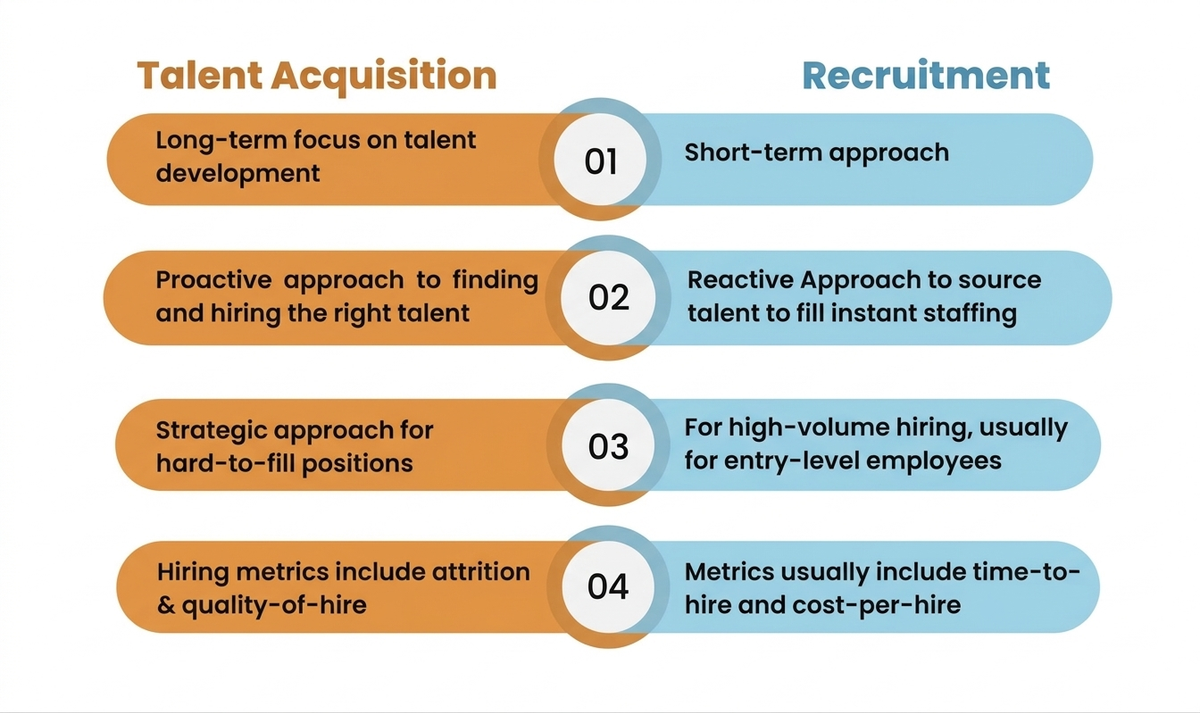
| Dimension | Recruitment | Talent Acquisition |
|---|---|---|
| Time horizon | Immediate, fills today's vacancy | Long-term, plans 12–36 months ahead |
| Orientation | Reactive: responds to gaps | Proactive: anticipates needs |
| Scope | Role-specific | Organization-wide workforce planning |
| Measurement | Time-to-fill, cost-per-hire | Quality of hire, retention rate, pipeline health |
| Employer brand | Not a priority | Core investment |
| Pipeline | Built fresh each time | Always maintained and refreshed |
| All Talentz delivers | Rapid, quality-vetted placement in 48 hours | Strategic workforce planning and pipeline access |
Talent Acquisition vs Recruitment in US, UK, and Canadian Markets
United States: Why the Talent Acquisition vs Recruitment Choice Is Critical
US businesses face some of the most competitive talent markets in the world. In Silicon Valley, qualified software engineers receive an average of 12 recruiter outreaches per week. In New York's financial district, experienced analysts are fielding multiple competing offers simultaneously. In Houston's legal market, top paralegals are often not even visible on job boards, they are placed before they are posted. In this environment, reactive recruitment consistently loses the best candidates to companies with mature talent acquisition strategies and warm pipelines.
United Kingdom: London and Beyond
UK businesses face a talent acquisition vs recruitment dilemma complicated by post-Brexit labour market dynamics. London's Canary Wharf financial services firms, Birmingham's legal services cluster, Manchester's tech corridor, and Edinburgh's growing professional services sector are all competing for a talent pool that has tightened since EU freedom of movement ended. Companies with proactive talent acquisition infrastructure, employer brand investment, global hiring partnerships, and warm candidate pipelines, are winning the hiring competition decisively.
Canada: Toronto, Vancouver, Calgary and Growing Tech Hubs
Canada's technology sector in Waterloo and Toronto, its energy industry in Calgary and Fort McMurray, and its financial services in downtown Vancouver are all experiencing the pressure of fast-growing talent demand against constrained domestic supply. Canadian businesses that have shifted from reactive recruitment to strategic talent acquisition, building partnerships with global talent networks like All Talentz, are accessing the quality and quantity of professionals their growth requires at costs their domestically-focused competitors cannot match.
Build the Hiring Strategy That Fills Roles in Days, Not Months
All Talentz delivers both talent acquisition strategy and rapid recruitment execution for US, UK, and Canadian businesses. Pre-vetted professionals. 48-hour presentation. Strategic workforce planning included.
When to Use Recruitment vs When to Use Talent Acquisition
Choose Recruitment When
- You have a specific, well-defined vacancy that must be filled immediately
- The role is entry-level or standard, with a large candidate pool available
- The position is temporary, project-based, or fixed-term
- Speed is the primary requirement and quality risk is relatively low.
Choose Talent Acquisition When
- The role is senior, specialised, or leadership-level, where the cost of a poor hire is high
- You are building a new team, department, or function from scratch
- Your business is entering a significant growth phase requiring multiple hires
- Retention and cultural alignment are as important as technical skills
- You want to reduce cost-per-hire over time through pipeline development and employer brand investment.
Frequently Asked Questions About Talent Acquisition vs Recruitment
Recruitment is reactive and role-specific, it fills a vacancy when it arises. Talent acquisition is proactive and strategic, it builds pipelines, develops employer brand, and plans workforce needs 12–36 months ahead. Most competitive businesses need both, which is what All Talentz delivers.
Talent acquisition delivers stronger long-term outcomes by ensuring the organisation always has access to the talent its strategy requires. It reduces cost-per-hire over time, improves retention, and prevents the costly reactive hiring cycles that constrain growth. But it works best when combined with responsive recruitment execution, which All Talentz provides.
Startups typically need the speed of recruitment for immediate hires, but benefit enormously from introducing talent acquisition thinking early, building an employer brand and candidate pipeline before urgency creates pressure. All Talentz provides both capabilities scaled to startup budgets and timelines.
All Talentz maintains continuously refreshed talent pipelines across every major business function, enabling rapid deployment for recruitment needs. Simultaneously, we provide workforce planning advisory and employer brand guidance that builds long-term talent acquisition capability. One partner. Both disciplines.
Post-Brexit labour constraints in the UK and growing demand-supply gaps in Canada are pushing businesses toward global talent acquisition models. Partnering with All Talentz for offshore talent acquisition gives UK and Canadian businesses access to world-class remote professionals at significantly lower cost than domestic equivalents.
If your hiring process starts when a vacancy is announced and ends when it is filled, you are doing recruitment. If your hiring process involves ongoing pipeline maintenance, employer brand investment, and workforce forecasting regardless of current vacancies, you are doing talent acquisition. Most businesses need to evolve from the first to the seconds
Technology, financial services, legal services, healthcare administration, and professional services benefit most from strategic talent acquisition because competition for skilled professionals in these sectors is intense. Reactive recruitment consistently underperforms in these markets, which is why the most successful businesses in these sectors invest in acquisition strategy.
All Talentz presents pre-vetted candidate profiles within 48 hours of receiving a brief. End-to-end placement typically takes one to three weeks, dramatically faster than the 44-day industry average for traditional recruitment, without sacrificing placement quality.
Conclusion: Ready to Transform Your Business?
All Talentz connects US, UK, and Canadian businesses with world-class remote talent, pre-vetted, affordable, and ready within 48 hours. Whether you need legal support, finance professionals, recruitment strategy, or business process outsourcing, your growth starts here.