The accounting software market has convinced most small business owners of something that is not quite true: that the right platform makes bookkeeping manageable without dedicated expertise. QuickBooks, Xero, FreshBooks, and their competitors are excellent tools. They also require a knowledgeable person to configure them correctly, categorize transactions accurately, reconcile accounts consistently, and interpret what the numbers actually mean for the business. When that person does not exist, the software produces records that are technically populated but financially unreliable.
A remote bookkeeper for small business is the professional who changes that equation. They do not replace the software. They run it properly, maintain the records it generates, and produce the financial picture that makes the software's output useful rather than cosmetically organized but functionally misleading.
This post follows the bookkeeping need at three stages of small business growth, showing what typically breaks at each stage when bookkeeping is left to software alone, and what a remote bookkeeper fixes. For more on how the broader finance outsourcing model works and what different finance roles contribute, see our post on why Smart Companies Hire Remote Finance Experts.

Stage 1: The Solo Founder Doing Their Own Books
At the earliest stage of a small business, the founder handles bookkeeping alongside everything else. This is understandable. The transaction volume is low, the categories seem simple, and the software makes it look manageable. In practice, three things go wrong consistently at this stage.
The first is categorization errors that compound over time. Business expenses assigned to the wrong category, personal expenses that bleed into the business account, and income that is recorded without the associated cost of sale create a profit and loss statement that does not reflect what the business actually earned. A tax professional who receives these records at year end either has to spend significant time cleaning them up or files returns based on numbers that do not match the business's financial reality.
The second is a cash flow picture that does not match the bank balance. Outstanding invoices that have not been recorded as receivables, bills that have been paid but not matched against the correct liability, and bank accounts that have not been reconciled in months mean the business owner is making spending and investment decisions based on a snapshot of the bank account rather than a complete picture of the business's financial position.
The third is falling behind. At the early stage, bookkeeping often happens in batches: the owner catches up at the end of the month, or before a tax deadline, or when an accountant asks for records. Batch bookkeeping produces anxiety and errors in equal measure. A remote bookkeeper for small business at this stage maintains the books on a regular weekly or bi-weekly cycle, so the records are current at any given time and the owner can make decisions from accurate data rather than educated guesses.
SCORE, the US Small Business Administration's mentoring network, consistently identifies inaccurate financial records as one of the top preventable reasons small businesses face cash flow crises in their first three years. The fix is not more software features. It is a qualified professional running the software correctly.
Stage 2: The Growing Business That Has Outgrown the Owner's Books
Between roughly five and fifteen employees, the bookkeeping function reaches a complexity threshold that most founder-run arrangements cannot sustain. Payroll has been added. Multiple bank accounts may exist. Expense categories have multiplied. Revenue may come from several product lines or service types that need to be tracked separately to understand which parts of the business are actually profitable.
This is the stage at which the books most commonly fall apart quietly. Not catastrophically, but in ways that take months to surface. Accounts receivable that is not being tracked systematically, so revenue appears lower than it is until someone audits the outstanding invoices. Job costing that is not being allocated correctly, so a project that appeared profitable turns out to have been absorbing costs from other accounts. Sales tax that is being collected but not being remitted correctly, producing a liability that compounds with each passing quarter.
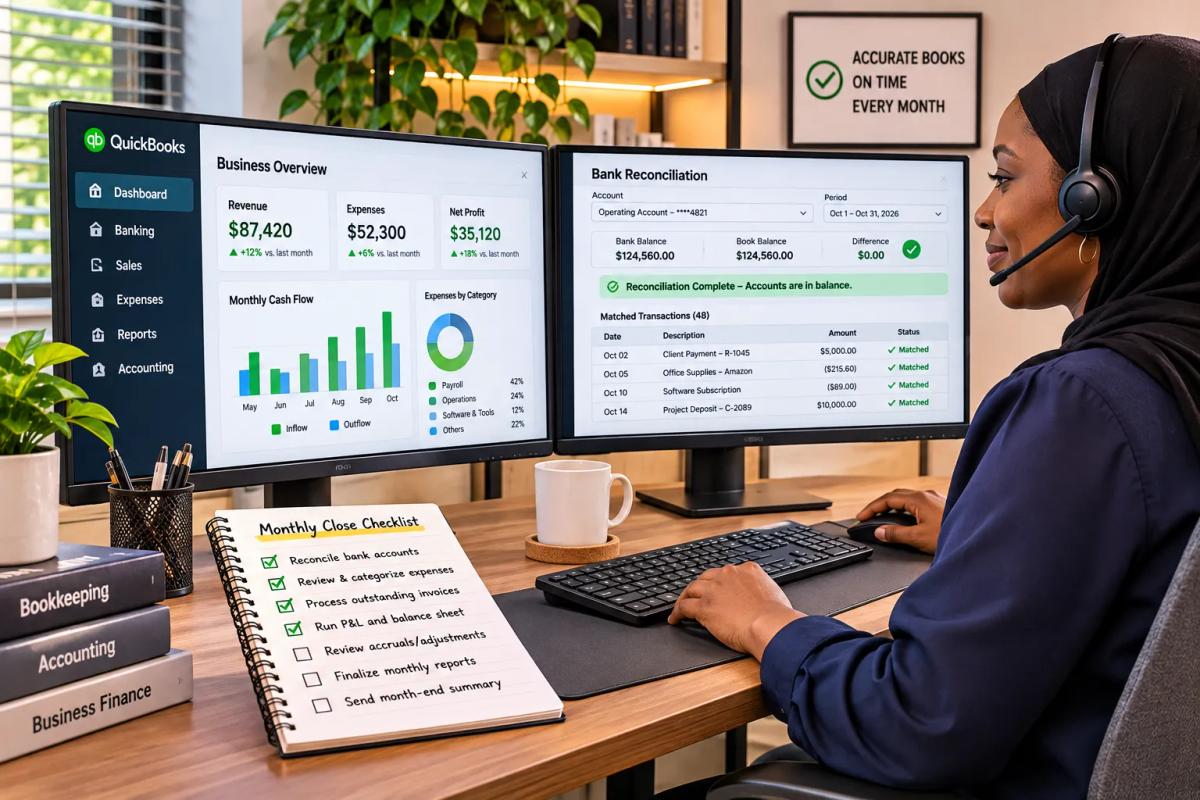
A remote bookkeeper for small business at this stage brings the structured, role-specific attention that transforms a collection of connected accounts into a coherent financial record. They maintain the accounts receivable ledger. They reconcile all accounts at month end. They track payroll allocations. They flag inconsistencies before they compound. They prepare monthly financial statements in the format the owner actually needs to run the business rather than the default reports the software generates automatically.
The American Institute of Professional Bookkeepers (AIPB) sets the competency standards for professional bookkeepers in the US. A bookkeeper working to AIPB standards at this business stage produces records that are accurate enough to be used directly by the business's CPA at tax time, reducing the cleanup cost that most small businesses absorb when their books are prepared by someone without formal bookkeeping training.
All Talentz places dedicated remote bookkeepers whose platform proficiency and accounting accuracy are verified before placement. Request a Remote Bookkeeper from All Talentz and have qualified support for your books in less than 48 hours.
Stage 3: The Established Business That Needs Specialist Depth
At the stage where a small business has moved beyond fifteen employees or added significant complexity through multiple locations, service lines, or regulatory requirements, the bookkeeping function needs specialist depth rather than general financial management.
In the US, businesses at this stage face payroll tax complexity across multiple states, sales tax obligations in multiple jurisdictions, and revenue recognition requirements that vary by contract type. The IRS Small Business and Self-Employed Tax Center publishes guidance on the tax obligations that apply at different business sizes and structures, and the compliance requirements at this stage are materially more complex than at the startup stage.
In the UK, businesses at this stage face VAT return management, Making Tax Digital (MTD) compliance requirements under HMRC, and the payroll reporting obligations of Real Time Information (RTI) submissions that require accurate, timely payroll bookkeeping every pay period.
A remote bookkeeper for small business at this stage is not a generalist managing a single set of accounts. They are a specialist who understands the specific compliance environment the business operates in, maintains the chart of accounts with the granularity the business needs for meaningful management reporting, and produces records that support both tax compliance and strategic financial decision-making.
This is the stage at which the distinction between bookkeeping and accounting becomes operationally significant. A bookkeeper maintains the records; an accountant interprets and advises on them. A remote bookkeeper for small business at this stage gives the accountant or CFO clean, current, accurate records to work from, which dramatically reduces the cost of accounting and financial advisory services by removing the cleanup layer that accounts for a significant portion of most CPA invoices.
Not sure whether you need a bookkeeper, an accountant, or both? Contact All Talentz and talk through your current financial operations with our team. We will match you with the right finance professional for your stage.
What to Look for When You Hire a Remote Bookkeeper for Your Small Business
Platform proficiency that matches your tools. A remote bookkeeper who cannot work fluently in your accounting platform from Day One creates a setup delay before useful work begins. Whether your business uses QuickBooks Online, Xero, FreshBooks, Sage, or Wave, verify hands-on proficiency rather than general software familiarity.
Credentials that signal competency. The AIPB Certified Bookkeeper (CB) designation and QuickBooks ProAdvisor certification are the most widely recognized markers of professional bookkeeping competency for small business contexts. For Canadian businesses, CPA Canada's bookkeeping guidelines and provincial accounting body standards apply. For UK businesses, the International Association of Bookkeepers (IAB) and the Institute of Certified Bookkeepers (ICB) credentials are relevant markers.
Industry familiarity. A bookkeeper with direct experience in your industry arrives with knowledge of the specific revenue recognition conventions, cost categories, and compliance requirements your business type requires. A restaurant's books look different from a legal firm's books, which look different from a construction company's. Industry familiarity reduces ramp time significantly.
Regular close cycle discipline. A remote bookkeeper who closes the books monthly on a consistent schedule produces records that are usable for decision-making. One who closes quarterly or on request produces records that are perpetually behind the business's current reality.
How All Talentz Places Remote Bookkeepers for Small Businesses
All Talentz places dedicated, pre-vetted remote bookkeepers for small businesses across the US, Canada, and the UK through a full talent partner model. Every bookkeeper placed is assessed for platform proficiency, credential status, industry experience, and close cycle discipline before any match is made. The bookkeeper placed works exclusively for one business, builds familiarity with its chart of accounts and financial patterns over time, and is supported by a dedicated relationship manager who monitors performance and facilitates an immediate replacement if the placement is not the right fit.
Work tools and equipment are provided by All Talentz. Employment and health insurance are managed on our side. Placements start in as little as seven days.
Our finance talent services cover remote bookkeepers, accounts receivable specialists, accounts payable specialists, payroll specialists, and financial analysts, all placed as dedicated resources to the businesses they serve.
For more on what to evaluate before placing a finance professional at any level, see our post on what to look for when you hire skilled finance professionals.
Conclusion
Accounting software is a tool. A remote bookkeeper for small business is the professional who makes that tool produce something useful. At every stage of business growth, from the solo founder managing their own books in batches to the established business navigating multi-state or multi-jurisdiction compliance, the gap between software-only bookkeeping and professionally maintained books is the gap between financial records that create confusion and financial records that support confident decision-making. All Talentz places dedicated, pre-vetted remote bookkeepers for small businesses across the US, Canada, and the UK, with placements starting in as little as seven days and employment infrastructure managed entirely on our side.
Hire a Remote Bookkeeper Through All Talentz
A remote bookkeeper for small business maintains the financial records that make a business legible to its owner, its accountant, and its lenders. Core responsibilities include recording and categorizing transactions, reconciling bank and credit card accounts, maintaining the accounts receivable and payable ledgers, processing payroll entries, preparing monthly financial statements, and producing the clean, current records that support tax compliance and operational decision-making.
No. A bookkeeper maintains financial records; an accountant interprets and advises on them. A remote bookkeeper for small business produces accurate, current records that a CPA or accountant uses for tax preparation, financial analysis, and strategic advice. Businesses typically need both: a bookkeeper for ongoing record maintenance and an accountant for compliance and strategic financial guidance.
For US businesses, the AIPB Certified Bookkeeper (CB) designation and platform-specific certifications such as QuickBooks ProAdvisor are the most recognized markers of professional competency. For Canadian businesses, CPA Canada guidelines apply. For UK businesses, IAB and ICB credentials are relevant. All Talentz verifies credential status before placing any bookkeeper.
Yes. All Talentz assesses software proficiency before placement, including hands-on experience with QuickBooks, Xero, FreshBooks, Sage, Wave, and similar platforms. The remote bookkeeper works within your existing software from Day One rather than requiring a platform change.
A monthly close cycle is the standard for most small businesses. It produces current financial statements at regular intervals, keeps records accurate enough for decision-making, and reduces the end-of-year cleanup cost that businesses with quarterly or annual close cycles typically face.
All Talentz can place a pre-vetted, dedicated remote bookkeeper in as little as seven days.