

Picture this. It is a Monday morning in Austin, Texas. A founder opens her laptop, scans a hiring dashboard, and sees three strong applicants for a single remote role, one based in Manchester, one in Toronto, and one in Denver. Three time zones. Three tax systems. Three sets of employment laws. One decision to make, and very little time to make it.
This is the new reality of building a team. Remote work has stopped being a perk and become a default expectation. Companies that once hired only within driving distance of a head office now compete for talent across the United States, the United Kingdom, and Canada, three of the world's richest, most competitive labor markets, and three of the most legally complex to hire in correctly.
If you are trying to hire remote workers in the US, UK and Canada, you already know the upside: bigger talent pools, round-the-clock coverage, lower overhead, and access to specialists you simply cannot find in your own city. What you may not know is how many companies quietly get this wrong, misclassifying contractors, missing statutory benefits, running payroll through the wrong entity, or losing a brilliant hire to a competitor who moved faster.
This guide walks through exactly how to hire remote workers in the US, UK and Canada the right way: legally, efficiently, and in a way that actually keeps great people on your team for years. Along the way, you will see exactly which counties, cities, and regions across all three countries hold the deepest pools of remote-ready talent, what statutory obligations follow each type of hire, and which mistakes most often turn a promising remote hire into a costly compliance problem.
And if at any point you decide you would rather have experts handle the heavy lifting, All Talentz, a recruitment and outsourcing firm built specifically for cross-border remote hiring, is ready to step in and carry that weight for you.
Why Companies Are Racing to Hire Remote Workers in the US, UK and Canada
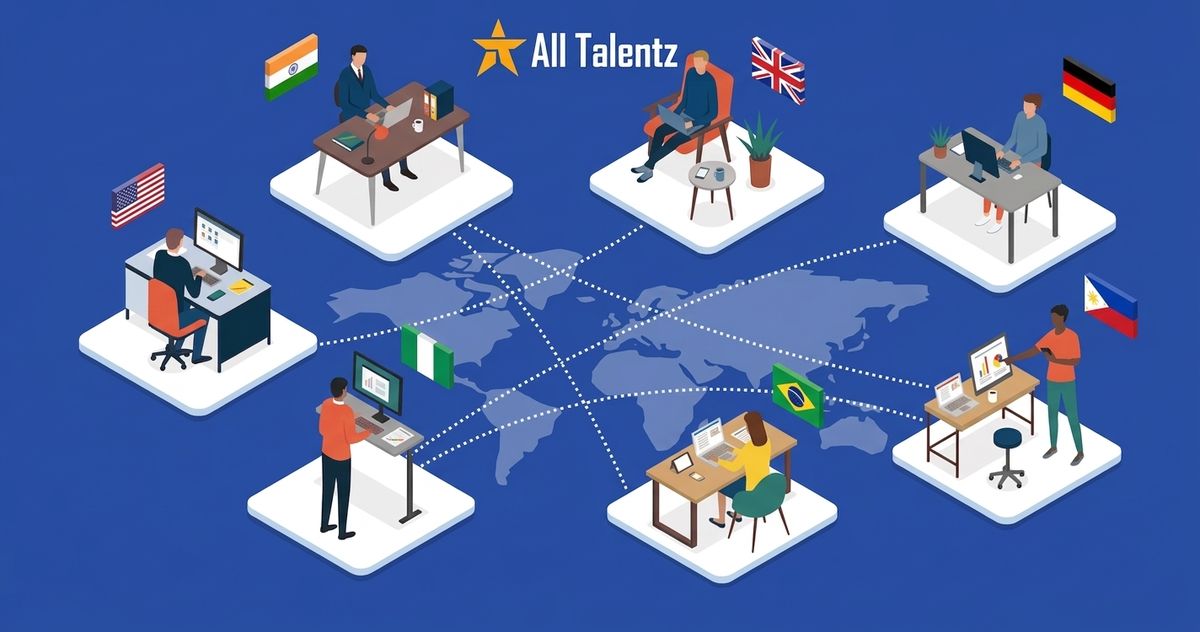
The shift toward distributed teams did not happen overnight, but it accelerated faster than almost anyone predicted. Millions of knowledge workers proved, almost by accident, that software engineering, customer support, marketing, finance, and design could be done just as well, sometimes better, from a home office in Leeds as from a corporate tower in Manhattan.
For employers, the math is compelling. A company based in California can now hire remote workers in the US, UK and Canada without opening a single additional office. That means access to software developers in Waterloo, Ontario, a region often called Canada's Silicon Valley, without the overhead of a Bay Area lease. It means tapping into the deep financial services talent pool around London's Canary Wharf, or the customer experience professionals clustered around Charlotte, North Carolina, one of the fastest-growing hubs for contact center talent in the US.
There is also a resilience argument. A distributed workforce spread across multiple provinces, states, and counties is less vulnerable to local disruptions, a snowstorm in Alberta will not shut down your entire support desk if you also have staff in Florida and the West Midlands.
But the opportunity comes with friction. Employment law differs sharply between the US, UK, and Canada, and even within each country, state, provincial, or regional rules can change the picture. This is precisely why so many businesses now search for a trusted partner to hire remote workers in the US, UK and Canada rather than trying to build in-house legal and payroll infrastructure from scratch.
There is a competitive angle too. Companies that limit themselves to local hiring are, in effect, competing for the same narrow slice of candidates as every other business in their postcode. Companies that hire remote workers across the US, UK and Canada are fishing in an ocean instead of a pond, and in a tight labor market for specialized skills, that difference decides whether a critical role gets filled in three weeks or three months.
Cost efficiency plays a role as well, though it should never be the only driver. Office space, commuting subsidies, and regional cost-of-living adjustments can make a remote hire in a secondary market, say, Sheffield in South Yorkshire rather than central London, or Winnipeg, Manitoba rather than downtown Toronto , a smarter long-term investment without sacrificing skill quality.
Understanding the Remote Talent Landscape Across the US
The United States remains the single largest remote talent pool in the English-speaking world, but it is not one market, it is fifty. A company that wants to hire remote workers in the US needs to understand that employment law is set largely at the state level, and sometimes even at the county or city level.
Take wage law. Minimum wage in King County, Washington, is dramatically higher than the federal minimum wage that still applies in large parts of the rural South. Paid sick leave is mandatory in California, New York, and Illinois, but not federally required nationwide. Non-compete agreements are effectively unenforceable in California but common in Texas. If you hire someone in Cook County, Illinois, without knowing local ordinances on predictive scheduling or biometric data privacy, you could be exposed to compliance risk you never saw coming.
Geographically, remote talent tends to cluster around established tech and business corridors even when workers are fully distributed: the Research Triangle around Raleigh-Durham, North Carolina; the Denver-Boulder corridor in Colorado; the Austin metro in Travis County, Texas; and the resurgent tech scene in Miami-Dade County, Florida. Customer support and back-office talent is strong in the Phoenix metro area of Maricopa County, Arizona, and throughout the Midwest, including Franklin County, Ohio, and Wayne County, Michigan.
For companies that want to hire remote workers across these varied US jurisdictions without setting up dozens of state tax registrations, a staffing and outsourcing partner that already holds compliant infrastructure in all fifty states is often the difference between a two-week hire and a two-month legal review.
Salary expectations also vary widely by region even for identical roles. A mid-level data analyst in Suffolk County, New York may expect meaningfully higher compensation than the same role based in Bexar County, Texas, purely because of differing local cost of living. Benchmarking against the candidate's actual location, not your own headquarters city, is essential to both fairness and retention.
Not sure which US states make sense for your next remote hire? Talk to All Talentz for a free talent-market snapshot.
Understanding the Remote Talent Landscape Across the UK
The UK presents a different but equally intricate picture. Remote hiring in the United Kingdom means navigating IR35 legislation, which determines whether a contractor should really be treated, and taxed, as an employee. Getting this wrong has cost UK businesses significant penalties, and it is one of the most common mistakes companies make when they try to hire remote workers in the UK without local expertise.
Talent is not confined to London, though Greater London remains the country's largest single labor market, particularly for finance, legal, and technology roles concentrated around the City of London and Canary Wharf. Manchester and the wider Greater Manchester county have become a genuine second hub, especially for media, software, and fintech. Leeds, in West Yorkshire, has a fast-growing digital and legal services sector. Edinburgh, in Scotland, is a major center for financial technology and asset management, while Bristol, in the South West, has built a strong reputation in aerospace engineering and creative technology.
Statutory requirements also differ from the US: UK employees are entitled to a minimum of 5.6 weeks of paid annual leave, automatic pension enrollment above certain earnings thresholds, and statutory sick pay. A company that wants to hire remote workers in the UK compliantly must build these entitlements into contracts from day one, not bolt them on later.
Beyond the major cities, regional counties such as Kent, Hampshire, and Cheshire have become popular bases for remote professionals who left London for lower housing costs while keeping London-level salaries, meaning employers can often access London-caliber talent at a more competitive rate simply by recruiting county-wide rather than city-only.
Northern Ireland, particularly Belfast, has also emerged as a strong fintech and cybersecurity talent hub, often overlooked by companies that default to London-centric searches. Expanding your search to include these regions is one of the simplest ways to widen your UK candidate pool without lowering the bar on skill.
Understanding the Remote Talent Landscape Across Canada
Canada rounds out the picture with its own patchwork of provincial employment standards. Ontario, British Columbia, Alberta, and Quebec each set their own minimum wage, overtime rules, and termination notice requirements, and Quebec adds the additional layer of French-language employment law under Bill 96, which affects everything from job postings to internal communications.
Toronto and the surrounding Greater Toronto Area remain Canada's largest talent market, especially for finance and technology. But remote hiring has opened up exceptional pools of talent in Waterloo Region, home to a dense cluster of software engineers; in Vancouver, British Columbia, where the tech and creative sectors have boomed; in Calgary, Alberta, with its strengths in energy-sector analytics and finance; and in Montreal, Quebec, a global hub for artificial intelligence research and gaming development.
Canadian statutory obligations include vacation pay (typically a minimum of 4% of gross wages), public holiday pay, and, depending on province, mandatory termination notice or severance tied to length of service. Miss these details and a company that set out simply to hire remote workers in Canada can find itself facing a wrongful dismissal claim.
Smaller but fast-growing markets deserve attention too. Halifax, Nova Scotia has built a respectable cluster of cybersecurity and marine technology talent, while Ottawa, Ontario, home to a large federal government workforce, has a deep bench of policy, compliance, and public-sector-adjacent professionals well suited to regulated industries.
Employee vs Contractor: The Classification Question That Trips Up Most Employers
The single most common, and most expensive, mistake companies make when they hire remote workers in the US, UK and Canada is misclassification. Calling someone an independent contractor because it is simpler on paper does not make it legally true.
In the US, the IRS and Department of Labor apply behavioral, financial, and relationship tests. If you control how, when, and where the work is done, and the relationship looks ongoing rather than project-based, tax authorities may reclassify that contractor as an employee, triggering back taxes, penalties, and potential benefits liability.
In the UK, HMRC's IR35 rules ask a similar question through the lens of tax status, focused on whether the worker would be an employee if the intermediary company were removed from the equation. In Canada, the Canada Revenue Agency looks at control, ownership of tools, chance of profit, and risk of loss.
None of these tests hinge on what the contract is titled. A document labeled 'Independent Contractor Agreement' offers little protection if the actual day-to-day relationship, fixed hours, company-provided equipment, ongoing indefinite engagement, no ability to work for other clients, looks like employment in substance. Regulators in all three countries look past labels to the reality of how the work happens.
Three countries. Three tests. One shared consequence: get it wrong, and you are exposed to fines, retroactive tax bills, and reputational damage. This is exactly the kind of risk a specialist staffing and outsourcing partner like All Talentz is built to absorb, classifying every hire correctly from day one, in every jurisdiction you operate in.
It is worth noting that classification is not a one-time decision made at hiring, it needs revisiting whenever the working relationship changes. A contractor who started as a project-based specialist but has since become a full-time fixture on your team, working set hours under your direct supervision, may have drifted into employee territory without anyone updating the paperwork. Periodic classification audits are cheap insurance against an expensive correction later.
Payroll, Tax, and Benefits: What It Really Takes to Hire Remote Workers Compliantly
Once classification is settled, payroll becomes the next hurdle. To directly employ someone in the US, you generally need a registered business entity and payroll tax account in their state, sometimes their county. To directly employ someone in the UK, you need a PAYE scheme registered with HMRC. To directly employ someone in Canada, you need a payroll account with the Canada Revenue Agency and, in Quebec, Revenu Québec as well.
Benefits obligations compound the complexity. US health insurance norms vary enormously by state and industry; UK statutory sick pay and pension auto-enrollment are non-negotiable; Canadian provincial health plans interact with private benefits differently in Ontario than in Alberta.
Many growing companies solve this with an Employer of Record (EOR) model, engaging a partner that is already the legal employer on paper in each jurisdiction, handling payroll, tax withholding, and statutory benefits, while the hiring company directs the day-to-day work. This is one of the fastest, lowest-risk ways to hire remote workers in the US, UK and Canada without opening local entities in fifty states, four Canadian provinces, and multiple UK regions all at once.
Currency and payment timing add another wrinkle. Paying a contractor in Vancouver in Canadian dollars, an employee in Bristol in pounds sterling, and a team member in Ohio in US dollars means managing exchange-rate exposure and ensuring payment dates align with each country's payroll norms, biweekly in much of the US, monthly in most of the UK, and biweekly or semi-monthly across Canada depending on the province.
Let All Talentz run compliant, on-time payroll across the US, UK and Canada so your finance team never has to become an international tax expert.
A Step-by-Step Process to Hire Remote Workers in the US, UK and Canada
1. Define the role with location flexibility in mind. Decide upfront whether the position can be filled from any of the three countries, or whether time-zone overlap with your core team makes one region more practical.
2. Map the compliance requirements. Identify whether the hire will be an employee or contractor, which state, province, or UK region they sit in, and what statutory entitlements apply.
3. Choose your hiring structure. Options include opening a local entity, using an Employer of Record, engaging a compliant contractor arrangement, or partnering with a staffing and outsourcing firm that already has infrastructure in place.
4. Source strategically. Go beyond generic job boards. Tap into regional talent networks, from the Research Triangle in North Carolina to Leeds in West Yorkshire to Waterloo Region in Ontario, where the specific skills you need already cluster.
5. Screen for remote-readiness, not just skill. Communication clarity, self-management, and time-zone flexibility matter as much as technical competence for distributed roles.
6. Structure a compliant offer and contract. Include statutory benefits, correct notice periods, and clear IP and confidentiality clauses appropriate to the worker's jurisdiction.
7. Onboard with intention. Remote onboarding needs more structure, not less, clear documentation, scheduled check-ins, and early access to the tools and context a co-located hire would absorb informally.
8. Review and retain. Build in regular compensation benchmarking against local markets so your remote hires in Toronto, Manchester, or Denver do not quietly start looking elsewhere.
Each of these eight steps sounds straightforward in isolation, but stacked together across three countries, with three different tax authorities, three different notice-period defaults, and dozens of regional variations underneath, the administrative load multiplies quickly. This is exactly why most companies that successfully hire remote workers in the US, UK and Canada at scale eventually bring in a specialist partner rather than managing all eight steps entirely in-house.
Common Pitfalls When You Hire Remote Workers Across Borders

Even well-intentioned companies stumble in predictable ways. Some assume a single contractor agreement template will work in all three countries, it will not, because notice periods, IP assignment defaults, and tax withholding rules differ sharply between the US, UK, and Canada.
Others underestimate time-zone friction. A team split between Vancouver and London has almost no natural overlap, which can quietly erode collaboration if meeting culture and asynchronous documentation are not deliberately designed.
A third common pitfall is treating compliance as a one-time task. Employment law changes, the UK's IR35 rules have been amended multiple times, and several US states update paid leave and wage requirements annually. A hire that was compliant in 2023 may not be compliant today without a periodic review.
Finally, many companies underinvest in candidate experience for remote roles, assuming distance lowers expectations. It does the opposite: remote candidates in competitive markets like Austin or Toronto often have multiple offers and choose employers who make the process fast, transparent, and well communicated.
A related pitfall: relying on a single generic salary benchmark for an entire country. Paying a 'UK rate' without distinguishing between London and a lower-cost county like Nottinghamshire either overpays unnecessarily or underpays and loses the candidate to a competitor who did the regional research. The same logic applies across US states and Canadian provinces, national averages hide meaningful local variation. Regional benchmarking, refreshed at least annually, is a small investment that prevents both overspending and costly attrition.
Avoid these pitfalls entirely, let All Talentz manage sourcing, compliance and contracts for your next remote hire in the US, UK or Canada.
The Tools and Systems That Make Cross-Border Remote Teams Work
Technology cannot fix a bad hiring process, but the wrong technology can undermine an otherwise good one. Companies that successfully hire remote workers in the US, UK and Canada tend to standardize a small set of tools early: a single applicant tracking system that captures candidates from all three countries in one pipeline, a payroll platform capable of handling multiple currencies and tax jurisdictions, and a communication stack built around asynchronous-first defaults rather than real-time chat alone.
Time-zone management deserves its own tooling. A shared team calendar that displays working hours in Pacific Time, Eastern Time, GMT, and the relevant Canadian zone side by side prevents the common mistake of scheduling a 9 a.m. meeting in New York that lands at 2 p.m. in London but 6 a.m. in Vancouver.
Document-first collaboration also matters more for distributed teams than co-located ones. Decisions made verbally in a hallway conversation at a head office simply do not exist for a remote hire in Leeds unless someone writes them down. Companies that hire remote workers across multiple countries successfully tend to over-invest, if anything, in written documentation, recorded meetings, and clear async update rituals.
Security and access management round out the technical picture. Hiring across three countries means granting system access to employees and contractors operating under different data protection regimes, UK GDPR, for instance, imposes specific obligations that do not map one-to-one onto US state privacy laws or Canada's PIPEDA. IT and compliance teams should coordinate closely whenever a new remote hire in a new jurisdiction is onboarded.
Where to Actually Find Remote Talent in the US, UK and Canada
Job boards alone rarely deliver the strongest candidates anymore, especially for competitive roles. The best remote hires are often not actively browsing listings, they are employed, performing well, and only reachable through direct outreach, referral networks, or a recruiter who already has them in a talent pipeline.
Regional professional communities matter more than most hiring teams realize. Software talent in Waterloo Region often surfaces through university partnerships with the University of Waterloo's renowned co-op program. Fintech professionals in Edinburgh frequently move within a tightly connected network tied to the city's asset management sector. Customer experience talent in Tampa Bay, Florida and the surrounding Hillsborough County area has grown around the region's dense concentration of contact center operations.
Referral programs, alumni networks from remote-first companies, and niche communities, from developer forums to regional Slack and Discord groups, consistently outperform generic job board postings for specialized roles. A recruiting partner with existing relationships across these US, UK, and Canadian networks can access candidates weeks before they ever appear on a public job board.
Building a Remote-First Culture That Keeps Your US, UK and Canada Hires Long-Term
Hiring remote workers in the US, UK and Canada is only half the challenge, keeping them engaged and loyal is the other half, and it is where many companies quietly fail. A remote hire in Calgary who feels invisible in meetings dominated by a head-office team in Chicago will start updating their resume within a year, regardless of salary.
Strong distributed teams build deliberate rituals: asynchronous documentation so no one depends on being awake at the same hour as headquarters, recorded meetings for those in earlier or later time zones, and regular one-on-ones that go beyond task updates to actually check in on how someone is doing.
Recognition matters more, not less, at a distance. A UK-based employee in Cardiff who never hears direct feedback beyond a monthly status email is far more likely to disengage than one who gets specific, regular acknowledgment of their contributions. Simple structural choices, rotating meeting times so no single region always sacrifices personal time, translating company updates for Quebec-based francophone staff, or building in-person gatherings once or twice a year, meaningfully reduce turnover.
Compensation reviews should also reflect local market movement. A software engineer's market rate in Austin can shift substantially within eighteen months; a remote employer that fails to benchmark regularly risks losing hires to competitors offering current-market pay for the same skill set.
Why Partner With All Talentz to Hire Remote Workers in the US, UK and Canada
All Talentz exists to remove exactly this friction. As a dedicated recruitment and outsourcing firm, All Talentz already maintains compliant hiring infrastructure across US states, UK regions, and Canadian provinces, so you can hire remote workers in the US, UK and Canada without building that infrastructure yourself.
That means sourcing from deep regional talent pools, Charlotte to Calgary, Bristol to Boston, screening for both skill and remote-work readiness, and handling classification, contracts, and payroll compliance behind the scenes. You focus on the work; All Talentz handles the legal and administrative weight of cross-border employment.
Whether you need a single specialist hire or you are building an entire distributed department, a partner that already understands the US, UK, and Canadian markets can compress a process that might otherwise take months into a matter of weeks.
Think back to that Monday morning founder in Austin, weighing three candidates across three countries. With the right partner, that decision no longer means three separate legal reviews and three separate payroll setups. It means a single conversation with a team that already knows how to hire remote workers in the US, UK and Canada, so the only thing left to decide is who is the best person for the job.
Ready to build your remote team the right way? Reach out to All Talentz today and get matched with vetted candidates across the US, UK and Canada.]
Frequently Asked Questions About “How to Hire Remote Workers in the US, UK and Canada”
The fastest compliant route is usually an Employer of Record (EOR) arrangement or partnering with a staffing and outsourcing firm like All Talentz that already has registered payroll and tax infrastructure in place across US states, UK regions, and Canadian provinces. This avoids the cost and delay of incorporating separately in every jurisdiction you want to hire in.
Only if the working relationship genuinely meets the legal test for self-employment under IR35 rules. If you control the worker's schedule, tools, and methods the way you would an employee, HMRC can reclassify the arrangement, leaving you liable for back taxes and penalties. Genuine contractor relationships are possible, but the label alone does not protect you.
In most cases, yes, directly employing someone in a state typically requires registering for state income tax withholding and unemployment insurance in that state, and sometimes at the county or city level depending on local tax ordinances. Many companies avoid this by using an Employer of Record instead of registering in every state individually.
Quebec has additional requirements under provincial language law, including French-language employment contracts and internal communications in many circumstances, alongside its own labor standards board (CNESST) rules on minimum wage, vacation, and termination notice that differ from Ontario, British Columbia, or Alberta.
Misclassification of employees as independent contractors is consistently the costliest mistake. Each country applies its own test, behavioral and financial control in the US, IR35 status in the UK, and control/ownership/risk factors in Canada, and getting it wrong can trigger back taxes, penalties, and benefits liability.
In most cases, yes. Statutory entitlements such as paid leave, pension contributions in the UK, or provincial vacation pay in Canada generally apply regardless of whether the employee works remotely or on-site, provided they are properly classified as employees rather than contractors.
Sourcing and interviewing usually take two to six weeks depending on role seniority. Compliant onboarding, including contract structuring and payroll setup, can add another one to three weeks unless you are working with a partner that already has infrastructure in place, which can compress this significantly.
The US spans six time zones, Canada spans six as well, and the UK operates on a single time zone (GMT/BST). A hire in Vancouver and a hire in London will have minimal working-hour overlap, so many companies design roles around at least a two-to-four hour daily overlap window with the core team.
Visa sponsorship is generally unnecessary for remote hires who continue living and working in their own country, since they are not relocating. Visa questions only arise if the worker plans to physically relocate to your company's home country.
An Employer of Record becomes the legal employer for compliance and payroll purposes while you direct daily work. A staffing and outsourcing firm, like All Talentz, typically combines this with active recruitment, sourcing, screening, and presenting candidates, in addition to compliant employment infrastructure.
Provincial rules vary, but most Canadian provinces require either working notice or pay in lieu of notice upon termination, scaled to length of service. Ontario and federally regulated employers also have separate severance pay obligations above certain thresholds.
At minimum: classification status, compensation and currency, working hours and time-zone expectations, statutory leave entitlements for the relevant jurisdiction, confidentiality and IP assignment clauses, termination notice periods, and the governing law of the contract.
Compensation benchmarks vary by role and region rather than by country alone. A senior software engineer in Waterloo, Ontario may command a similar salary to one in Austin, Texas, while customer support roles in regional UK cities like Leeds are often more cost-effective than London-based hires.
All Talentz sources and screens candidates from deep regional talent pools across all three countries, manages classification and compliance, structures compliant contracts, and can handle payroll so companies can build distributed teams without building legal infrastructure themselves.
Correcting a misclassification typically requires back-paying employment taxes and, in some jurisdictions, providing retroactive benefits or leave entitlements. Voluntary correction is generally viewed more favorably by tax authorities than a correction triggered by an audit, so addressing suspected misclassification early is strongly advisable.
Yes. All Talentz supports everything from a single specialist role to full department build-outs across the US, UK, and Canada, scaling sourcing and compliance support to match the size of the hiring need.
Partner with All Talentz, the recruitment and outsourcing firm that makes hiring across the US, UK and Canada simple, compliant and fast. Contact us today to get started.