

Maria runs operations for a growing logistics company in Atlanta. Last quarter she lost four people in six weeks. Her job ads drew few applicants. The ones who applied wanted more money than she could offer. Orders piled up.
Across the Atlantic, Daniel leads a fintech start-up in Manchester. He needs two senior developers and a compliance officer. He has been recruiting for five months. Nothing sticks.
In Toronto, Priya manages a healthcare clinic network. She cannot fill front-desk, billing and admin roles fast enough. Patients wait longer every week.
Three leaders. Three countries. One problem: the right people are hard to find.
That is why more employers now turn to a global staffing agency in the US, UK and Canada. A global agency searches wider. It hires faster. It handles the paperwork. And it gives you access to talent your local market cannot supply.
This guide explains how global staffing works. You will learn the models, the rules, the costs and the traps. You will also see how All Talentz, a recruitment and outsourcing firm, helps businesses build strong teams across borders.
Need talent in the US, UK or Canada? Tell All Talentz the roles you are struggling to fill." Button: "Share Your Hiring Needs".
What Is a Global Staffing Agency? A Clear Definition
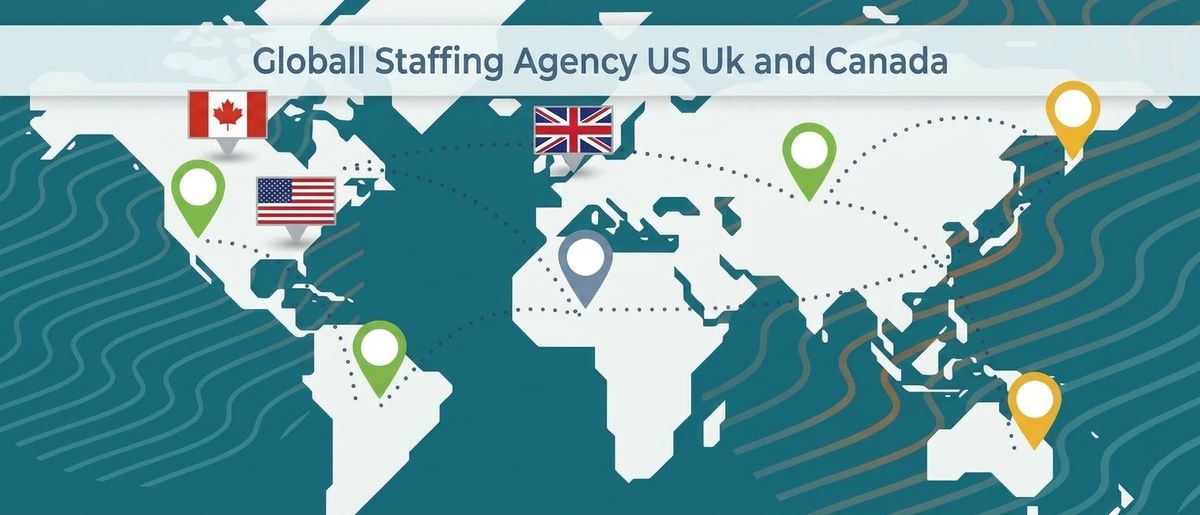
A global staffing agency finds, screens and supplies workers for employers in more than one country. It may place people in permanent jobs. It may supply temporary or contract workers. It may build remote teams that work from another country.
A global agency differs from a local one in three ways.
- Reach. It sources from several talent markets at once.
- Know-how. It understands labour rules, payroll and tax in each place.
- Capacity. It can scale teams in multiple regions at the same time.
Staffing Agency vs Recruitment Agency vs Outsourcing Firm
These terms overlap. Here is the simple view.
- Recruitment agency. Finds candidates for your open roles. Usually paid a fee on placement.
- Staffing agency. Supplies workers who may be on the agency's payroll. Common for temporary and contract roles.
- Outsourcing firm. Takes on a function or team and delivers the outcome, often with remote staff.
All Talentz combines recruitment and outsourcing. That means we can place people in your business or build a remote team that works for you from elsewhere.
Why Businesses in the US, UK and Canada Use a Global Staffing Agency
The case is strong. Here are the main drivers.
Talent shortages persist. Many sectors in all three countries report skills gaps. Healthcare, technology, engineering, finance, logistics and skilled trades all struggle.
Hiring takes too long. A slow process loses good candidates. The best people often accept offers within days.
Costs keep rising. Wages, benefits, rent and recruitment fees add up. Businesses want flexibility.
Work has gone remote. Cloud tools make it easy to work across time zones. Many roles no longer need a desk in your office.
Demand moves in waves. Retail peaks at holidays. Construction peaks in summer. Accounting peaks at tax time. Staffing agencies absorb these swings.
The Size of the Staffing Industry
The American Staffing Association reports that US staffing companies hire roughly 16 million temporary and contract employees each year. In the UK, the Recruitment and Employment Confederation (REC) represents a large and mature recruitment sector. Canada has a sizeable network of staffing and recruitment firms serving every province.
These are big, established industries. Used well, they are a proven route to the right people.
Global Staffing Agency in the US: Hiring Across American States and Counties
The US labour market is huge and uneven. Talent is concentrated in some places and thin in others. A global staffing agency helps you tap the right pools.
Key US Hiring Hubs
- New York County and the NYC metro. Finance, media, law and healthcare.
- Santa Clara, San Francisco and Los Angeles Counties. Technology, entertainment and life sciences.
- Harris, Dallas and Travis Counties, Texas. Energy, tech, logistics and construction.
- Cook County, Illinois. Finance, manufacturing and transport.
- Miami-Dade and Orange Counties, Florida. Hospitality, trade and healthcare.
- Fulton County, Georgia. Logistics, media and fintech.
- King County, Washington. Cloud, aerospace and e-commerce.
- Maricopa County, Arizona. Semiconductors, real estate and healthcare.
- Mecklenburg and Wake Counties, North Carolina. Banking, research and technology.
- Suffolk and Middlesex Counties, Massachusetts. Biotech, education and healthcare.
US Roles in High Demand
- Software engineers and data analysts
- Nurses, medical assistants and healthcare admins
- Customer support and call centre staff
- Accountants and bookkeepers
- Legal assistants and paralegals
- Warehouse, driver and logistics staff
- Sales and business development reps
- Virtual assistants and executive assistants
US Employment Rules to Know
Staffing in the US is shaped by federal and state law.
- Fair Labor Standards Act (FLSA). Sets minimum wage and overtime rules.
- Equal Employment Opportunity laws. The EEOC enforces rules against discrimination in hiring.
- Form I-9 and E-Verify. Employers must verify employment eligibility.
- Affordable Care Act. Large employers have health coverage duties.
- State laws. States such as California, New York and Illinois have extra rules on pay transparency, scheduling, background checks and worker classification.
Misclassifying employees as independent contractors can lead to penalties. So can joint-employer risks. A good agency helps you stay on the right side of these lines.
Hiring in the US? Let All Talentz source, screen and place your next team member.
Global Staffing Agency in the UK: Recruiting in England, Scotland, Wales and Northern Ireland
The UK labour market is regulated and relationship-driven. Employers value clear contracts, right-to-work checks and fair treatment of agency workers.
Key UK Hiring Hubs
- Greater London. City of London, Canary Wharf, Westminster, Croydon and Stratford.
- Greater Manchester. Spinningfields, Salford Quays and Trafford Park.
- West Midlands. Birmingham, Coventry, Solihull and Wolverhampton.
- West Yorkshire. Leeds and Bradford.
- South Yorkshire. Sheffield and Rotherham.
- Merseyside. Liverpool.
- Tyne and Wear. Newcastle and Sunderland.
- South West. Bristol, Bath and Exeter.
- Scotland. Edinburgh, Glasgow and Aberdeen.
- Wales. Cardiff and Swansea.
- Northern Ireland. Belfast and Derry-Londonderry.
- Home Counties. Surrey, Hertfordshire, Kent, Essex, Hampshire, Berkshire and Buckinghamshire.
UK Roles in High Demand
- Healthcare and social care workers
- IT, cyber security and data specialists
- Finance, accounting and compliance staff
- Engineers and construction professionals
- Teachers and teaching assistants
- Logistics and warehouse operatives
- Customer service and sales teams
- Legal support and admin roles
UK Employment Rules to Know
- Employment Agencies Act 1973 and the Conduct of Employment Agencies and Employment Businesses Regulations 2003. These set standards for agencies and employment businesses.
- Agency Workers Regulations 2010. Agency workers gain equal treatment on basic pay and conditions after 12 weeks in the same role.
- Right to work checks. Employers must check that workers can legally work in the UK. The Home Office sets the rules and penalties for illegal working are serious.
- IR35 and off-payroll working rules. These affect contractors working through intermediaries. Status decisions matter.
- Gangmasters and Labour Abuse Authority (GLAA). Licensing applies in some sectors such as agriculture and food processing.
- UK GDPR. Candidate data must be handled lawfully.
Strong agencies keep up with these rules so you do not have to.
Global Staffing Agency in Canada: Hiring in Ontario, BC, Alberta, Quebec and Beyond
Canada's labour rules are set mainly by provinces and territories. Federal rules cover certain industries such as banking, telecoms and transport. So hiring in Canada means checking local law.
Key Canadian Hiring Hubs
- Greater Toronto Area. Toronto, Mississauga, Brampton, Markham and Vaughan in Peel and York Regions.
- Waterloo Region. Waterloo, Kitchener and Cambridge, known for technology.
- Ottawa. Government, telecoms and technology.
- Greater Vancouver. Vancouver, Burnaby, Richmond and Surrey.
- Alberta. Calgary and Edmonton, strong in energy and construction.
- Quebec. Montreal and Quebec City, strong in aerospace, games and AI.
- Prairies. Winnipeg, Saskatoon and Regina.
- Atlantic Canada. Halifax, Moncton and St. John's.
Canadian Roles in High Demand
- Healthcare and nursing support
- Skilled trades such as electricians, welders and carpenters
- Software and AI professionals
- Logistics and warehouse workers
- Finance and accounting staff
- Customer service and administration
- Hospitality and food service staff
Canadian Employment Rules to Know
- Provincial employment standards. Each province sets rules on wages, hours, vacation and termination.
- Temporary help agency rules. In Ontario, the Employment Standards Act, 2000 contains specific rules for temporary help agencies. Ontario also introduced a licensing requirement for temporary help agencies and recruiters, which took effect on 1 July 2024. Confirm the latest rules before engaging a provider.
- Human rights laws. Federal and provincial codes prohibit discrimination.
- Privacy law. PIPEDA and provincial privacy laws govern personal information.
- Immigration programmes. Employers who need foreign workers may use the Temporary Foreign Worker Program or other pathways. Rules change often.
- Language rules. Quebec has strong French-language requirements for workplaces.
Hiring in Toronto, Vancouver or Calgary? Ask All Talentz how we staff Canadian teams fast.
Types of Global Staffing Services: Choose the Model That Fits
Not every business needs the same thing. Here are the main models.
Permanent Placement (Direct Hire)
The agency finds a full-time employee. You hire them directly. You pay a placement fee, often a percentage of first-year pay or a fixed amount.
Best for: Senior roles, specialist skills and long-term needs.
Temporary and Contract Staffing
The agency supplies workers for a set period. The agency may run payroll.
Best for: Peaks, project work, leave cover and trial periods.
Temp-to-Perm
A worker starts on a temporary basis. You may convert them to permanent later. It reduces hiring risk.
Remote Staffing and Offshore Teams
The agency builds a team that works for you from another country. This can cut costs and widen the talent pool.
Best for: Admin, customer support, finance, legal support, IT and creative services.
Executive Search
Targeted search for senior leaders and rare skills.
Employer of Record (EOR)
An EOR legally employs workers on your behalf in a country where you have no entity. It handles payroll, tax and benefits. You manage day-to-day work.
Best for: Testing a new market without setting up a local company.
Managed Services and RPO
Recruitment process outsourcing (RPO) lets a provider run all or part of your hiring. Managed services hand an entire function to the provider.
| Model | Who Employs the Worker | Speed | Typical Use |
|---|---|---|---|
| Permanent placement | You | Moderate | Core, long-term roles |
| Temporary or contract | Agency | Fast | Peaks and projects |
| Temp-to-perm | Agency, then you | Fast | Trial-then-hire |
| Remote or offshore team | Provider or you | Moderate | Cost-efficient support teams |
| Employer of record | EOR | Fast | Market entry |
| RPO and managed services | Varies | Varies | High-volume hiring |
The Benefits of Using a Global Staffing Agency
Let us look at what you really gain.
- Speed. Agencies keep talent pools ready. Many roles fill faster than with ads alone.
- Reach. You tap candidates who are not browsing job boards.
- Quality. Screening, testing and reference checks reduce bad hires.
- Compliance. Agencies handle right-to-work checks, contracts and payroll where they are the employer.
- Flexibility. Scale up or down without long-term commitments.
- Cost control. Pay for what you need. Avoid some recruitment overheads.
- Market insight. Agencies know pay benchmarks and trends.
- Focus. Your managers spend time running the business, not sorting CVs.
The Hidden Cost of a Bad Hire
A bad hire costs far more than a salary. It costs lost time, lost clients and team morale. Many HR studies put the cost of a mis-hire at a large multiple of annual pay. Good agencies cut that risk with rigorous screening.
How a Global Staffing Agency Works: The Process From Brief to Start Date
Here is the typical journey.
Step 1: Brief
You explain the role, the team, the budget and the timeline. The agency asks questions to sharpen the picture.
Step 2: Market Mapping
The agency checks salary levels, supply and competition in your location. It may suggest changes to the role or pay.
Step 3: Sourcing
Recruiters search their database, networks, job boards and social platforms. They also approach passive candidates.
Step 4: Screening
Candidates face interviews, skills tests and reference checks. Background checks follow where legally allowed.
Step 5: Shortlist
You get a small set of strong, pre-qualified candidates. Each comes with notes on strengths and fit.
Step 6: Interview and Offer
You interview. The agency coordinates feedback and manages offer negotiations.
Step 7: Onboarding and Follow-Up
The agency supports paperwork, start dates and early check-ins. Good agencies continue to monitor how the placement is going.
Want a shortlist in days, not months? Brief All Talentz today.
Cross-Border Hiring: What You Must Know Before You Hire Abroad
Hiring across borders opens great opportunities. It also opens risks. Know the main ones.
- Employment status. Is the worker an employee or a contractor? Each country has its own tests
- Tax and social contributions. Payroll taxes differ. Some arrangements may create tax residency or permanent establishment risk.
- Work authorisation. Workers need the right to work where they live and, if they travel, where they work.
- Data protection. Candidate and employee data must be handled lawfully when it crosses borders.
- Intellectual property. Contracts must clearly assign IP created by remote workers
- Benefits and leave. Statutory leave and benefits differ by country.
- Currency and payment. Plan for exchange rates, banking and payment timing.
- Termination rules. Ending employment can be complex. Notice, severance and consultation rules vary.
Contractor vs Employee vs EOR vs Agency Worker
| Option | Pros | Watch-outs |
|---|---|---|
| Independent contractor | Flexible, simple for short projects | Misclassification risk |
| Direct employee | Full control and loyalty | Local entity and compliance needed |
| Employer of record | Fast, no entity required | Higher ongoing fees |
| Agency worker | Fast, agency handles payroll | Equal treatment rules may apply |
| Managed offshore team | Cost-effective, scalable | Needs strong management and security |
Take professional tax and legal advice for your own case. A good agency will explain your options clearly and flag risks early.
Remote Staffing: Building Teams for the US, UK and Canada From Anywhere
Remote staffing is the fastest-growing part of global staffing. Here is why.
Cloud tools let teams share files, hold video calls and track tasks. Customers do not care where the person sits. They care that the work is done well.
Roles That Work Well Remotely
- Executive and virtual assistants
- Customer support and live chat agents
- Bookkeepers and accounts staff
- Software developers and QA testers
- Digital marketers and content writers
- Graphic designers and video editors
- Legal assistants and paralegals
- HR and recruitment coordinators
- Data entry and research analysts
Setting Up a Remote Team for Success
1. Define roles and outcomes. Write clear job scopes and goals.
2. Choose overlapping hours. Match your time zone where it matters.
3. Use the right tools. Slack, Teams, Zoom, Asana, Trello and shared drives help.
4. Secure your systems. Use strong passwords, multi-factor authentication and managed access.
5. Onboard properly. Treat remote hires like on-site hires. Give them time and attention.
6. Measure results. Track outputs, not hours on a screen.
7. Build culture. Hold regular check-ins and celebrate wins.
Remote teams work best when managers communicate clearly and often
Industries That Rely on a Global Staffing Agency in the US, UK and Canada
Different sectors have different needs. Here are some leading examples.
- Healthcare. Hospitals, clinics and care homes in Houston, Birmingham and Toronto need nurses, carers and admin staff
- Technology. Start-ups in Silicon Valley, Shoreditch and Waterloo seek engineers and data talent.
- Finance and accounting. Banks and fintechs in New York, London and Toronto need analysts, auditors and compliance staff.
- Legal. Law firms and legal teams in Chicago, Manchester and Vancouver need legal assistants, paralegals and document reviewers.
- Logistics and supply chain. Hubs in Atlanta, Felixstowe and Calgary need drivers, planners and warehouse teams.
- Construction and engineering. Growth areas in Texas, the Midlands and Alberta need skilled trades.
- Retail and hospitality. Seasonal demand in Florida, London and Vancouver calls for flexible staff.
- Customer service and BPO. Companies in every market need support teams that cover extended hours.
How to Choose a Global Staffing Agency: A 10-Point Checklist
Not all agencies are equal. Use this list.
1. Check track record. How long have they operated? Which industries do they serve?
2. Ask about geographic coverage. Can they truly deliver in the US, UK and Canada?
3. Review compliance knowledge. Do they understand local labour law and payroll rules?
4. Examine screening. What tests, interviews and checks do they use?
5. Understand pricing. Ask for fee structures, markups and any extra charges.
6. Check guarantees. Is there a replacement period if a placement does not work?
7. Test responsiveness. Do they reply quickly and clearly?
8. Look for transparency. You should know who is working on your account.
9. Read reviews and references. Speak with current clients.
10. Start small. Try one role before a big commitment.
Warning Signs
- Pressure to sign quickly
- Vague answers on compliance
- No guarantee or replacement terms
- Hidden fees
- Candidates presented without real screening
- Poor communication
Choose a partner, not just a supplier.
Staffing Agency Fees and Pricing: What Does It Cost?
Costs depend on the model. Here is a plain guide.
- Permanent placement fees. Often a percentage of the first-year salary, or a flat fee. Rates vary by role and market.
- Temporary and contract markups. The agency adds a margin to the worker's pay rate to cover payroll costs, insurance, taxes and profit
- Remote and managed team fees. Usually a monthly rate per person, or a project fee.
- EOR fees. A monthly fee per employee, plus the employment costs.
- Retained search fees. Paid in stages for executive roles
Questions to Ask About Price
- What is included in the fee?
- Is there a replacement guarantee and for how long
- Are there extra charges for background checks or onboarding?
- How are overtime, holidays and expenses billed?
- Are there minimum terms or exit fees?
Compare total cost, not just headline rates. The cheapest quote can be the most expensive in the end.
Common Mistakes When Using a Global Staffing Agency
- A vague brief. Without clear goals, even great recruiters guess.
- Slow feedback. Delays lose candidates.
- Unrealistic pay. Market data should guide offers.
- Ignoring culture fit. Skills matter, but so does teamwork.
- Skipping legal checks. Cutting corners on right-to-work or classification can be costly.
- Using too many agencies at once. It confuses candidates and weakens commitment.
- No onboarding plan. The first 90 days decide whether a hire stays.
How All Talentz Delivers Global Staffing for the US, UK & Canada
All Talentz is a recruitment and outsourcing firm. We help companies hire the right people, in the right place, at the right time.
What We Do
- Recruitment and talent sourcing for permanent, contract and temporary roles
- Remote staffing and outsourcing for admin, support, finance, legal and technical teams
- Specialist teams for sectors such as legal, healthcare, technology and professional services
- Scalable workforce solutions for seasonal peaks and growth
How We Work
1. Understand. We learn your business, culture and goals.
2. Search. We tap our networks and run targeted searches.
3. Screen. We test skills, check references and assess fit.
4. Present. You meet a short list of strong candidates.
5. Support. We assist with offers, onboarding and early check-ins.
6. Grow. We adjust your team as your needs change.
Why Employers Pick All Talentz
- A people-first approach built on qualit
- Flexible models to suit your budget
- Support for US, UK and Canadian business hours
- Clear communication from brief to start date
- A partner mindset focused on your results
Placeholder: add testimonials, client logos or placement numbers once approved by All Talentz.
"Your next great hire is out there. Let All Talentz find them. Book a free talent consultation.
Success Stories: Global Staffing in Action
These composite stories show how global staffing can work. Replace them with real case studies when you have them.
The Atlanta Logistics Company
Maria's team needed dispatchers and admin staff fast. The agency built a shortlist within days. Temp-to-perm contracts let her test fit. Within two months her turnover dropped and shipments ran on time.
The Manchester Fintech
Daniel needed senior developers and a compliance lead. The agency mapped the market, adjusted the salary range and approached passive candidates. Two developers started within weeks. The compliance role was filled through a short contract and later made permanent.
The Toronto Clinic Group
Priya used a blend of local placements and remote billing and admin staff. Patient wait times fell. Her clinic managers got hours back each day.
The pattern is the same each time. Clear brief. Fast sourcing. Careful screening. Ongoing support.
Your 30-Day Plan to Start With a Global Staffing Agency
Week 1: Plan. List the roles you need. Define skills, budget and timing. Decide which roles can be remote.
Week 2: Choose. Speak with two or three agencies. Check coverage, compliance knowledge and fees.
Week 3: Launch. Share the brief. Review the first shortlist. Interview quickly.
Week 4: Onboard. Make offers. Prepare the first-day plan. Set 30-60-90 day goals.
Then review. What worked? What did not? Refine and repeat.
Trends Shaping Global Staffing in the US, UK and Canada
Keep an eye on these shifts.
Skills-based hiring. Employers look at skills and results, not just degrees.
Hybrid and remote work. Flexible arrangements are now a major factor in attracting talent.
AI in recruitment. Tools help screen and schedule. Humans still make final decisions. Regulators are paying more attention to fairness and transparency in automated hiring.
Pay transparency. More US states and cities require salary ranges in job ads. Similar moves are gaining ground elsewhere.
Compliance complexity. Cross-border rules keep changing. Agencies with local expertise become more valuable.
Contingent workforce growth. More firms blend permanent staff with contractors and outsourced teams.
Final Thoughts: Why a Global Staffing Agency Is a Smart Move
Great people drive great businesses. But finding them is harder than ever.
A global staffing agency for the US, UK and Canada gives you speed, reach and expert support. It helps you hire the right people without drowning in paperwork. It lets you grow, test and adapt.
Choose a partner who listens. Insist on compliance. Start with a clear brief. And move fast. The best talent does not wait.
All Talentz is ready when you are.
Build your dream team across the US, UK and Canada. Contact All Talentz today
Frequently Asked Questions About Global Staffing Agencies in the US, UK & Canada
A global staffing agency finds, screens and supplies workers for employers in more than one country. It can place permanent staff, supply temporary or contract workers and build remote teams. It also helps with compliance, payroll and onboarding. Global agencies suit businesses that want a wider talent pool or need to hire in several markets.
You share a brief with the role, skills, budget and timeline. The agency searches its network, screens candidates and presents a shortlist. You interview and choose. The agency then supports offers, paperwork and onboarding. For temporary roles, it may employ the worker and handle payroll.
Fees depend on the model. Permanent placements often carry a fee based on a percentage of first-year pay or a flat rate. Temporary staffing adds a markup to the worker's pay rate. Remote teams are often charged per person per month. Always ask what is included and whether a replacement guarantee applies.
A recruitment agency usually finds candidates for you to hire directly. A staffing agency often employs the worker and supplies them to you, especially for temporary and contract roles. Many firms do both. All Talentz offers recruitment and outsourcing so you can choose the right model.
Yes, if the agency has the right reach and compliance knowledge. A global agency can source in each market, follow local labour rules and coordinate across time zones. Check that it understands employment law, payroll and right-to-work rules in each country.
The Agency Workers Regulations 2010 give agency workers the right to equal treatment on basic pay and conditions after 12 weeks in the same role. Agencies must also follow the Conduct of Employment Agencies and Employment Businesses Regulations 2003. Employers must carry out right-to-work checks. Take advice for your specific situation.
It depends on the province. Ontario introduced licensing for temporary help agencies and recruiters, which took effect on 1 July 2024. Other provinces have their own rules, such as licensing or registration in some regions. Always verify the current requirements and ask any agency to confirm its status.
An employer of record legally employs workers on your behalf in a country where you have no local company. It handles payroll, taxes, benefits and compliance. You direct the day-to-day work. It is a fast way to hire abroad, though fees are usually higher than direct employment.
Often yes. Remote and offshore teams can lower salary, office and benefits costs. Agencies also reduce recruitment time and risk. But the total cost depends on role, location, management time and security needs. Compare full costs, not just hourly rates.
Speed varies by role and market. Common roles may fill within days to a few weeks. Rare or senior roles can take longer. Clear briefs, quick feedback and realistic pay all help speed things up.
Common roles include virtual assistants, customer support agents, bookkeepers, developers, designers, marketers, legal assistants, paralegals, HR coordinators and data analysts. Roles that need physical presence, such as nurses or warehouse staff, are usually placed locally.
Agencies review CVs, conduct interviews, run skills tests and check references. They may carry out right-to-work, identity and background checks where the law allows. Good agencies also assess communication, reliability and cultural fit.
Temporary staffing fills roles for a fixed time, such as projects, peaks or leave cover. Permanent staffing fills ongoing roles with employees you hire directly. Temp-to-perm lets you try a worker first and convert later.
Yes. Agencies can offer market insight, salary benchmarks and candidate access. With an employer of record or managed team model, you can start hiring without setting up a local company. Take tax and legal advice on your long-term structure.
Check experience, references, reviews and compliance knowledge. Look for clear contracts, transparent fees and a replacement guarantee. In the UK, check membership of bodies such as the REC. In the US and Canada, verify licences and registrations where required. Trust agencies that answer questions openly.
Agree overlapping hours. Use shared tools like Slack, Teams and project boards. Set clear goals and hold regular check-ins. Document processes. Measure results rather than hours online. Build culture through video calls and recognition.
Yes. UK GDPR and the Data Protection Act 2018 apply to personal data in the UK. PIPEDA and provincial laws apply in Canada. The US has sector and state laws such as the California Consumer Privacy Act. Agencies and employers must handle candidate and employee data lawfully and securely.
All Talentz is a recruitment and outsourcing firm. We source, screen and place permanent, contract and remote talent. We tailor each engagement to your market, budget and timeline. Contact us for a free consultation and a clear plan for your hiring needs.